

REALISTIC MODELS IN POPULATION ECOLOQY
251
Varying the assimilation efficiency, too, does not greatly affect the
population. Values of Ea between 0- 15 and 0.90 result in final populations
which differ by only 12%. Higher values of Ea lead to slightly higher
biomass, more rapid initial population increase, and shorter elapsed
time before equilibrium. For Ea = 0.75, the elapsed time was 62 days,
while for Ea = 0.25, it was 94 days.
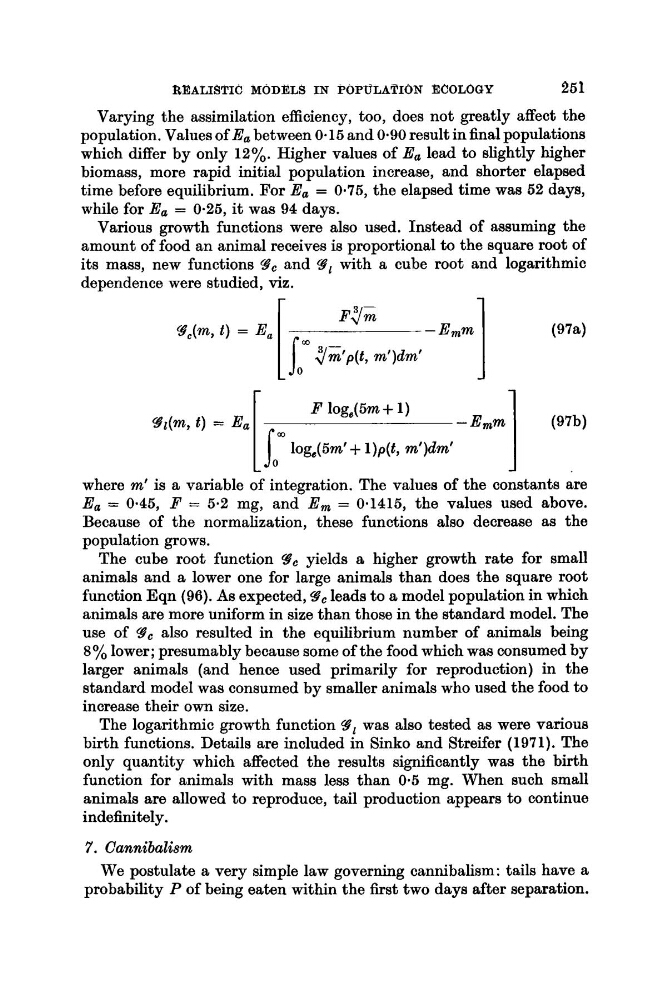
Various growth functions were also used. Instead of assuming the
amount of food an animal receives is proportional to the square root of
its mass, new functions 9, and 9, with a cube root and logarithmic
dependence were studied, viz.
1
r
where m’ is a variable of integration. The values of the constants are
E a = 0.45, F = 5.2 mg, and Em = 0.1415, the values used above.
Because of the normalization, these functions also decrease as the
population grows.
The cube root function 9, yields a higher growth rate for small
animals and a lower one for large animals than does the square root
function Eqn (96). As expected, 3, leads to a model population in which
animals are more uniform in size than those in the standard model. The
use of 3, also resulted in the equilibrium number of animals being
8% lower; presumably because some of the food which was consumed by
larger animals (and hence used primarily for reproduction) in the
standard model was consumed by smaller animals who used the food to
increase their own size.
The logarithmic growth function 9, was also tested as were various
birth functions. Details are included in Sinko and Streifer (1971). The
only quantity which affected the results significantly was the birth
function for animals with mass less than 0-5 mg. When such small
animals are allowed to reproduce, tail production appears to continue
indefinitely.
7. Cannibalism
We postulate a very simple law governing cannibalism: tails have a
probability P of being eaten within the first two days after separation.
251
Varying the assimilation efficiency, too, does not greatly affect the
population. Values of Ea between 0- 15 and 0.90 result in final populations
which differ by only 12%. Higher values of Ea lead to slightly higher
biomass, more rapid initial population increase, and shorter elapsed
time before equilibrium. For Ea = 0.75, the elapsed time was 62 days,
while for Ea = 0.25, it was 94 days.
Various growth functions were also used. Instead of assuming the
amount of food an animal receives is proportional to the square root of
its mass, new functions 9, and 9, with a cube root and logarithmic
dependence were studied, viz.
1
r
where m’ is a variable of integration. The values of the constants are
E a = 0.45, F = 5.2 mg, and Em = 0.1415, the values used above.
Because of the normalization, these functions also decrease as the
population grows.
The cube root function 9, yields a higher growth rate for small
animals and a lower one for large animals than does the square root
function Eqn (96). As expected, 3, leads to a model population in which
animals are more uniform in size than those in the standard model. The
use of 3, also resulted in the equilibrium number of animals being
8% lower; presumably because some of the food which was consumed by
larger animals (and hence used primarily for reproduction) in the
standard model was consumed by smaller animals who used the food to
increase their own size.
The logarithmic growth function 9, was also tested as were various
birth functions. Details are included in Sinko and Streifer (1971). The
only quantity which affected the results significantly was the birth
function for animals with mass less than 0-5 mg. When such small
animals are allowed to reproduce, tail production appears to continue
indefinitely.
7. Cannibalism
We postulate a very simple law governing cannibalism: tails have a
probability P of being eaten within the first two days after separation.