

252
WILLIAM STREIFER
This probability is no doubt strongly dependent on food supply, and to
a lesser extent on the numbers of tails and feeding animals. In performing the calculations the masses of tails consumed must also be added to
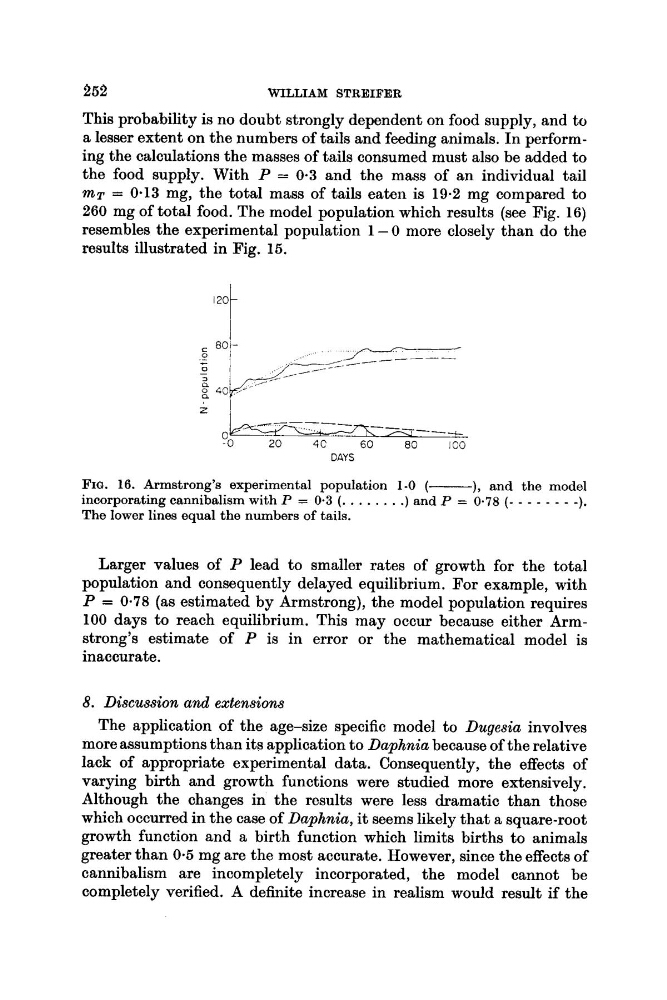
the food supply. With P = 0.3 and the mass of an individual tail
m~ = 0.13 mg, the total mass of tails eaten is 19.2 mg compared to
260 mg of total food. The model population which results (see Fig. 16)
resembles the experimental population 1 - 0 more closely than do the
results illustrated in Fig. 15.
- i
- - - - , ,
-
00
20
4 C
60
00
I00
DAYS
FIQ. 16. Armstrong’s experimental population 1-0 (
-
), and the model
incorporating cannibalism with P = 0.3 (. . . . . . . .) and P = 0.78 (- - - - - - - -).
The lower lines equal the numbers of tails.
Larger values of P lead to smaller rates of growth for the total
population and consequently delayed equilibrium. For example, with
P = 0.78 (as estimated by Armstrong), the model population requires
100 days to reach equilibrium. This may occur because either Armstrong’s estimate of P is in error or the mathematical model is
inaccurate.
8. Discussion and extensions
The application of the age-size specific model to Dugesia involves
more assumptions than its application to Daphnia because of the relative
lack of appropriate experimental data. Consequently, the effects of
varying birth and growth functions were studied more extensively.
Although the changes in the results were less dramatic than those
which occurred in the case of Daphnia, it seems likely that a square-root
growth function and a birth function which limits births to animals
greater than 0.5 mg are the most accurate. However, since the effects of
cannibalism are incompletely incorporated, the model cannot be
completely verified. A definite increase in realism would result if the
WILLIAM STREIFER
This probability is no doubt strongly dependent on food supply, and to
a lesser extent on the numbers of tails and feeding animals. In performing the calculations the masses of tails consumed must also be added to
the food supply. With P = 0.3 and the mass of an individual tail
m~ = 0.13 mg, the total mass of tails eaten is 19.2 mg compared to
260 mg of total food. The model population which results (see Fig. 16)
resembles the experimental population 1 - 0 more closely than do the
results illustrated in Fig. 15.
- i
- - - - , ,
-
00
20
4 C
60
00
I00
DAYS
FIQ. 16. Armstrong’s experimental population 1-0 (
-
), and the model
incorporating cannibalism with P = 0.3 (. . . . . . . .) and P = 0.78 (- - - - - - - -).
The lower lines equal the numbers of tails.
Larger values of P lead to smaller rates of growth for the total
population and consequently delayed equilibrium. For example, with
P = 0.78 (as estimated by Armstrong), the model population requires
100 days to reach equilibrium. This may occur because either Armstrong’s estimate of P is in error or the mathematical model is
inaccurate.
8. Discussion and extensions
The application of the age-size specific model to Dugesia involves
more assumptions than its application to Daphnia because of the relative
lack of appropriate experimental data. Consequently, the effects of
varying birth and growth functions were studied more extensively.
Although the changes in the results were less dramatic than those
which occurred in the case of Daphnia, it seems likely that a square-root
growth function and a birth function which limits births to animals
greater than 0.5 mg are the most accurate. However, since the effects of
cannibalism are incompletely incorporated, the model cannot be
completely verified. A definite increase in realism would result if the