

REALISTIC MODELS IN POPULATION ECOLOGY
247
The fractional mass lost by a tail during its nonfeeding interval of
length T is h.
To apply the model to Armstrong’s population I - 0, we construct the
functions 9? and 6, estimate H , h and T , and specify the initial number
and mass distribution of animals.
1. Growth function
The growth function is proportional to the difference between food
intake and food required for maintenance. The latter depends on the
maintenance eficiency, Em, which we define as the ratio of the dry mass
of food consumed during a two-day feeding interval to the dry mass of
the animals when the population is in equilibrium. Armstrong found
that the amount of food required for maintenance is (approximately)
directly proportional to the mass of the animal, i.e. Em is constant and
equal to 0.141 for his population 1 - 0.
Since little or no data relating to food intake as a function of mass
exist for Dugesia, we assume that small animals receive more food per
unit mass than do large animals. This is in agreement with the data
obtained by Richman (1958) for Daphnia. More precisely, we assume
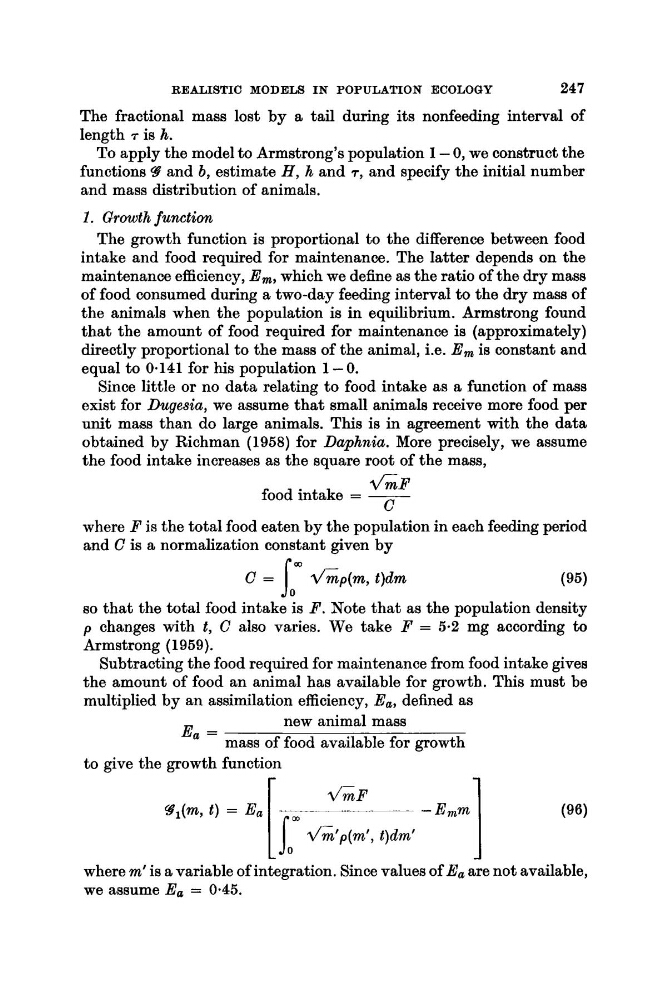
the food intake increases as the square root of the mass,
G F
food intake = ~ C
where F is the total food eaten by the population in each feeding period
and C is a normalization constant given by
c = J
: G p ( m , t)dm
(95)
so that the total food intake is F . Note that as the population density
p changes with t , C also varies. We take F = 5.2 mg according to
Armstrong (1959).
Subtracting the food required for maintenance from food intake gives
the amount of food an animal has available for growth. This must be
multiplied by an assimilation efficiency, Ea, defined as
new animal mass
mass of food available for growth
Ea =
to give the growth function
d G F
t, = ECX [ J;
(96)
l/&’p(m’, t)dm‘
where m’ is a variable of integration. Since values of Ea are not available,
we assume E, = 0.45.
247
The fractional mass lost by a tail during its nonfeeding interval of
length T is h.
To apply the model to Armstrong’s population I - 0, we construct the
functions 9? and 6, estimate H , h and T , and specify the initial number
and mass distribution of animals.
1. Growth function
The growth function is proportional to the difference between food
intake and food required for maintenance. The latter depends on the
maintenance eficiency, Em, which we define as the ratio of the dry mass
of food consumed during a two-day feeding interval to the dry mass of
the animals when the population is in equilibrium. Armstrong found
that the amount of food required for maintenance is (approximately)
directly proportional to the mass of the animal, i.e. Em is constant and
equal to 0.141 for his population 1 - 0.
Since little or no data relating to food intake as a function of mass
exist for Dugesia, we assume that small animals receive more food per
unit mass than do large animals. This is in agreement with the data
obtained by Richman (1958) for Daphnia. More precisely, we assume
the food intake increases as the square root of the mass,
G F
food intake = ~ C
where F is the total food eaten by the population in each feeding period
and C is a normalization constant given by
c = J
: G p ( m , t)dm
(95)
so that the total food intake is F . Note that as the population density
p changes with t , C also varies. We take F = 5.2 mg according to
Armstrong (1959).
Subtracting the food required for maintenance from food intake gives
the amount of food an animal has available for growth. This must be
multiplied by an assimilation efficiency, Ea, defined as
new animal mass
mass of food available for growth
Ea =
to give the growth function
d G F
t, = ECX [ J;
(96)
l/&’p(m’, t)dm‘
where m’ is a variable of integration. Since values of Ea are not available,
we assume E, = 0.45.