

246
WILLIAM STREIFEK
B. D U Q E S I A T I Q R I N A
The planarian worm Dugesia tigrim was studied by Armstrong (1959,
1964) and modeled by Sinko and Streifer (1971). In Armstrong’s experiments, reproduction was entirely by the asexual process of binary
fission, in which the tail of a worm breaks away from the parent and
develops into a new worm. Deaths from senescence in his populations
were negligible; for all practical purposes individual animals can be
regarded as immortal. The only mortality resulted from cannibalism of
undeveloped tails by feeding individuals.
As far as can be determined from the available data, only the mass
and not the age of a feeding individual affects its birth rate or any other
important physiological characteristic. This combined with the absence
of senescence in feeding individuals allows us to consider the physiological properties of an animal as determined by its mass alone. New
tails do not behave like feeding individuals, but this is taken into
account by using a time lag in the model. Since only the mass is of
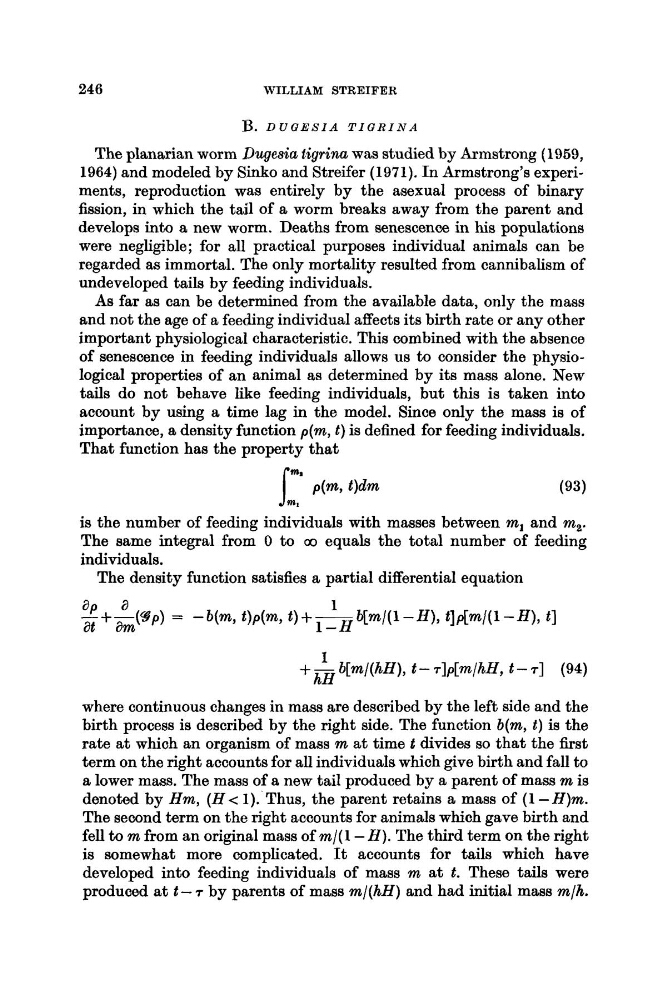
importance, a density function p(m, t ) is defined for feeding individuals.
That function has the property that
is the number of feeding individuals with masses between m, and m2.
The same integral from 0 to 00 equals the total number of feeding
individuals.
The density function satisfies a partial differential equation
a P
a
1
-+-(%p)
= -b(m, t)p(m, t ) + - b [ m / ( l - H ) ,
t ] p [ m / ( l - H ) , t ]
at am
1 - H
I
hH
+ - b[m/(hH), t - ~ ] p [ m / h H ,
t - T ] (94)
where continuous changes in mass are described by the left side and the
birth process is described by the right side. The function b(m, t ) is the
rate at which an organism of mass m at time t divides so that the fist
term on the right accounts for all individuals which give birth and fall to
a lower mass. The mass of a new tail produced by a parent of mass m is
denoted by Hm, (H < 1). Thus, the parent retains a mass of ( 1 - H)m.
The second term on the right accounts for animals which gave birth and
fell to m from an original mass of m / ( 1 - H ) . The third term on the right
is somewhat more complicated. It accounts for tails which have
developed into feeding individuals of mass m at t. These tails were
produced at t - T by parents of mass m/(hH) and had initial mass m/h.
WILLIAM STREIFEK
B. D U Q E S I A T I Q R I N A
The planarian worm Dugesia tigrim was studied by Armstrong (1959,
1964) and modeled by Sinko and Streifer (1971). In Armstrong’s experiments, reproduction was entirely by the asexual process of binary
fission, in which the tail of a worm breaks away from the parent and
develops into a new worm. Deaths from senescence in his populations
were negligible; for all practical purposes individual animals can be
regarded as immortal. The only mortality resulted from cannibalism of
undeveloped tails by feeding individuals.
As far as can be determined from the available data, only the mass
and not the age of a feeding individual affects its birth rate or any other
important physiological characteristic. This combined with the absence
of senescence in feeding individuals allows us to consider the physiological properties of an animal as determined by its mass alone. New
tails do not behave like feeding individuals, but this is taken into
account by using a time lag in the model. Since only the mass is of
importance, a density function p(m, t ) is defined for feeding individuals.
That function has the property that
is the number of feeding individuals with masses between m, and m2.
The same integral from 0 to 00 equals the total number of feeding
individuals.
The density function satisfies a partial differential equation
a P
a
1
-+-(%p)
= -b(m, t)p(m, t ) + - b [ m / ( l - H ) ,
t ] p [ m / ( l - H ) , t ]
at am
1 - H
I
hH
+ - b[m/(hH), t - ~ ] p [ m / h H ,
t - T ] (94)
where continuous changes in mass are described by the left side and the
birth process is described by the right side. The function b(m, t ) is the
rate at which an organism of mass m at time t divides so that the fist
term on the right accounts for all individuals which give birth and fall to
a lower mass. The mass of a new tail produced by a parent of mass m is
denoted by Hm, (H < 1). Thus, the parent retains a mass of ( 1 - H)m.
The second term on the right accounts for animals which gave birth and
fell to m from an original mass of m / ( 1 - H ) . The third term on the right
is somewhat more complicated. It accounts for tails which have
developed into feeding individuals of mass m at t. These tails were
produced at t - T by parents of mass m/(hH) and had initial mass m/h.