

REALISTIC MODELS IN POPULATION ECOLOGY
241
where 4.092 and 5.075 are the calorific values of one mg of pre-adult and
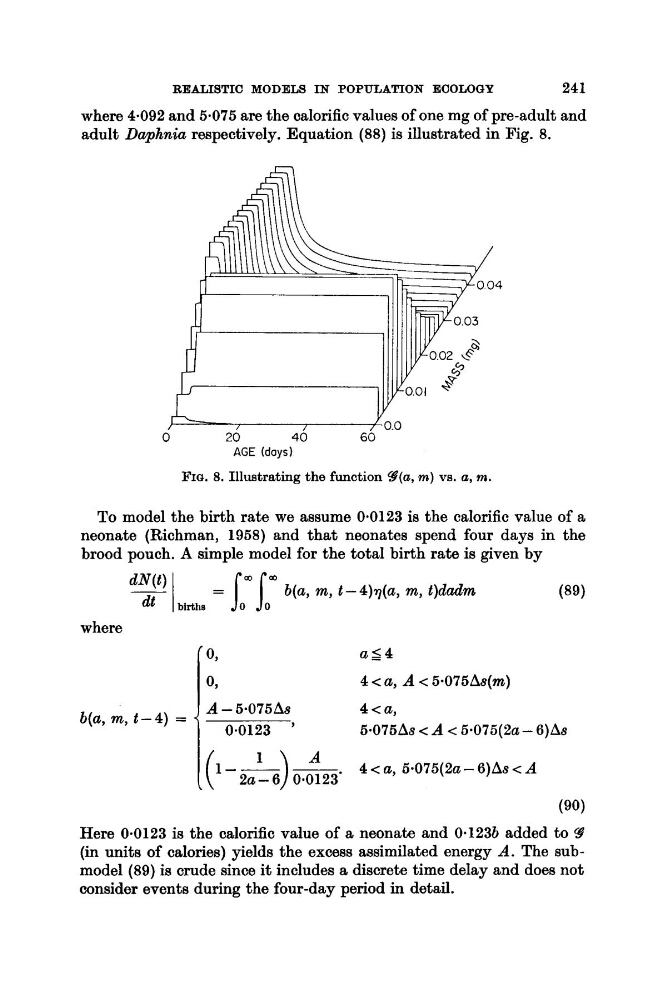
adult Daphnia respectively. Equation (88) is illustrated in Fig. 8.
4
0
20
40
60
AGE (days)
FIU. 8. Illustrating the function Y(a, m) vs. a, m.
To model the birth rate we assume 0.0123 is the calorific value of a
neonate (Richman, 1958) and that neonates spend four days in the
brood pouch. A simple model for the total birth rate is given by
where
a 5 4
4 c a, A < 5*075As(m)
A - 5.075AS
4 < a,
0.0123 '
5-075As < A < 5-075(2a- 6)As
b(a, m, t-4) =
4 < a, 5.075(2a- 6)As < A
I ( 1 - L ) -
A
2a-6 0.0123'
(90)
Here 0.0123 is the calorific value of a neonate and 0.123b added to Y
(in units of calories) yields the excess assimilated energy A. The submodel (89) is crude since it includes a discrete time delay and does not
consider events during the four-day period in detail.
241
where 4.092 and 5.075 are the calorific values of one mg of pre-adult and
adult Daphnia respectively. Equation (88) is illustrated in Fig. 8.
4
0
20
40
60
AGE (days)
FIU. 8. Illustrating the function Y(a, m) vs. a, m.
To model the birth rate we assume 0.0123 is the calorific value of a
neonate (Richman, 1958) and that neonates spend four days in the
brood pouch. A simple model for the total birth rate is given by
where
a 5 4
4 c a, A < 5*075As(m)
A - 5.075AS
4 < a,
0.0123 '
5-075As < A < 5-075(2a- 6)As
b(a, m, t-4) =
4 < a, 5.075(2a- 6)As < A
I ( 1 - L ) -
A
2a-6 0.0123'
(90)
Here 0.0123 is the calorific value of a neonate and 0.123b added to Y
(in units of calories) yields the excess assimilated energy A. The submodel (89) is crude since it includes a discrete time delay and does not
consider events during the four-day period in detail.