

240
WILLIAM STREIFER
The above formulas enable us to compute the excess assimilated energy
A.
The relative separation of excess assimilated energy into growth A,
and reproduction A, (see Eqn (83)) depends on age, mass and past food
supply. Pre-adults (a 5 4) devote all excess energy to growth. Adult
animals give priority to growth, until that growth exceeds a particular
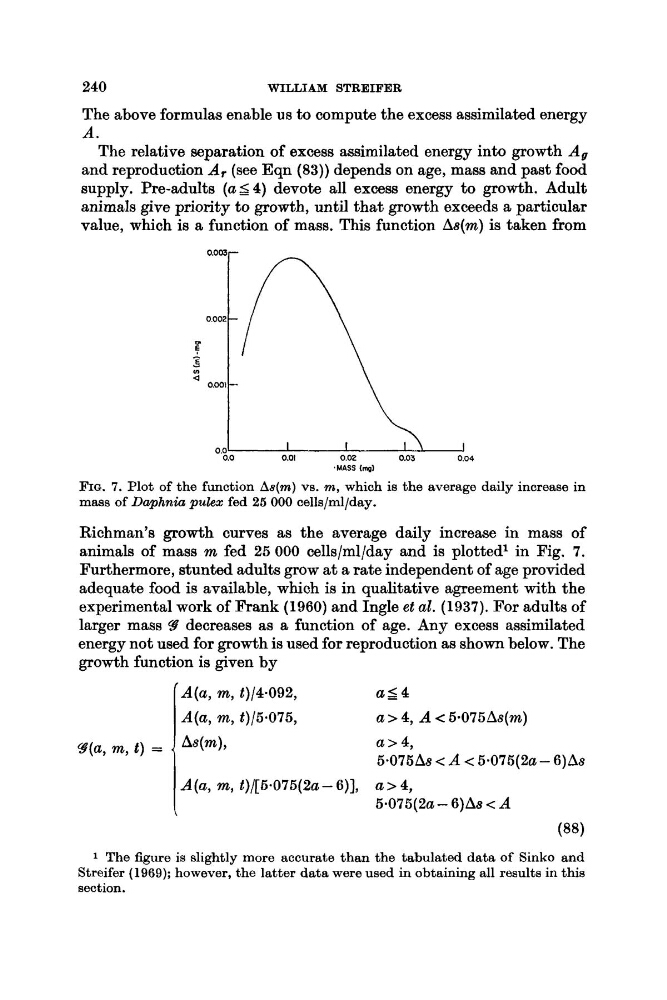
value, which is a function of mass. This function As(m) is taken from
FIQ. 7. Plot of the function A8(m) vs. wa, which is the average daily increase in
mass of Daphnia pulex fed 25 000 cells/ml/day.
Richman's growth curves as the average daily increase in mass of
animals of mass m fed 25 000 cells/ml/day and is plotted1 in Fig. 7.
Furthermore, stunted adults grow at a rate independent of age provided
adequate food is available, which is in qualitative agreement with the
experimental work of Frank (1960) and Ingle et ab. (1937). For adults of
larger mass 3 decreases as a function of age. Any excess assimilated
energy not used for growth is used for reproduction as shown below. The
growth function is given by
A(a, m, t)/4-092,
a s 4
A(a, m, t)/5.075,
a > 4, A < 5.075As(m)
I
u > 4 ,
5-075As < A c 5.075(2a - 6)As
A(u, WJ, t)/[5.075(2~- 6)], a > 4,
I
5*075(2a- 6)As < A
1 The figure is slightly more accurate than the tabulated data of Sinko and
Streifer (1969); however, the latter data were used in obtaining all results in this
section.
WILLIAM STREIFER
The above formulas enable us to compute the excess assimilated energy
A.
The relative separation of excess assimilated energy into growth A,
and reproduction A, (see Eqn (83)) depends on age, mass and past food
supply. Pre-adults (a 5 4) devote all excess energy to growth. Adult
animals give priority to growth, until that growth exceeds a particular
value, which is a function of mass. This function As(m) is taken from
FIQ. 7. Plot of the function A8(m) vs. wa, which is the average daily increase in
mass of Daphnia pulex fed 25 000 cells/ml/day.
Richman's growth curves as the average daily increase in mass of
animals of mass m fed 25 000 cells/ml/day and is plotted1 in Fig. 7.
Furthermore, stunted adults grow at a rate independent of age provided
adequate food is available, which is in qualitative agreement with the
experimental work of Frank (1960) and Ingle et ab. (1937). For adults of
larger mass 3 decreases as a function of age. Any excess assimilated
energy not used for growth is used for reproduction as shown below. The
growth function is given by
A(a, m, t)/4-092,
a s 4
A(a, m, t)/5.075,
a > 4, A < 5.075As(m)
I
u > 4 ,
5-075As < A c 5.075(2a - 6)As
A(u, WJ, t)/[5.075(2~- 6)], a > 4,
I
5*075(2a- 6)As < A
1 The figure is slightly more accurate than the tabulated data of Sinko and
Streifer (1969); however, the latter data were used in obtaining all results in this
section.