

REALISTIC MODELS IN POPULATION ECOLOGY
239
where A , and Ar are the energy devoted to growth and reproduction,
respectively.
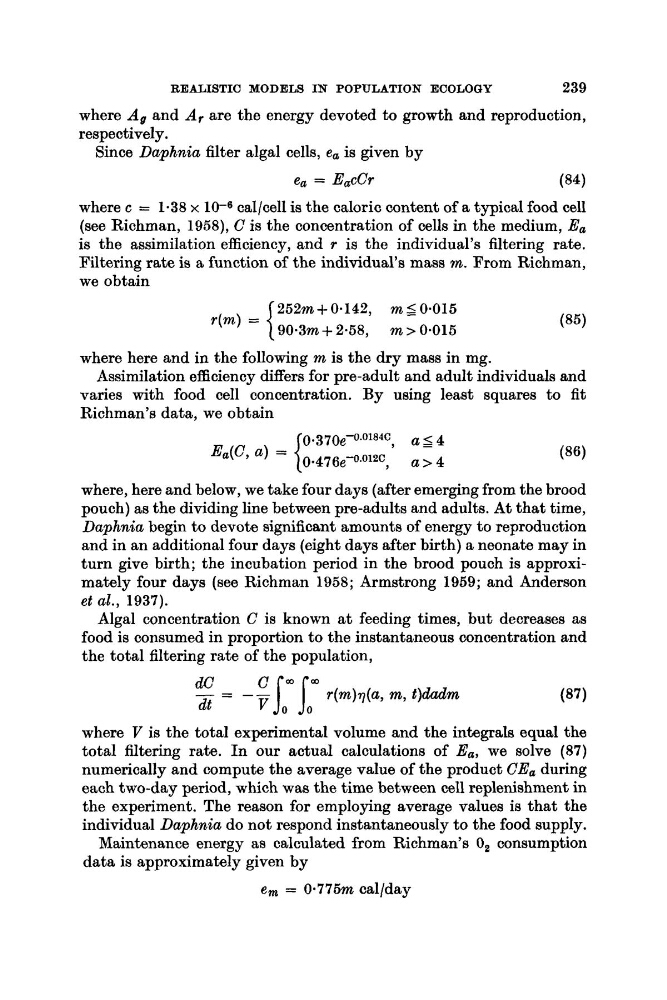
Since Daphnia filter algal cells, ea is given by
where c = 1-38 x 10-6 cal/cell is the caloric content of a typical food cell
(see Richman, 1958), C is the concentration of cells in the medium, Ea
is the assimilation efficiency, and r is the individual’s filtering rate.
Filtering rate is a function of the individual’s mass m. From Richman,
we obtain
252m + 0.142,
90-3m + 2-58,
m 5 0.015
m > 0.015
r ( m ) =
where here and in the following m is the dry mass in mg.
Assimilation efficiency differs for pre-adult and adult individuals and
varies with food cell concentration. By using least squares to fit
Richman’s data, we obtain
where, here and below, we take four days (after emerging from the brood
pouch) as the dividing line between pre-adults and adults. At that time,
Daphnia begin to devote significant amounts of energy to reproduction
and in an additional four days (eight days after birth) a neonate may in
turn give birth; the incubation period in the brood pouch is approximately four days (see Richman 1958; Armstrong 1959; and Anderson
et al., 1937).
Algal concentration C is known at feeding times, but decreases as
food is consumed in proportion to the instantaneous concentration and
the total filtering rate of the population,
where V is the total experimental volume and the integrals equal the
total filtering rate. In our actual calculations of Ea, we solve (87)
numerically and compute the average value of the product CEa during
each two-day period, which was the time between cell replenishment in
the experiment. The reason for employing average values is that the
individual Daphnia do not respond instantaneously to the food supply.
Maintenance energy as calculated from Richman’s 0, consumption
data is approximately given by
em = 0-775m cal/day
239
where A , and Ar are the energy devoted to growth and reproduction,
respectively.
Since Daphnia filter algal cells, ea is given by
where c = 1-38 x 10-6 cal/cell is the caloric content of a typical food cell
(see Richman, 1958), C is the concentration of cells in the medium, Ea
is the assimilation efficiency, and r is the individual’s filtering rate.
Filtering rate is a function of the individual’s mass m. From Richman,
we obtain
252m + 0.142,
90-3m + 2-58,
m 5 0.015
m > 0.015
r ( m ) =
where here and in the following m is the dry mass in mg.
Assimilation efficiency differs for pre-adult and adult individuals and
varies with food cell concentration. By using least squares to fit
Richman’s data, we obtain
where, here and below, we take four days (after emerging from the brood
pouch) as the dividing line between pre-adults and adults. At that time,
Daphnia begin to devote significant amounts of energy to reproduction
and in an additional four days (eight days after birth) a neonate may in
turn give birth; the incubation period in the brood pouch is approximately four days (see Richman 1958; Armstrong 1959; and Anderson
et al., 1937).
Algal concentration C is known at feeding times, but decreases as
food is consumed in proportion to the instantaneous concentration and
the total filtering rate of the population,
where V is the total experimental volume and the integrals equal the
total filtering rate. In our actual calculations of Ea, we solve (87)
numerically and compute the average value of the product CEa during
each two-day period, which was the time between cell replenishment in
the experiment. The reason for employing average values is that the
individual Daphnia do not respond instantaneously to the food supply.
Maintenance energy as calculated from Richman’s 0, consumption
data is approximately given by
em = 0-775m cal/day