

242
WILLIAM STREIFER
2. Death rates
The existing experimental data are not complete. According to Frank
et al. (1957)’ death rates are dependent on crowding and are a minimum
for eight animalslml. Frank’s data are not expressed as a function of age
and mass, only as a function of age and crowding. We associate mass
dependence with crowding by referring to Richman’s growth-curve
experiment with animals fed 25 000 algal cells/ml/day. Let s(a) be the
average mass of an animal in Richman’s experiment. We assume that all
animals of age a and mass m>s(a) experience a death rate equal to
0.0i
0.04
60
40
20
0
AGE (doys)
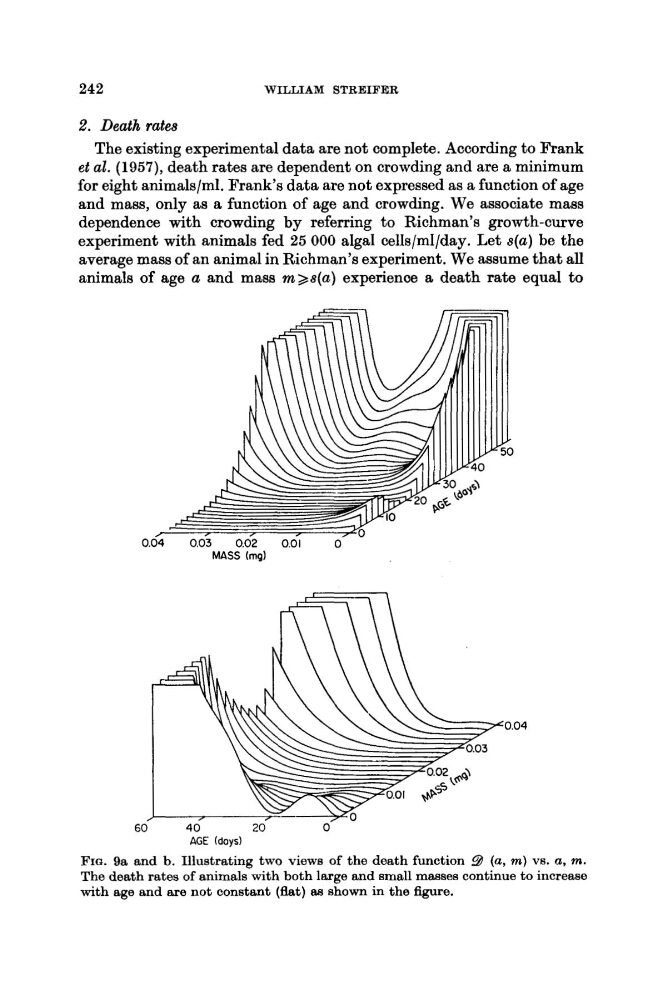
FIU. 9a and b. Illustrating two views of the death function 9 (a, m ) vs. a, m.
The death rates of animals with both large and small masses continue to increase
with age and are not constant (tlat) aa shown in the figure.
WILLIAM STREIFER
2. Death rates
The existing experimental data are not complete. According to Frank
et al. (1957)’ death rates are dependent on crowding and are a minimum
for eight animalslml. Frank’s data are not expressed as a function of age
and mass, only as a function of age and crowding. We associate mass
dependence with crowding by referring to Richman’s growth-curve
experiment with animals fed 25 000 algal cells/ml/day. Let s(a) be the
average mass of an animal in Richman’s experiment. We assume that all
animals of age a and mass m>s(a) experience a death rate equal to
0.0i
0.04
60
40
20
0
AGE (doys)
FIU. 9a and b. Illustrating two views of the death function 9 (a, m ) vs. a, m.
The death rates of animals with both large and small masses continue to increase
with age and are not constant (tlat) aa shown in the figure.