

236
WILLIAM STREIFER
depend on the variables d, 6, a, p and v which satisfy differential
equations and thus change with time. These dependences are not
arbitrary; they are determined by experimental data for the growth,
deaths and births of individuals as a function of age and mass, either
directly or via the density function formulation. The effects of variations
in the food supply, environment etc. are also included. The formulation
is general, although the equations will depend in detail on the submodels
for the particular species being studied.
The critical variable formulation for a single-species population
replaces the single partial differential equation with six ordinary
differential equations. This is a substantial simplification mathematically, since the numerical solution of the partial differential equation
may require that it be replaced by approximately forty ordinary
differential equations for a single-stage species. This simplification,
however, is at the expense of accuracy, and the formulation is presently
being checked in this respect by comparison with the results of Sinko
and Streifer (1969) for Daphnia. Even if the formulation is accurate for
Daphnia it may be less so for multistage species. It is highly unlikely
that a species passing through stages of eggs, larvae, pupae and adults
can have its age-size structure represented by the five variables d , 6 , a,
p and v. (Incidentally, in this situation, the partial differential equation may require more than forty approximating ordinary differential
equations for numerical computation.) How can the accuracy of the
critical variable formulation be improved, so that it applies to multistage species, for example? I believe the inclusion of higher moments of
age and mass distributions is an inefficient way to increase the accuracy.
Instead, I suggest separating the species into subpopulations and
employing a critical variable formulation for each. The ordinary
differential equations for each stage couple to the other stages and
contain time delays. An alternative is to combine the density function
approach and the critical variable formulation. Say for a single-stage
species detailed age structure is required, but it appears sufficient to
know 6i and possibly p. Von Foerster’s equation is modified to include
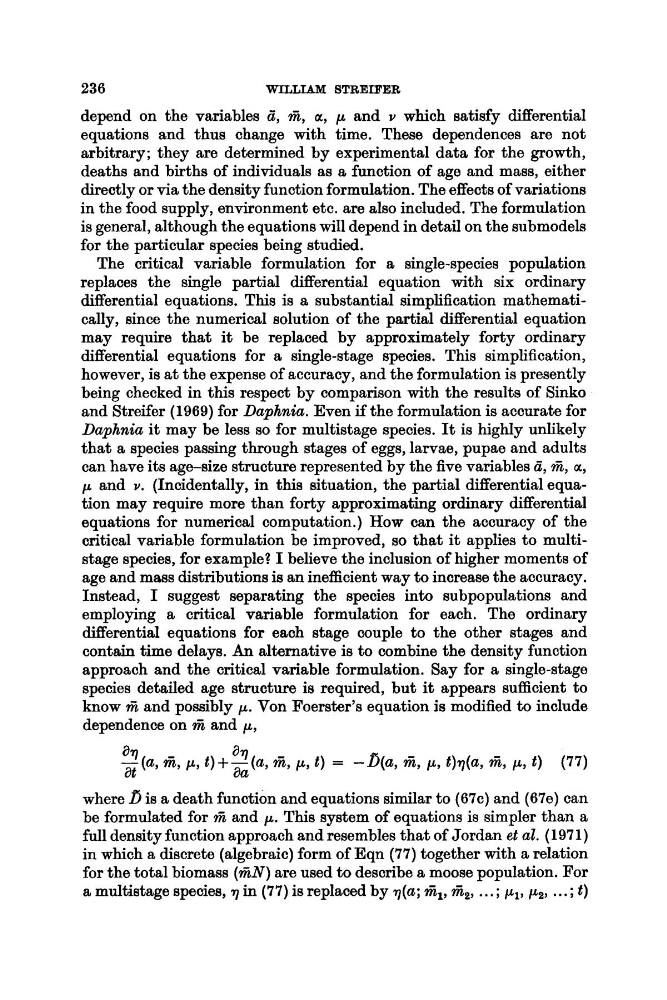
dependence on 6 and p,
where .ti is a death function and equations similar to (67c) and (67e) can
be formulated for 6 and p. This system of equations is simpler than a
full density function approach and resembles that of Jordan et al. (197 1)
in which a discrete (algebraic) form of Eqn (77) together with a relation
for the total biomass (TEN) are used to describe a moose population. For
a multistage species, 7 in (77) is replaced by V(a; f i l , fiZ, . . .; pl, pz, . . . ; t )
WILLIAM STREIFER
depend on the variables d, 6, a, p and v which satisfy differential
equations and thus change with time. These dependences are not
arbitrary; they are determined by experimental data for the growth,
deaths and births of individuals as a function of age and mass, either
directly or via the density function formulation. The effects of variations
in the food supply, environment etc. are also included. The formulation
is general, although the equations will depend in detail on the submodels
for the particular species being studied.
The critical variable formulation for a single-species population
replaces the single partial differential equation with six ordinary
differential equations. This is a substantial simplification mathematically, since the numerical solution of the partial differential equation
may require that it be replaced by approximately forty ordinary
differential equations for a single-stage species. This simplification,
however, is at the expense of accuracy, and the formulation is presently
being checked in this respect by comparison with the results of Sinko
and Streifer (1969) for Daphnia. Even if the formulation is accurate for
Daphnia it may be less so for multistage species. It is highly unlikely
that a species passing through stages of eggs, larvae, pupae and adults
can have its age-size structure represented by the five variables d , 6 , a,
p and v. (Incidentally, in this situation, the partial differential equation may require more than forty approximating ordinary differential
equations for numerical computation.) How can the accuracy of the
critical variable formulation be improved, so that it applies to multistage species, for example? I believe the inclusion of higher moments of
age and mass distributions is an inefficient way to increase the accuracy.
Instead, I suggest separating the species into subpopulations and
employing a critical variable formulation for each. The ordinary
differential equations for each stage couple to the other stages and
contain time delays. An alternative is to combine the density function
approach and the critical variable formulation. Say for a single-stage
species detailed age structure is required, but it appears sufficient to
know 6i and possibly p. Von Foerster’s equation is modified to include
dependence on 6 and p,
where .ti is a death function and equations similar to (67c) and (67e) can
be formulated for 6 and p. This system of equations is simpler than a
full density function approach and resembles that of Jordan et al. (197 1)
in which a discrete (algebraic) form of Eqn (77) together with a relation
for the total biomass (TEN) are used to describe a moose population. For
a multistage species, 7 in (77) is replaced by V(a; f i l , fiZ, . . .; pl, pz, . . . ; t )