

REALISTIC MODELS I N POPUIATION ECOLOGY
237
where fi,, fi,, . .. and p,, p,, . . . are the mean masses and mass variances
of the different stages. An ordinary differential equation is required for
each of these variables.
The critical variable formulation was developed primarily to model
multi-species interactions. To date, however, virtually no progress has
been made in that direction. The brief discussion which follows is
limited to the most basic considerations and ideas.
Clearly, when several species interact the six ordinary differential
equations for each species will, in general, depend on the six variables
(N, 6, f i etc.) describing each of the other species. Actually to formulate
the equations is no trivial task. If a full density function formulation is
available for all the interacting species under consideration, partial
differential equations would lead directly to complete critical variable
equations in the same way as for single-species equations. To obtain a
full density function formulation is a very laborious procedure. Rather,
one could attempt to formulate the critical variable equations directly.
For example, suppose that a two-species interaction situation with a
predator species is numbered 1 and a prey species numbered 2. The total
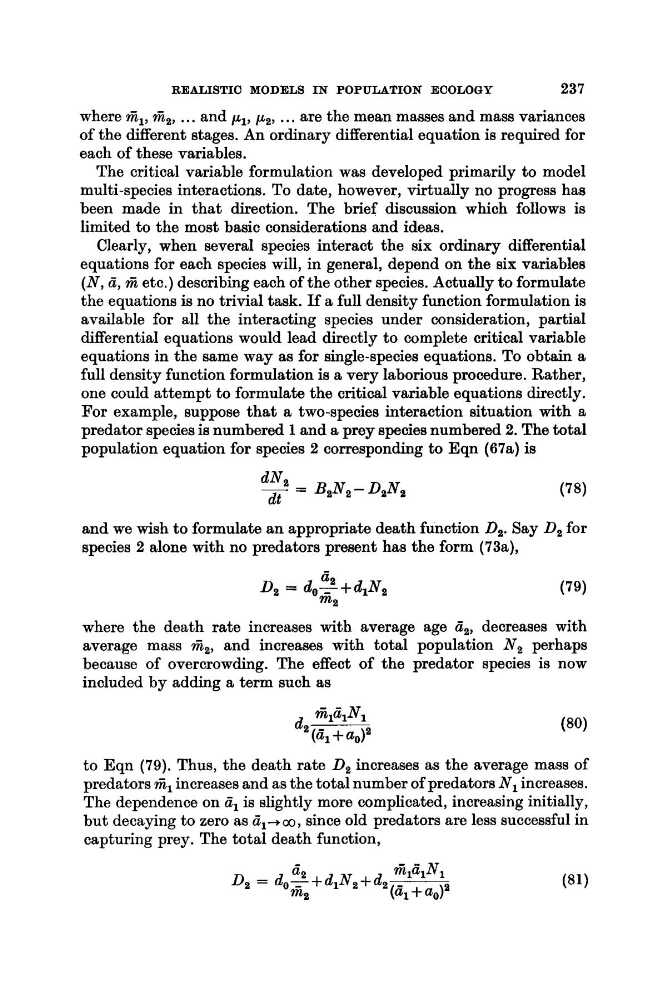
population equation for species 2 corresponding to Eqn (67a) is
- -
dN2 - B,N,- D,N,
at
and we wish to formulate an appropriate death function D,. Say D, for
species 2 alone with no predators present has the form (73a),
where the death rate increases with average age ii,, decreases with
average mass fi,, and increases with total population N , perhaps
because of overcrowding. The effect of the predator species is now
included by adding a term such as
to Eqn (79). Thus, the death rate D, increases as the average mass of
predators f i l increases and as the total number of predators N, increases.
The dependence on 6, is slightly more complicated, increasing initially,
but decaying to zero as El+ co, since old predators are less successful in
capturing prey. The total death function,
6 2
filiilNl
D, = d , T + d N d
m2
,+ 2(iil+ao)2
237
where fi,, fi,, . .. and p,, p,, . . . are the mean masses and mass variances
of the different stages. An ordinary differential equation is required for
each of these variables.
The critical variable formulation was developed primarily to model
multi-species interactions. To date, however, virtually no progress has
been made in that direction. The brief discussion which follows is
limited to the most basic considerations and ideas.
Clearly, when several species interact the six ordinary differential
equations for each species will, in general, depend on the six variables
(N, 6, f i etc.) describing each of the other species. Actually to formulate
the equations is no trivial task. If a full density function formulation is
available for all the interacting species under consideration, partial
differential equations would lead directly to complete critical variable
equations in the same way as for single-species equations. To obtain a
full density function formulation is a very laborious procedure. Rather,
one could attempt to formulate the critical variable equations directly.
For example, suppose that a two-species interaction situation with a
predator species is numbered 1 and a prey species numbered 2. The total
population equation for species 2 corresponding to Eqn (67a) is
- -
dN2 - B,N,- D,N,
at
and we wish to formulate an appropriate death function D,. Say D, for
species 2 alone with no predators present has the form (73a),
where the death rate increases with average age ii,, decreases with
average mass fi,, and increases with total population N , perhaps
because of overcrowding. The effect of the predator species is now
included by adding a term such as
to Eqn (79). Thus, the death rate D, increases as the average mass of
predators f i l increases and as the total number of predators N, increases.
The dependence on 6, is slightly more complicated, increasing initially,
but decaying to zero as El+ co, since old predators are less successful in
capturing prey. The total death function,
6 2
filiilNl
D, = d , T + d N d
m2
,+ 2(iil+ao)2