

REIILISTIU MODELS IN POPULATION ECOLOGY
236
which follows from setting Eqn (74b) equal zero. The straight line and
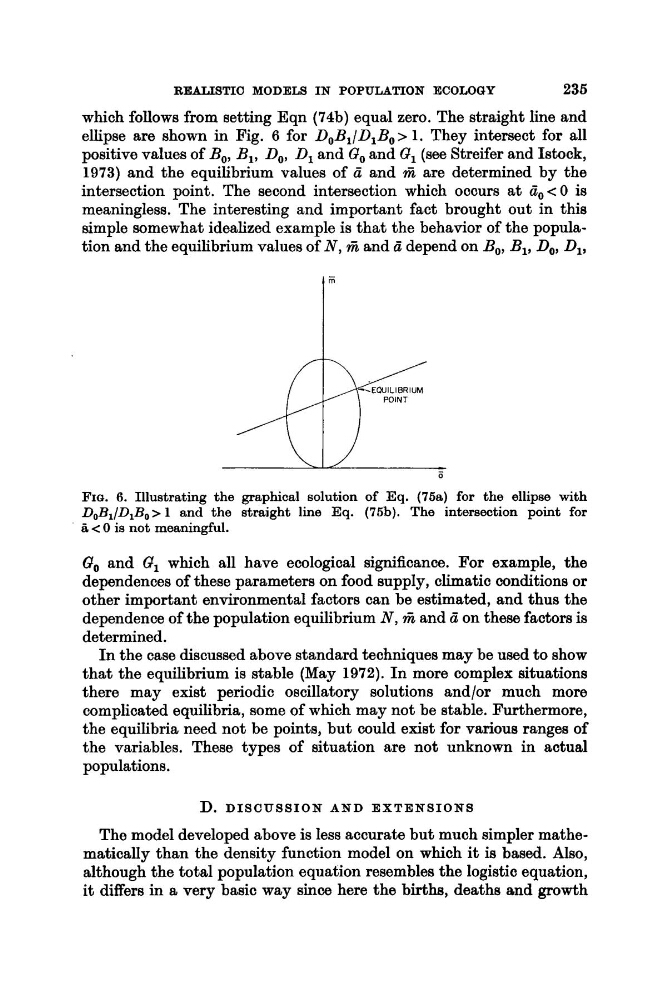
ellipse are shown in Fig. 6 for D,B,/D,B,> 1. They intersect for all
positive values of B,, B,, Do, D, and Go and G, (see Streifer and Istock,
1973) and the equilibrium values of E and 6 i are determined by the
intersection point. The second intersection which occurs at d,
simple somewhat idealized example is that the behavior of the population and the equilibrium values of N, 5 and 6 depend on B,, B,, Do, D,,
\ i /
FIG 6. Illustrating the graphical solution of Eq. (76a) for the ellipse with
DoBl/DIBo> 1 and the straight line Eq. (76b). The intersection point for
6 c 0 is not meaningful.
B, and B, which all have ecological significance. For example, the
dependences of these parameters on food supply, climatic conditions or
other important environmental factors can be estimated, and thus the
dependence of the population equilibrium N, f i and d on these factors is
determined.
In the case discussed above standard techniques may be used to show
that the equilibrium is stable (May 1972). I n more complex situations
there may exist periodic oscillatory solutions and/or much more
complicated equilibria, some of which may not be stable. Furthermore,
the equilibria need not be points, but could exist for various ranges of
the variables. These types of situation are not unknown in actual
populations.
D. D I S C U S S I O N A N D E X T E N S I O N S
The model developed above is less accurate but much simpler mathematically than the density function model on which it is based. Also,
although the total population equation resembles the logistic equation,
it differs in a very basic way since here the births, deaths and growth
236
which follows from setting Eqn (74b) equal zero. The straight line and
ellipse are shown in Fig. 6 for D,B,/D,B,> 1. They intersect for all
positive values of B,, B,, Do, D, and Go and G, (see Streifer and Istock,
1973) and the equilibrium values of E and 6 i are determined by the
intersection point. The second intersection which occurs at d,
simple somewhat idealized example is that the behavior of the population and the equilibrium values of N, 5 and 6 depend on B,, B,, Do, D,,
\ i /
FIG 6. Illustrating the graphical solution of Eq. (76a) for the ellipse with
DoBl/DIBo> 1 and the straight line Eq. (76b). The intersection point for
6 c 0 is not meaningful.
B, and B, which all have ecological significance. For example, the
dependences of these parameters on food supply, climatic conditions or
other important environmental factors can be estimated, and thus the
dependence of the population equilibrium N, f i and d on these factors is
determined.
In the case discussed above standard techniques may be used to show
that the equilibrium is stable (May 1972). I n more complex situations
there may exist periodic oscillatory solutions and/or much more
complicated equilibria, some of which may not be stable. Furthermore,
the equilibria need not be points, but could exist for various ranges of
the variables. These types of situation are not unknown in actual
populations.
D. D I S C U S S I O N A N D E X T E N S I O N S
The model developed above is less accurate but much simpler mathematically than the density function model on which it is based. Also,
although the total population equation resembles the logistic equation,
it differs in a very basic way since here the births, deaths and growth