

234
WILLIAM STREIFER
and
f i
a
B = Boy-BIN
(73c)
where Do, D,, Go, G,, B, and B, are all positive constants. The death
function (73a) is such that older individuals have higher death rates,
larger individuals have lower death rates, and the death rate increases
with population N , perhaps because of overcrowding. Similarly, the
growth rate Yo decreases and becomes negative as the population
increases. Finally, births per individual increase with average mass,
decrease with mean age, and decrease with larger population. Clearly
Eqn (73c) is unrealistic for G near zero, but with this particular choice,
the subsequent algebra is simpler than if G were replaced by 6 + a,, for
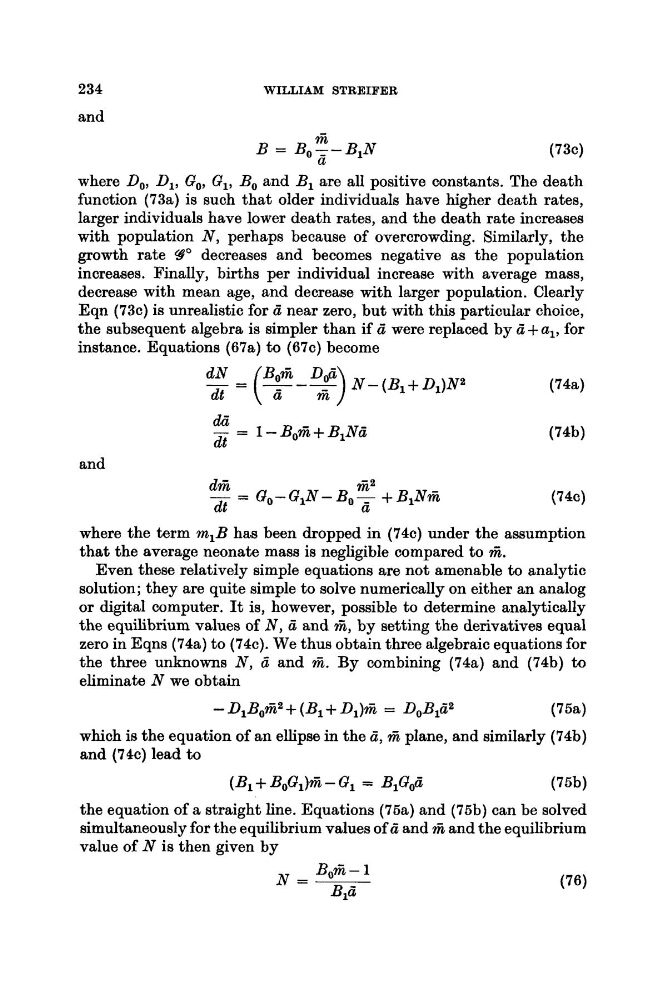
instance. Equations (67a) to (67c) become
and
_ - - I-Bofi+B1NG
at
where the term m,B has been dropped in (74c) under the assumption
that the average neonate mass is negligible compared to f i .
Even these relatively simple equations are not amenable to analytic
solution; they are quite simple to solve numerically on either an analog
or digital computer. It is, however, possible to determine analytically
the equilibrium values of N, G and 6, by setting the derivatives equal
zero in Eqns (74a) to (74c). We thus obtain three algebraic equations for
the three unknowns N , 5 and f i . By combining (74a) and (74b) to
eliminate N we obtain
- D,Bofii2 + ( B , + D J f i = DoB1G2
(75a)
which is the equation of an ellipse in the 5 , f i plane, and similarly (74b)
and (7413) lead to
( B , + BOGJfi - GI = BlG@
(75b)
the equation of a straight line. Equations (75a) and (75b) can be solved
simultaneously for the equilibrium values of G and f i and the equilibrium
value of N is then given by
WILLIAM STREIFER
and
f i
a
B = Boy-BIN
(73c)
where Do, D,, Go, G,, B, and B, are all positive constants. The death
function (73a) is such that older individuals have higher death rates,
larger individuals have lower death rates, and the death rate increases
with population N , perhaps because of overcrowding. Similarly, the
growth rate Yo decreases and becomes negative as the population
increases. Finally, births per individual increase with average mass,
decrease with mean age, and decrease with larger population. Clearly
Eqn (73c) is unrealistic for G near zero, but with this particular choice,
the subsequent algebra is simpler than if G were replaced by 6 + a,, for
instance. Equations (67a) to (67c) become
and
_ - - I-Bofi+B1NG
at
where the term m,B has been dropped in (74c) under the assumption
that the average neonate mass is negligible compared to f i .
Even these relatively simple equations are not amenable to analytic
solution; they are quite simple to solve numerically on either an analog
or digital computer. It is, however, possible to determine analytically
the equilibrium values of N, G and 6, by setting the derivatives equal
zero in Eqns (74a) to (74c). We thus obtain three algebraic equations for
the three unknowns N , 5 and f i . By combining (74a) and (74b) to
eliminate N we obtain
- D,Bofii2 + ( B , + D J f i = DoB1G2
(75a)
which is the equation of an ellipse in the 5 , f i plane, and similarly (74b)
and (7413) lead to
( B , + BOGJfi - GI = BlG@
(75b)
the equation of a straight line. Equations (75a) and (75b) can be solved
simultaneously for the equilibrium values of G and f i and the equilibrium
value of N is then given by