

REALISTIC MODELS IN POPULATION ECOLOGY
233
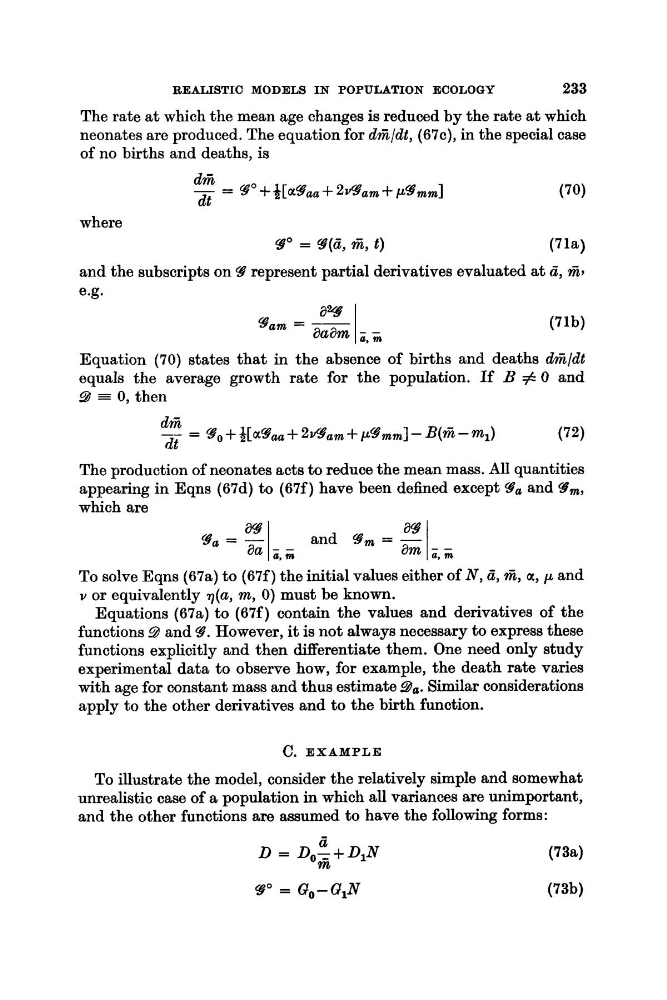
The rate at which the mean age changes is reduced by the rate at which
neonates are produced. The equation for dfildt, (67c), in the special caae
of no births and deaths, is
where
9" = %(a, rii, t )
and the subscripts on B represent partial derivatives evaluated at 6, rii)
e.g.
Equation (70) states that in the absence of births and deaths drii/dt
equals the average growth rate for the population. If B # 0 and
9 = 0, then
(72)
arii
at
- - - 9 0 + +[a%aa + 2vBam + p 9 m m ] - B ( 6 - m,)
The production of neonates acts to reduce the mean mass. All quantities
appearing in Eqns (67d) to (67f) have been defined except B, and Ym,
which are
To solve Eqns (67a) to (67f) the initial values either of N , d, 6, a, p and
v or equivalently $a, m, 0) must be known.
Equations (67a) to (67f) contain the values and derivatives of the
functions 9 and 9. However, it is not always necessary to express these
functions explicitly and then differentiate them. One need only study
experimental data to observe how, for example, the death rate varies
with age for constant mass and thus estimate 9 a . Similar considerations
apply to the other derivatives and to the birth function.
c. E X A M P L E
To illustrate the model, consider the relatively simple and somewhat
unrealistic case of a population in which all variances are unimportant,
and the other functions are assumed to have the following forms:
d
D = DOT + DIN
m
( 7 3 4
233
The rate at which the mean age changes is reduced by the rate at which
neonates are produced. The equation for dfildt, (67c), in the special caae
of no births and deaths, is
where
9" = %(a, rii, t )
and the subscripts on B represent partial derivatives evaluated at 6, rii)
e.g.
Equation (70) states that in the absence of births and deaths drii/dt
equals the average growth rate for the population. If B # 0 and
9 = 0, then
(72)
arii
at
- - - 9 0 + +[a%aa + 2vBam + p 9 m m ] - B ( 6 - m,)
The production of neonates acts to reduce the mean mass. All quantities
appearing in Eqns (67d) to (67f) have been defined except B, and Ym,
which are
To solve Eqns (67a) to (67f) the initial values either of N , d, 6, a, p and
v or equivalently $a, m, 0) must be known.
Equations (67a) to (67f) contain the values and derivatives of the
functions 9 and 9. However, it is not always necessary to express these
functions explicitly and then differentiate them. One need only study
experimental data to observe how, for example, the death rate varies
with age for constant mass and thus estimate 9 a . Similar considerations
apply to the other derivatives and to the birth function.
c. E X A M P L E
To illustrate the model, consider the relatively simple and somewhat
unrealistic case of a population in which all variances are unimportant,
and the other functions are assumed to have the following forms:
d
D = DOT + DIN
m
( 7 3 4