

232
WILLIAM STREIFER
* = - ( B - D ) p - p 9 O + 2 ~ 9 ~
+ 2pgm + (mf - 2m,% + A2)B
at
av
- = - ( B - D)v - I&" + + +CAB -6m,B
at
(67e)'
(67f)
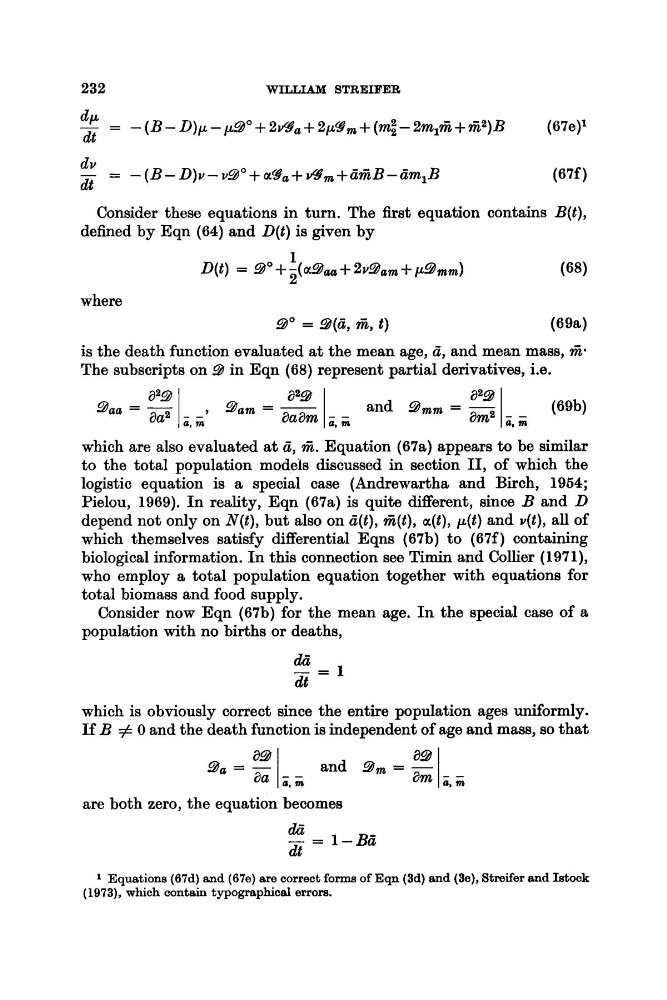
Consider these equations in turn. The fist equation contains B(t),
defined by Eqn (64) and D(t) is given by
(68)
(69s)
1
2
D(t) = go +-(a%
+ 2 ~ 9 t z m + @ m m )
go = 9(6, A, t )
where
is the death function evaluated at the mean age, 6, and mean mass, fiThe subscripts on 9 3 in Eqn (68) represent partial derivatives, i.e.
which are also evaluated at 6, A. Equation (67a) appears to be similar
to the total population modeis discussed in section 11, of which the
logistic equation is a special case (Andrewartha and Birch, 1964;
Pielou, 1969). I n reality, Eqn (67a) is quite different, since B and D
depend not only on N ( t ) , but also on 6 ( t ) , A(t), a(t), p ( t ) and v(t), all of
which themselves satisfy differential Eqns (67b) to (67f) containing
biological information. I n this connection see Timin and Collier (1971),
who employ a total population equation together with equations for
total biomass and food supply.
Consider now Eqn (67b) for the mean age. I n the special case of a
population with no births or deaths,
&
- = I
at
which is obviously correct since the entire population ages uniformly.
If B # 0 and the death function is independent of age and mass, so that
are both zero, the equation becomes
_ - - 1-B6
&
at
Equations (67d) and (67e) are correct forms of Eqn (3d) and (3e), Streifer and Istock
(1973), which contain typographical errors.
WILLIAM STREIFER
* = - ( B - D ) p - p 9 O + 2 ~ 9 ~
+ 2pgm + (mf - 2m,% + A2)B
at
av
- = - ( B - D)v - I&" + + +CAB -6m,B
at
(67e)'
(67f)
Consider these equations in turn. The fist equation contains B(t),
defined by Eqn (64) and D(t) is given by
(68)
(69s)
1
2
D(t) = go +-(a%
+ 2 ~ 9 t z m + @ m m )
go = 9(6, A, t )
where
is the death function evaluated at the mean age, 6, and mean mass, fiThe subscripts on 9 3 in Eqn (68) represent partial derivatives, i.e.
which are also evaluated at 6, A. Equation (67a) appears to be similar
to the total population modeis discussed in section 11, of which the
logistic equation is a special case (Andrewartha and Birch, 1964;
Pielou, 1969). I n reality, Eqn (67a) is quite different, since B and D
depend not only on N ( t ) , but also on 6 ( t ) , A(t), a(t), p ( t ) and v(t), all of
which themselves satisfy differential Eqns (67b) to (67f) containing
biological information. I n this connection see Timin and Collier (1971),
who employ a total population equation together with equations for
total biomass and food supply.
Consider now Eqn (67b) for the mean age. I n the special case of a
population with no births or deaths,
&
- = I
at
which is obviously correct since the entire population ages uniformly.
If B # 0 and the death function is independent of age and mass, so that
are both zero, the equation becomes
_ - - 1-B6
&
at
Equations (67d) and (67e) are correct forms of Eqn (3d) and (3e), Streifer and Istock
(1973), which contain typographical errors.