

REALISTIC MODELS IN POPULATION ECOLOGY
23 1
final formulation. If a knowledge of q were required, we would have
achieved no simplification, since the purpose of the formulation is to
avoid the need to calculate q.
As a population interacts with its environment N, 8 , f i , u, p. and v all
vary with time. To derive ordinary differential equations for these
variables, we employ the partial differential equation for q(a, m, t),
Eqn (20) repeated here
a
-+-+(Yq) = -9q
at 8a am
and assume that the death and growth functions, $9 and 9, and the birth
rate q(0, m, t ) are known for the particular populations. Various expressions are appropriate for q(0, m, t ) depending on the reproductive
method and the species being studied, but in this section we assume
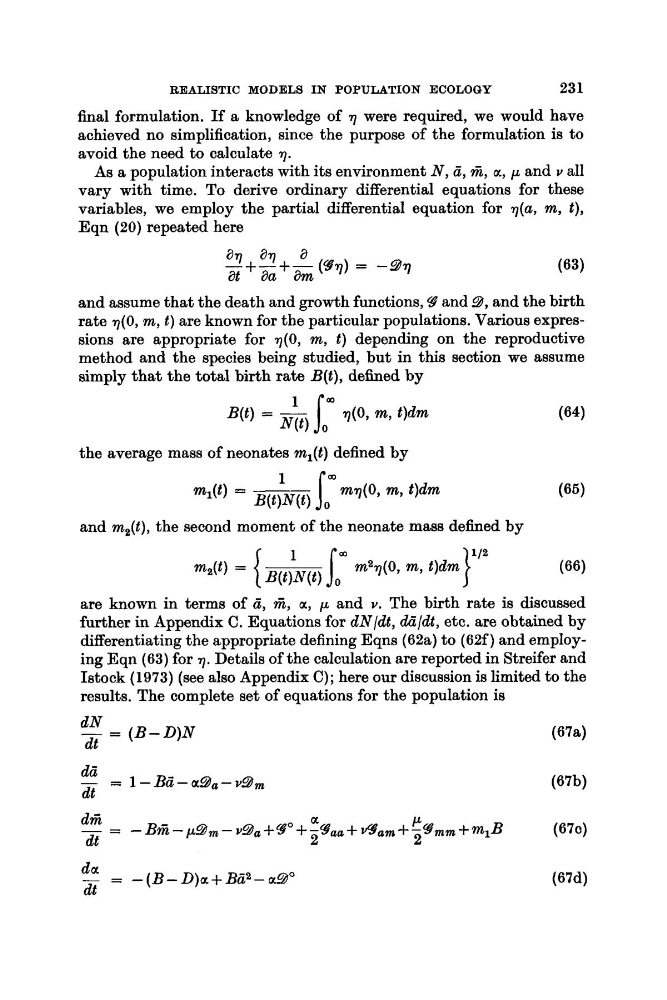
simply that the total birth rate B(t), defined by
the average mass of neonates ml(t) defined by
1
P m
and m2(t), the second moment of the neonate mass defined by
are known in terms of 5, f i , a, p. and v. The birth rate is discussed
further in Appendix C. Equations for dN/dt, &/at, etc. are obtained by
differentiating the appropriate defining Eqns (62a) to (62f) and employing Eqn (63) for q. Details of the calculation are reported in Streifer and
Istock ( 1 9 7 3 ) (see also Appendix C); here our discussion is limited to the
results. The complete set of equations for the population is
_ - - ( B - D ) N
dN
at
du
- = - ( B - D ) a + B G 2 - a 9 0
at
23 1
final formulation. If a knowledge of q were required, we would have
achieved no simplification, since the purpose of the formulation is to
avoid the need to calculate q.
As a population interacts with its environment N, 8 , f i , u, p. and v all
vary with time. To derive ordinary differential equations for these
variables, we employ the partial differential equation for q(a, m, t),
Eqn (20) repeated here
a
-+-+(Yq) = -9q
at 8a am
and assume that the death and growth functions, $9 and 9, and the birth
rate q(0, m, t ) are known for the particular populations. Various expressions are appropriate for q(0, m, t ) depending on the reproductive
method and the species being studied, but in this section we assume
simply that the total birth rate B(t), defined by
the average mass of neonates ml(t) defined by
1
P m
and m2(t), the second moment of the neonate mass defined by
are known in terms of 5, f i , a, p. and v. The birth rate is discussed
further in Appendix C. Equations for dN/dt, &/at, etc. are obtained by
differentiating the appropriate defining Eqns (62a) to (62f) and employing Eqn (63) for q. Details of the calculation are reported in Streifer and
Istock ( 1 9 7 3 ) (see also Appendix C); here our discussion is limited to the
results. The complete set of equations for the population is
_ - - ( B - D ) N
dN
at
du
- = - ( B - D ) a + B G 2 - a 9 0
at