

230
WILLIAM STREIFER
that a full knowledge of r] is not necessary to determine the important,
but grosser aspects of a population, e.g. the total numbers, the average
age, the biomass etc. The idea of the critical variable formulation is to
obtain ordinary differential equations for the total population, the
average age, the average mass and the variances and covariance of the
age and mass distributions, rather than deal with the partial differential
equation for r]. If these quantities are not sufficient realistically to
describe the population dynamics, the formulation can be improved at
the expense of some additional complexity. After a fairly complete
discussion of the formulation for single species, we discuss such improvements in accuracy and extensions to many-species interactions.
B. F O R M U L A T I O N
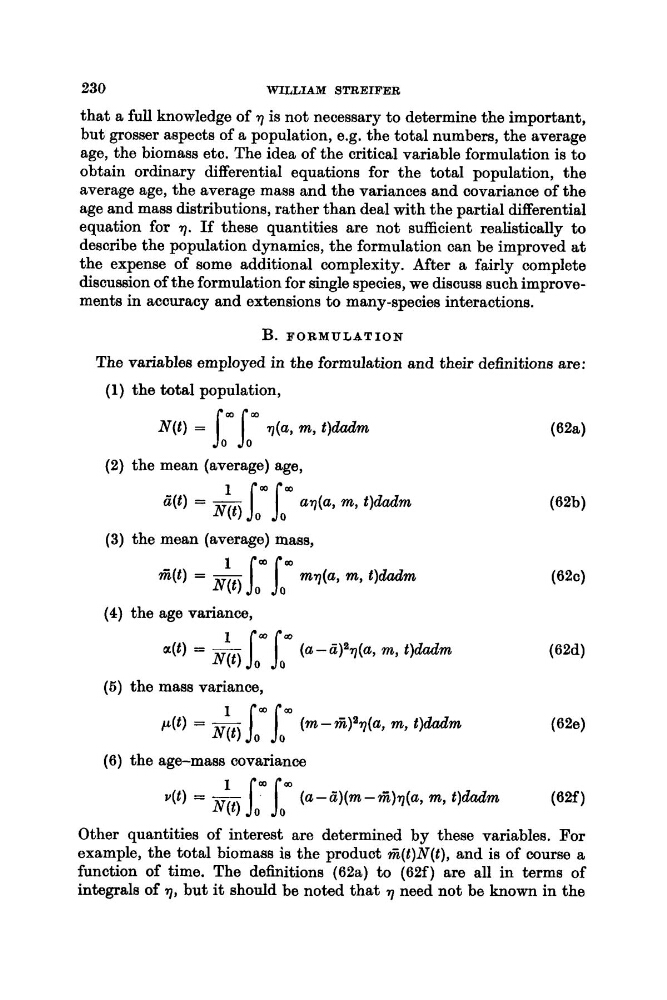
The variables employed in the formulation and their definitions are:
(1) the total population,
(2) the mean (average) age,
(3) the mean (average) mass,
(4) the age variance,
(6) the mass variance,
(6) the age-mass covariance
Other quantities of interest are determined by these variables. For
example, the total biomass is the product fi(t)N(t), and is of course a
function of time. The definitions (62a) to (62f) are all in terms of
integrals of r ] , but it should be noted that r] need not be known in the
WILLIAM STREIFER
that a full knowledge of r] is not necessary to determine the important,
but grosser aspects of a population, e.g. the total numbers, the average
age, the biomass etc. The idea of the critical variable formulation is to
obtain ordinary differential equations for the total population, the
average age, the average mass and the variances and covariance of the
age and mass distributions, rather than deal with the partial differential
equation for r]. If these quantities are not sufficient realistically to
describe the population dynamics, the formulation can be improved at
the expense of some additional complexity. After a fairly complete
discussion of the formulation for single species, we discuss such improvements in accuracy and extensions to many-species interactions.
B. F O R M U L A T I O N
The variables employed in the formulation and their definitions are:
(1) the total population,
(2) the mean (average) age,
(3) the mean (average) mass,
(4) the age variance,
(6) the mass variance,
(6) the age-mass covariance
Other quantities of interest are determined by these variables. For
example, the total biomass is the product fi(t)N(t), and is of course a
function of time. The definitions (62a) to (62f) are all in terms of
integrals of r ] , but it should be noted that r] need not be known in the