

REALISTIC MODELS IN POPUUTION ECOLOUY
227
where
ax
dY
az
y z = z , V g = d t ' and V z = -
at
(59)
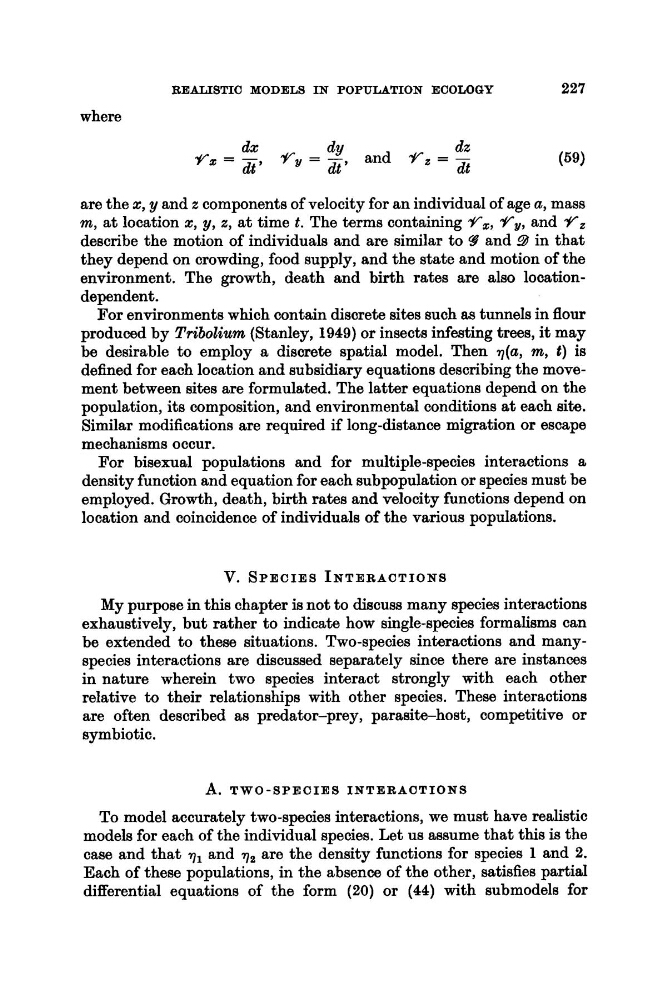
are the x, y and z components of velocity for an individual of age a, mass
m, at location x, y, z, at time t. The terms containing V z , Yg, and Y ,
describe the motion of individuals and are similar to '
3 and 9 in that
they depend on crowding, food supply, and the state and motion of the
environment. The growth, death and birth rates are also locationdependent.
For environments which contain discrete sites such as tunnels in flour
produced by Tribolium (Stanley, 1949) or insects infesting trees, it may
be desirable to employ a discrete spatial model. Then ~ ( a ,
m, t ) is
defined for each location and subsidiary equations describing the movement between sites are formulated. The latter equations depend on the
population, its composition, and environmental conditions at each site.
Similar modifications are required if long-distance migration or escape
mechanisms occur.
For bisexual populations and for multiple-species interactions a
density function and equation for each subpopulation or species must be
employed. Growth, death, birth rates and velocity functions depend on
location and coincidence of individuals of the various populations.
V. SPECIES INTERACTIONS
My purpose in this chapter is not to ditwuss many species interactions
exhaustively, but rather to indicate how single-species formalisms can
be extended to these situations. Two-species interactions and manyspecies interactions are discussed separately since there are instances
in nature wherein two species interact strongly with each other
relative to their relationships with other species. These interactions
are often described as predator-prey, parasite-host, competitive or
symbiotic.
A. T W O - S P E U I E S INTERAUTIONS
To model accurately two-species interactions, we must have realistic
models for each of the individual species. Let us assume that this is the
case and that v1 and ria are the density functions for species 1 and 2.
Each of these populations, in the absence of the other, satisfies partial
differential equations of the form (20) or (44) with submodels for
227
where
ax
dY
az
y z = z , V g = d t ' and V z = -
at
(59)
are the x, y and z components of velocity for an individual of age a, mass
m, at location x, y, z, at time t. The terms containing V z , Yg, and Y ,
describe the motion of individuals and are similar to '
3 and 9 in that
they depend on crowding, food supply, and the state and motion of the
environment. The growth, death and birth rates are also locationdependent.
For environments which contain discrete sites such as tunnels in flour
produced by Tribolium (Stanley, 1949) or insects infesting trees, it may
be desirable to employ a discrete spatial model. Then ~ ( a ,
m, t ) is
defined for each location and subsidiary equations describing the movement between sites are formulated. The latter equations depend on the
population, its composition, and environmental conditions at each site.
Similar modifications are required if long-distance migration or escape
mechanisms occur.
For bisexual populations and for multiple-species interactions a
density function and equation for each subpopulation or species must be
employed. Growth, death, birth rates and velocity functions depend on
location and coincidence of individuals of the various populations.
V. SPECIES INTERACTIONS
My purpose in this chapter is not to ditwuss many species interactions
exhaustively, but rather to indicate how single-species formalisms can
be extended to these situations. Two-species interactions and manyspecies interactions are discussed separately since there are instances
in nature wherein two species interact strongly with each other
relative to their relationships with other species. These interactions
are often described as predator-prey, parasite-host, competitive or
symbiotic.
A. T W O - S P E U I E S INTERAUTIONS
To model accurately two-species interactions, we must have realistic
models for each of the individual species. Let us assume that this is the
case and that v1 and ria are the density functions for species 1 and 2.
Each of these populations, in the absence of the other, satisfies partial
differential equations of the form (20) or (44) with submodels for