

226
WILLIAM STREIFER
could be incorporated into the age-mass specifk models discussed
above.
E’. H E T E R O G E N E O U S E N V I R O N M E N T S
In the models discussed above the environmental response of individuals in the population is incorporated in the growth, death and birth
submodels. Thus, if all individuals experience the same environmental
conditions, both exogenous (independent of the population) and endogenous (dependent on the population) environmental changes, either
random or deterministic, are included in the model. To determine how
populations respond to different environments, the model can be solved
for different conditions. Alternatively, the fact that individuals experience a variety of environments can be taken into consideration by
employing averages. However, averages are not always suitable (Levins,
1969) and neither of the above procedures describe situations in which
individuals are moved by external forces or move into unexploited parts
of the environment. Furthermore, averages are still less appropriate in
the study of species interactions (Pimentel et ul., 1963). In a competition
situation, for example, some parts of the environment may favor the
first species and other parts the second. A model which employs
averages will often predict the exclusion of one or the other species,
whereas both species actually survive in the heterogeneous environment.
Single-species populations in heterogeneous environments have been
studied by Bailey (1968) and Usher and Williamson (1970). I n their
models the total number of individuals at discrete locations are the
variables, and migration between these locations or sites is included. The
model I develop below includes age-size structure as well as motion
through a continuum of locations.
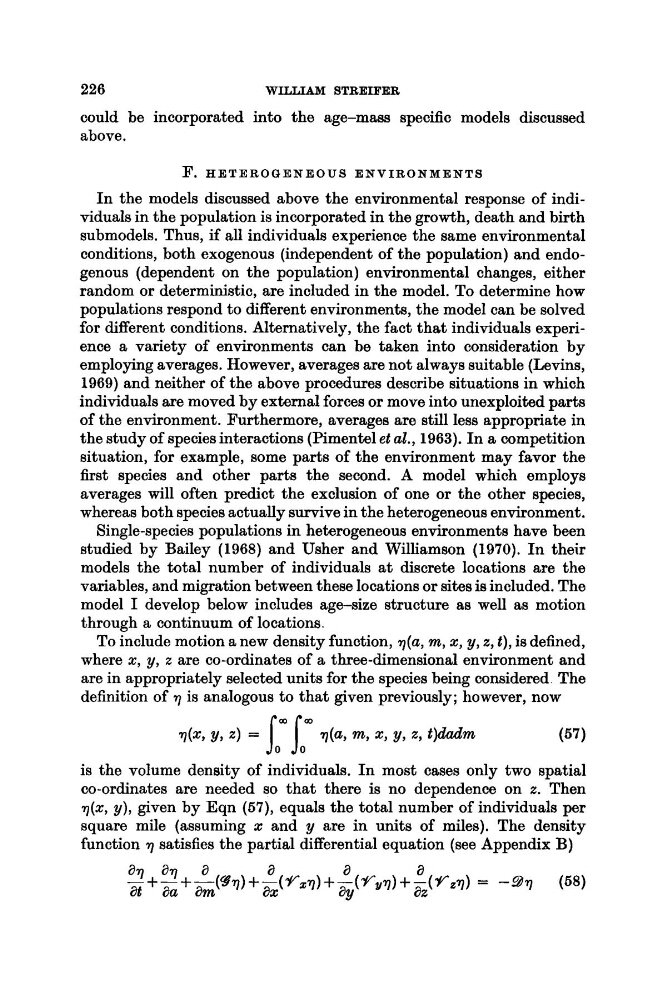
To include motion a new density function, ~ ( a ,
m, x, y, z, t), is defined,
where x, y, x are co-ordinates of a three-dimensional environment and
are in appropriately selected units for the species being considered The
definition of 7 is analogous to that given previously; however, now
7 ( x , Y, 2) = J; J; .I@, m, 2, y, 2, t)dadm
(57)
is the volume density of individuals. I n most cases only two spatial
co-ordinates are needed so that there is no dependence on z. Then
~ ( x ,
y), given by Eqn (67), equals the total number of individuals per
square mile (assuming x and y are in units of miles). The density
function r) satisfies the partial differential equation (see Appendix B)
WILLIAM STREIFER
could be incorporated into the age-mass specifk models discussed
above.
E’. H E T E R O G E N E O U S E N V I R O N M E N T S
In the models discussed above the environmental response of individuals in the population is incorporated in the growth, death and birth
submodels. Thus, if all individuals experience the same environmental
conditions, both exogenous (independent of the population) and endogenous (dependent on the population) environmental changes, either
random or deterministic, are included in the model. To determine how
populations respond to different environments, the model can be solved
for different conditions. Alternatively, the fact that individuals experience a variety of environments can be taken into consideration by
employing averages. However, averages are not always suitable (Levins,
1969) and neither of the above procedures describe situations in which
individuals are moved by external forces or move into unexploited parts
of the environment. Furthermore, averages are still less appropriate in
the study of species interactions (Pimentel et ul., 1963). In a competition
situation, for example, some parts of the environment may favor the
first species and other parts the second. A model which employs
averages will often predict the exclusion of one or the other species,
whereas both species actually survive in the heterogeneous environment.
Single-species populations in heterogeneous environments have been
studied by Bailey (1968) and Usher and Williamson (1970). I n their
models the total number of individuals at discrete locations are the
variables, and migration between these locations or sites is included. The
model I develop below includes age-size structure as well as motion
through a continuum of locations.
To include motion a new density function, ~ ( a ,
m, x, y, z, t), is defined,
where x, y, x are co-ordinates of a three-dimensional environment and
are in appropriately selected units for the species being considered The
definition of 7 is analogous to that given previously; however, now
7 ( x , Y, 2) = J; J; .I@, m, 2, y, 2, t)dadm
(57)
is the volume density of individuals. I n most cases only two spatial
co-ordinates are needed so that there is no dependence on z. Then
~ ( x ,
y), given by Eqn (67), equals the total number of individuals per
square mile (assuming x and y are in units of miles). The density
function r) satisfies the partial differential equation (see Appendix B)