

228
WILLIAM STREIFER
growth, death and births. These submodels are then altered to allow for
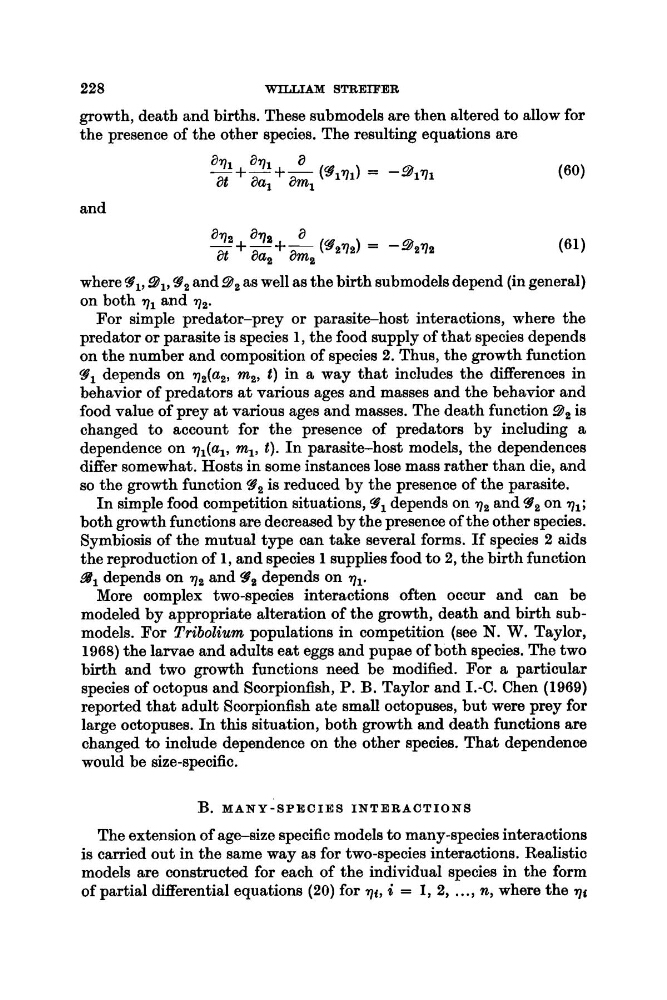
the presence of the other species. The resulting equations are
8% arl,
a
-+-+(Y,r],) = -9,q,
at aa, am,
and
where Y, , 9,, 9, and 9, as well as the birth submodels depend (in general)
on both r], and 7,.
For simple predator-prey or parasite-host interactions, where the
predator or parasite is species 1, the food supply of that species depends
on the number and composition of species 2. Thus, the growth function
9, depends on ~,(a,, m,, t ) in a way that includes the differences in
behavior of predators at various ages and masses and the behavior and
food value of prey at various ages and masses. The death function 9, is
changed to account for the presence of predators by including a
dependence on r],(u,, m,, t ) . I n parasitehost models, the dependences
differ somewhat. Hosts in some instances lose mass rather than die, and
so the growth function Y, is reduced by the presence of the parasite.
In simple food competition situations, Y, depends on r], and S , on vl;
both growth functions are decreased by the presence of the other species.
Symbiosis of the mutual type can take several forms. If species 2 aids
the reproduction of 1, and species 1 supplies food t o 2, the birth function
W, depends on r], and S , depends on 7,.
More complex two-species interactions often occur and can be
modeled by appropriate alteration of the growth, death and birth submodels. For Tribolium populations in competition (see N. W. Taylor,
1968) the larvae and adults eat eggs and pupae of both species. The two
birth and two growth functions need be modified. For a particular
species of octopus and Scorpionfish, P. B. Taylor and I.-C. Chen (1969)
reported that adult Scorpionfish ate small octopuses, but were prey for
large octopuses. In this situation, both growth and death functions are
changed to include dependence on the other species. That dependence
would be size-specific.
B. M A N Y - S P E C I E S INTERACTIONS
The extension of age-size specific models to many-species interactions
is carried out in the same way as for two-species interactions. Realistic
models are constructed for each of the individual species in the form
of partial differential equations (20) for rlf, i = I, 2, . . . , n, where the qf
WILLIAM STREIFER
growth, death and births. These submodels are then altered to allow for
the presence of the other species. The resulting equations are
8% arl,
a
-+-+(Y,r],) = -9,q,
at aa, am,
and
where Y, , 9,, 9, and 9, as well as the birth submodels depend (in general)
on both r], and 7,.
For simple predator-prey or parasite-host interactions, where the
predator or parasite is species 1, the food supply of that species depends
on the number and composition of species 2. Thus, the growth function
9, depends on ~,(a,, m,, t ) in a way that includes the differences in
behavior of predators at various ages and masses and the behavior and
food value of prey at various ages and masses. The death function 9, is
changed to account for the presence of predators by including a
dependence on r],(u,, m,, t ) . I n parasitehost models, the dependences
differ somewhat. Hosts in some instances lose mass rather than die, and
so the growth function Y, is reduced by the presence of the parasite.
In simple food competition situations, Y, depends on r], and S , on vl;
both growth functions are decreased by the presence of the other species.
Symbiosis of the mutual type can take several forms. If species 2 aids
the reproduction of 1, and species 1 supplies food t o 2, the birth function
W, depends on r], and S , depends on 7,.
More complex two-species interactions often occur and can be
modeled by appropriate alteration of the growth, death and birth submodels. For Tribolium populations in competition (see N. W. Taylor,
1968) the larvae and adults eat eggs and pupae of both species. The two
birth and two growth functions need be modified. For a particular
species of octopus and Scorpionfish, P. B. Taylor and I.-C. Chen (1969)
reported that adult Scorpionfish ate small octopuses, but were prey for
large octopuses. In this situation, both growth and death functions are
changed to include dependence on the other species. That dependence
would be size-specific.
B. M A N Y - S P E C I E S INTERACTIONS
The extension of age-size specific models to many-species interactions
is carried out in the same way as for two-species interactions. Realistic
models are constructed for each of the individual species in the form
of partial differential equations (20) for rlf, i = I, 2, . . . , n, where the qf