

REALISTIC MODELS IN POPULATION ECOLOQY
219
fission disappear from the population, an additional “death” term is to
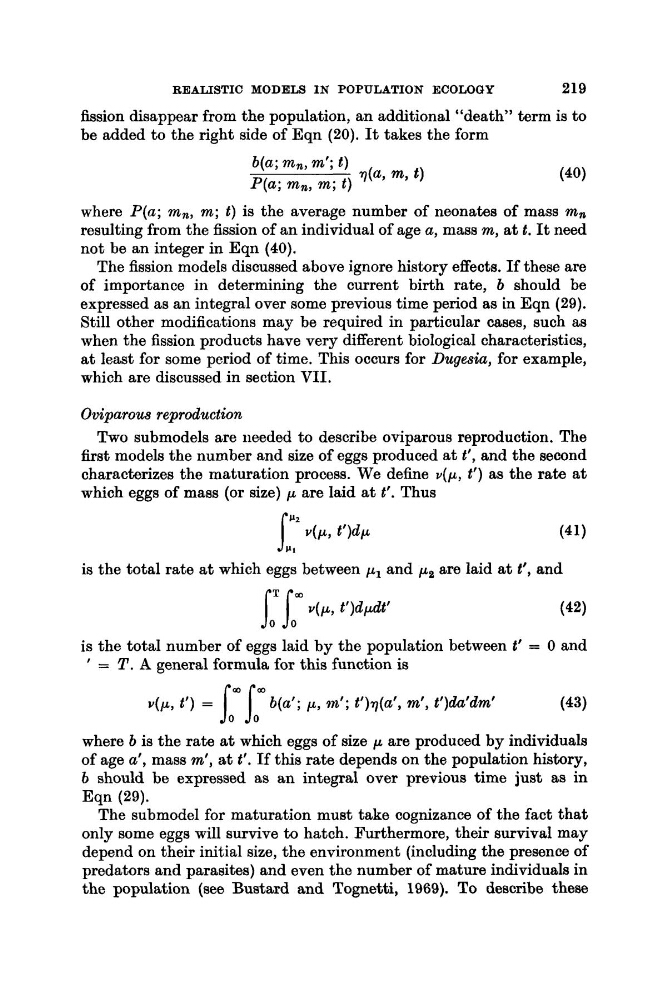
be added to the right side of Eqn (20). It takes the form
where P(a; mn, m; t ) is the average number of neonates of mass mn
resulting from the fission of an individual of age a, mass m, a t t. It need
not be an integer in Eqn (40).
The fission models discussed above ignore history effects. If these are
of importance in determining the current birth rate, b should be
expressed as an integral over some previous time period as in Eqn (29).
Still other modifications may be required in particular cases, such as
when the fission products have very different biological characteristics,
at least for some period of time. This occurs for Dugesia, for example,
which are discussed in section VII.
Oviparous reproduction
Two submodels are needed to describe oviparous reproduction. The
first models the number and size of eggs produced a t t’, and the second
characterizes the maturation process. We define ~ ( p ,
t’) as the rate a t
which eggs of mass (or size) p are laid at t’. Thus
JPI
is the total rate at which eggs between pI and p2 are laid at t‘, and
is the total number of eggs laid by the population between t’ = 0 and
’ = T. A general formula for this function is
v ( p , t’) = 1 : J : b(a’; p, m’; t’)q(a‘, m’, t’)da’dm’ (43)
where b is the rate at which eggs of size p are produced by individuals
of age a’, mass m‘, at t‘. If this rate depends on the population history,
b should be expressed as an integral over previous time just as in
Eqn (29).
The submodel for maturation must take cognizance of the fact that
only some eggs will survive to hatch. Furthermore, their survival may
depend on their initial size, the environment (including the presence of
predators and parasites) and even the number of mature individuals in
the population (see Bustard and Tognetti, 1969). To describe these
219
fission disappear from the population, an additional “death” term is to
be added to the right side of Eqn (20). It takes the form
where P(a; mn, m; t ) is the average number of neonates of mass mn
resulting from the fission of an individual of age a, mass m, a t t. It need
not be an integer in Eqn (40).
The fission models discussed above ignore history effects. If these are
of importance in determining the current birth rate, b should be
expressed as an integral over some previous time period as in Eqn (29).
Still other modifications may be required in particular cases, such as
when the fission products have very different biological characteristics,
at least for some period of time. This occurs for Dugesia, for example,
which are discussed in section VII.
Oviparous reproduction
Two submodels are needed to describe oviparous reproduction. The
first models the number and size of eggs produced a t t’, and the second
characterizes the maturation process. We define ~ ( p ,
t’) as the rate a t
which eggs of mass (or size) p are laid at t’. Thus
JPI
is the total rate at which eggs between pI and p2 are laid at t‘, and
is the total number of eggs laid by the population between t’ = 0 and
’ = T. A general formula for this function is
v ( p , t’) = 1 : J : b(a’; p, m’; t’)q(a‘, m’, t’)da’dm’ (43)
where b is the rate at which eggs of size p are produced by individuals
of age a’, mass m‘, at t‘. If this rate depends on the population history,
b should be expressed as an integral over previous time just as in
Eqn (29).
The submodel for maturation must take cognizance of the fact that
only some eggs will survive to hatch. Furthermore, their survival may
depend on their initial size, the environment (including the presence of
predators and parasites) and even the number of mature individuals in
the population (see Bustard and Tognetti, 1969). To describe these