

218
WILLIAM STREIFER
Fission reproduction
The type of modification described in Eqn ( 3 5 ) also occurs in fission
reproduction. Consider first a population in which the probability of
fission depends only on the age a and mass m of an individual at t and
the two neonates which result are of equal size (see Bell and Anderson,
1967). If the probability of an individual (age a, and mass m at t )
dividing within an incremental time interval dt is b(a, m, t)dt, then
Eqn (20) is to be modified by adding
-b(a, m, + ? ( a ,
m, t )
(36)
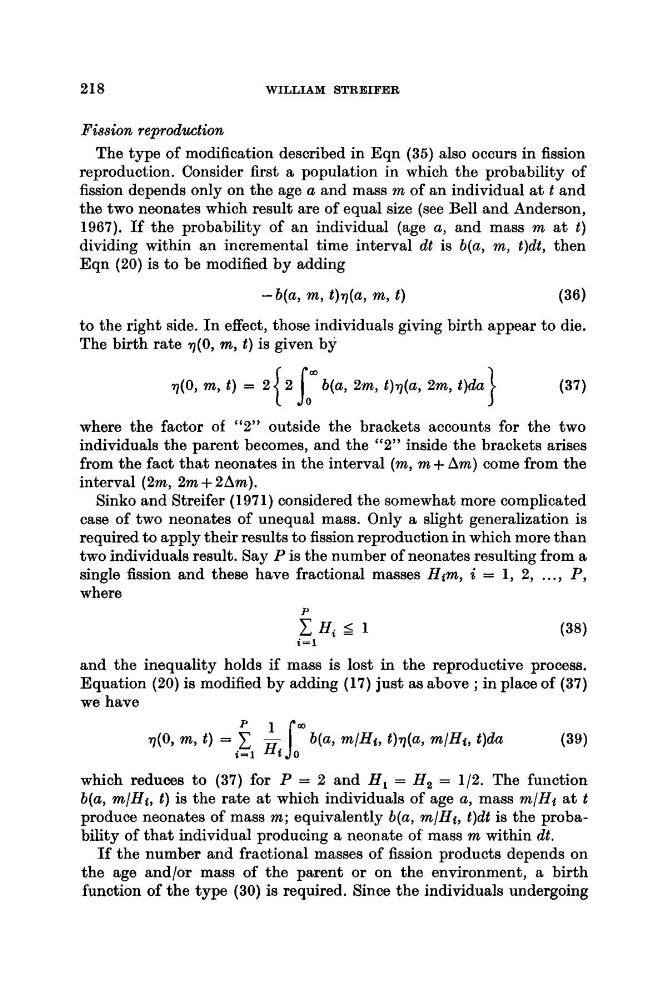
to the right side. In effect, those individuals giving birth appear to die.
The birth rate ~ ( 0 ,
m, t ) is given by
b(a, 2m, t)q(a, 2m, t)da
( 3 7 )
where the factor of “2” outside the brackets accounts for the two
individuals the parent becomes, and the “2” inside the brackets arises
from the fact that neonates in the interval (m, m+ Am) come from the
interval (2m, 2m + 2Am).
Sinko and Streifer (1971) considered the somewhat more complicated
case of two neonates of unequal mass. Only a slight generalization is
required to apply their results to fission reproduction in which more than
two individuals result. Say P is the number of neonates resulting from a
single fission and these have fractional masses Him, i = 1, 2, ..., P,
where
P
C H i 5 1
(38)
i = l
and the inequality holds if mass is lost in the reproductive process.
Equation (20) is modified by adding (17) just as above ; in place of (37)
we have
which reduces to (37) for P = 2 and H , = H, = 1/2. The function
b(a, m / H i , t ) is the rate at which individuals of age a, mass m/Ht at t
produce neonates of mass m; equivalently b(a, m/Hc, t)dt is the probability of that individual producing a neonate of’ mass m within dt.
If the number and fractional masses of fission products depends on
the age and/or mass of the parent or on the environment, a birth
function of the type (30) is required. Since the individuals undergoing
WILLIAM STREIFER
Fission reproduction
The type of modification described in Eqn ( 3 5 ) also occurs in fission
reproduction. Consider first a population in which the probability of
fission depends only on the age a and mass m of an individual at t and
the two neonates which result are of equal size (see Bell and Anderson,
1967). If the probability of an individual (age a, and mass m at t )
dividing within an incremental time interval dt is b(a, m, t)dt, then
Eqn (20) is to be modified by adding
-b(a, m, + ? ( a ,
m, t )
(36)
to the right side. In effect, those individuals giving birth appear to die.
The birth rate ~ ( 0 ,
m, t ) is given by
b(a, 2m, t)q(a, 2m, t)da
( 3 7 )
where the factor of “2” outside the brackets accounts for the two
individuals the parent becomes, and the “2” inside the brackets arises
from the fact that neonates in the interval (m, m+ Am) come from the
interval (2m, 2m + 2Am).
Sinko and Streifer (1971) considered the somewhat more complicated
case of two neonates of unequal mass. Only a slight generalization is
required to apply their results to fission reproduction in which more than
two individuals result. Say P is the number of neonates resulting from a
single fission and these have fractional masses Him, i = 1, 2, ..., P,
where
P
C H i 5 1
(38)
i = l
and the inequality holds if mass is lost in the reproductive process.
Equation (20) is modified by adding (17) just as above ; in place of (37)
we have
which reduces to (37) for P = 2 and H , = H, = 1/2. The function
b(a, m / H i , t ) is the rate at which individuals of age a, mass m/Ht at t
produce neonates of mass m; equivalently b(a, m/Hc, t)dt is the probability of that individual producing a neonate of’ mass m within dt.
If the number and fractional masses of fission products depends on
the age and/or mass of the parent or on the environment, a birth
function of the type (30) is required. Since the individuals undergoing