

REALISTIC MODELS IN POPULBTION ECOLOGY
217
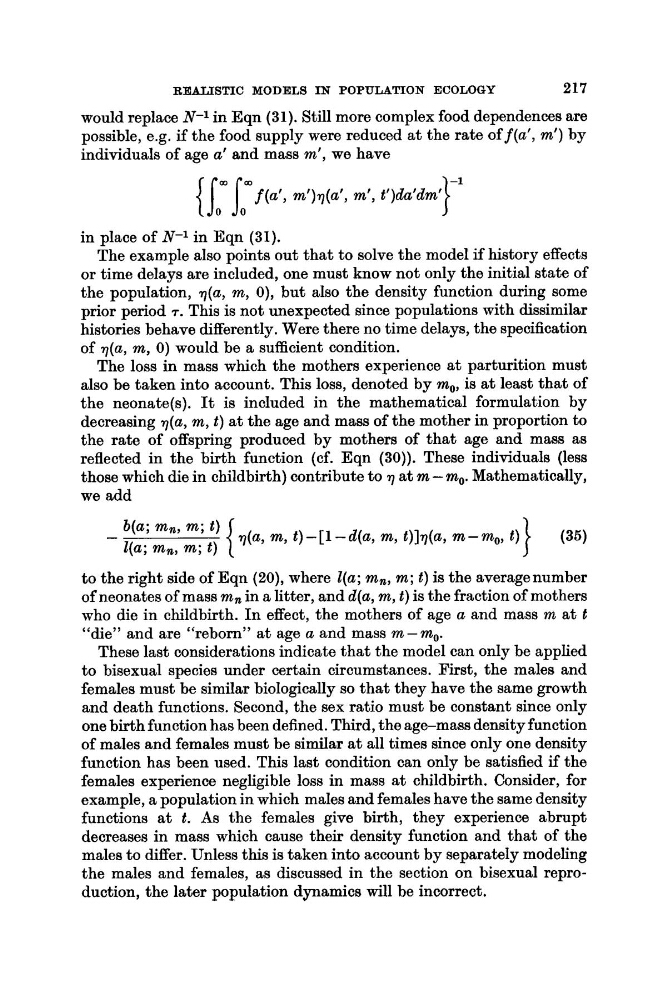
would replace N-1 in Eqn (31). Still more complex food dependences are
possible, e.g. if the food supply were reduced a t the rate of f(a’, m’) by
individuals of age a’ and mass m’, we have
in place of N-l in Eqn (31).
The example also points out that to solve the model if history effects
or time delays are included, one must know not only the initial state of
the population, q(a, m, 0 ) , but also the density function during some
prior period T . This is not unexpected since populations with dissimilar
histories behave differently. Were there no time delays, the specification
of $a, m, 0) would be a sufficient condition.
The loss in mass which the mothers experience at parturition must
also be taken into account. This loss, denoted by m,, is at least that of
the neonate(s). It is included in the mathematical formulation by
decreasing r)(a, m, t ) at the age and mass of the mother in proportion to
the rate of offspring produced by mothers of that age and mass as
reflected in the birth function (cf. Eqn (30)). These individuals (less
those which die in childbirth) contribute to r) at m - m,. Mathematically,
we add
to the right side of Eqn (20), where Z(a; m,, m; t ) is the averagenumber
of neonates of mass m, in a litter, and d(a, m, t ) is the fraction of mothers
who die in childbirth. In effect, the mothers of age a and mass m a t t
“die” and are “reborn” at age a and mass m - m,.
These last considerations indicate that the model can only be applied
to bisexual species under certain circumstances. First, the males and
females must be similar biologically so that they have the same growth
and death functions. Second, the sex ratio must be constant since only
one birth function has been defined. Third, the age-mass density function
of males and females must be similar at all times since only one density
function has been used. This last condition can only be satisfied if the
females experience negligible loss in mass at childbirth. Consider, for
example, a population in which males and females have the same density
functions at t. As the females give birth, they experience abrupt
decreases in mass which cause their density function and that of the
males to differ. Unless this is taken into account by separately modeling
the males and females, as discussed in the section on bisexual reproduction, the later population dynamics will be incorrect.
217
would replace N-1 in Eqn (31). Still more complex food dependences are
possible, e.g. if the food supply were reduced a t the rate of f(a’, m’) by
individuals of age a’ and mass m’, we have
in place of N-l in Eqn (31).
The example also points out that to solve the model if history effects
or time delays are included, one must know not only the initial state of
the population, q(a, m, 0 ) , but also the density function during some
prior period T . This is not unexpected since populations with dissimilar
histories behave differently. Were there no time delays, the specification
of $a, m, 0) would be a sufficient condition.
The loss in mass which the mothers experience at parturition must
also be taken into account. This loss, denoted by m,, is at least that of
the neonate(s). It is included in the mathematical formulation by
decreasing r)(a, m, t ) at the age and mass of the mother in proportion to
the rate of offspring produced by mothers of that age and mass as
reflected in the birth function (cf. Eqn (30)). These individuals (less
those which die in childbirth) contribute to r) at m - m,. Mathematically,
we add
to the right side of Eqn (20), where Z(a; m,, m; t ) is the averagenumber
of neonates of mass m, in a litter, and d(a, m, t ) is the fraction of mothers
who die in childbirth. In effect, the mothers of age a and mass m a t t
“die” and are “reborn” at age a and mass m - m,.
These last considerations indicate that the model can only be applied
to bisexual species under certain circumstances. First, the males and
females must be similar biologically so that they have the same growth
and death functions. Second, the sex ratio must be constant since only
one birth function has been defined. Third, the age-mass density function
of males and females must be similar at all times since only one density
function has been used. This last condition can only be satisfied if the
females experience negligible loss in mass at childbirth. Consider, for
example, a population in which males and females have the same density
functions at t. As the females give birth, they experience abrupt
decreases in mass which cause their density function and that of the
males to differ. Unless this is taken into account by separately modeling
the males and females, as discussed in the section on bisexual reproduction, the later population dynamics will be incorrect.