

220
WILLIAM STREIFER
phenomena, we defhe a hatching function X ( p ; m; t', t ; p ) which
specifies the rate at which eggs of mass p, laid at t', produce neonates of
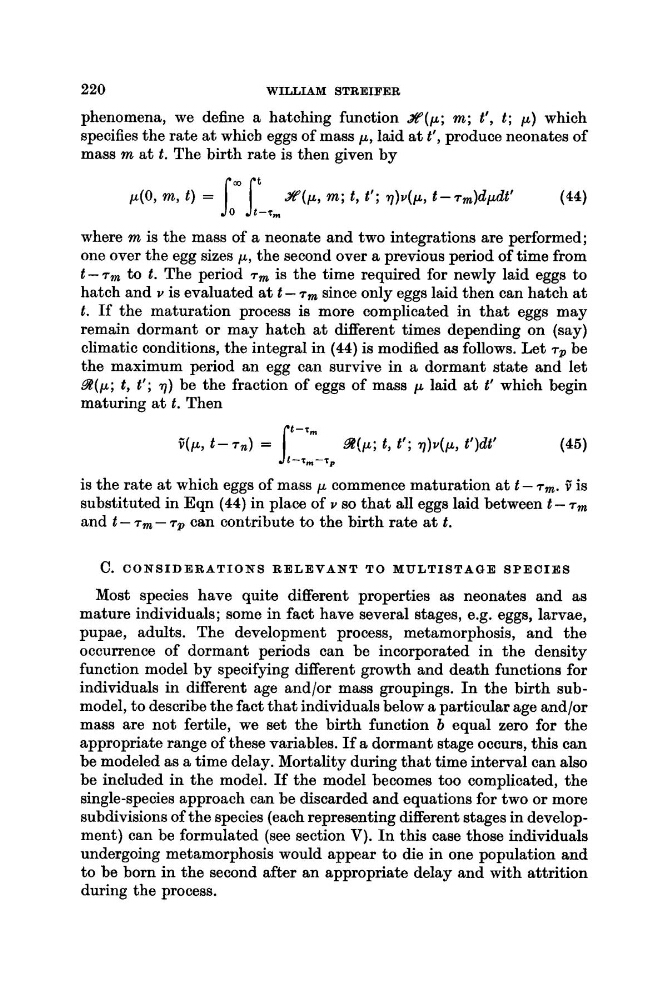
mass m at t. The birth rate is then given by
where rn is the mass of a neonate and two integrations are performed;
one over the egg sizes p, the second over a previous period of time from
t - Tm to t . The period r m is the time required for newly laid eggs to
hatch and v is evaluated at t - since only eggs laid then can hatch a t
t. If the maturation process is more complicated in that eggs may
remain dormant or may hatch at different times depending on (say)
climatic conditions, the integral in (44) is modified as follows. Let rp be
the maximum period an egg can survive in a dormant state and let
9 ( p ; t, t'; q ) be the fraction of eggs of mass p laid at t' which begin
maturing at t . Then
9qp; t, t'; r])v(p, t')dt'
(45)
L:-Tp
q p , t-712) =
is the rate at which eggs of mass p commence maturation at t - rm. v" is
substituted in Eqn (44) in place of v so that all eggs laid between t - 7 m
and t - Tm - r p can contribute to the birth rate at t .
c. C O N S I D E R A T I O N S R E L E V A N T TO M U L T I S T A G E S P E C I E S
Most species have quite different properties as neonates and as
mature individuals; some in fact have several stages, e.g. eggs, larvae,
pupae, adults. The development process, metamorphosis, and the
occurrence of dormant periods can be incorporated in the density
function model by specifying different growth and death functions for
individuals in different age and/or mass groupings. In the birth submodel, to describe the fact that individuals below a particular age and/or
mass are not fertile, we set the birth function b equal zero for the
appropriate range of these variables. If a dormant stage occurs, this can
be modeled as a time delay. Mortality during that time interval can also
be included in the model. If the model becomes too complicated, the
single-species approach can be discarded and equations for two or more
subdivisions of the species (each representing different stages in development) can be formulated (see section V). In this case those individuals
undergoing metamorphosis would appear to die in one population and
to be born in the second after an appropriate delay and with attrition
during the process.
WILLIAM STREIFER
phenomena, we defhe a hatching function X ( p ; m; t', t ; p ) which
specifies the rate at which eggs of mass p, laid at t', produce neonates of
mass m at t. The birth rate is then given by
where rn is the mass of a neonate and two integrations are performed;
one over the egg sizes p, the second over a previous period of time from
t - Tm to t . The period r m is the time required for newly laid eggs to
hatch and v is evaluated at t - since only eggs laid then can hatch a t
t. If the maturation process is more complicated in that eggs may
remain dormant or may hatch at different times depending on (say)
climatic conditions, the integral in (44) is modified as follows. Let rp be
the maximum period an egg can survive in a dormant state and let
9 ( p ; t, t'; q ) be the fraction of eggs of mass p laid at t' which begin
maturing at t . Then
9qp; t, t'; r])v(p, t')dt'
(45)
L:-Tp
q p , t-712) =
is the rate at which eggs of mass p commence maturation at t - rm. v" is
substituted in Eqn (44) in place of v so that all eggs laid between t - 7 m
and t - Tm - r p can contribute to the birth rate at t .
c. C O N S I D E R A T I O N S R E L E V A N T TO M U L T I S T A G E S P E C I E S
Most species have quite different properties as neonates and as
mature individuals; some in fact have several stages, e.g. eggs, larvae,
pupae, adults. The development process, metamorphosis, and the
occurrence of dormant periods can be incorporated in the density
function model by specifying different growth and death functions for
individuals in different age and/or mass groupings. In the birth submodel, to describe the fact that individuals below a particular age and/or
mass are not fertile, we set the birth function b equal zero for the
appropriate range of these variables. If a dormant stage occurs, this can
be modeled as a time delay. Mortality during that time interval can also
be included in the model. If the model becomes too complicated, the
single-species approach can be discarded and equations for two or more
subdivisions of the species (each representing different stages in development) can be formulated (see section V). In this case those individuals
undergoing metamorphosis would appear to die in one population and
to be born in the second after an appropriate delay and with attrition
during the process.