

2 14
WILLIAM STREIFER
population are assumed specified by b(a’; m, m‘; t ) . Thus, the neonates
produced by females of age a‘ and mass m’ are given by the product
b(a’; m, m’; t)q(a’, m’, t )
However, since individuals of different a’, m’ could give birth to similar
neonates, we must write
~ ( 0 ,
m, t ) = l : l : b(a’; m, m’; t)v(a’, m‘, t)cZu’dm’ (30)
If am and a, were respectively the minimum and maximum ages and mm
were the minimum mass at which reproduction occurred, the function b
would be zero for a’a, and r n k m , . Such limitations are
conveniently expressed by changing the integration limits in Eqn (30).
Furthermore, since individuals of age zero never produce neonates,
q(0, m, t ) need not be known to evaluate the right side of Eqn (30).
Since the birth model described above is rather complicated, it is by
no means clear at this point how one would formulate W. We defer
further discussion to consider a biologically reasonable, but somewhat
simplified example. The following assumptions are made :
(1) Only individuals between am and a, are fertile, W # 0 only for
(2) Only individuals with m’ > mm are fertile, W = 0 for m’ < m,.
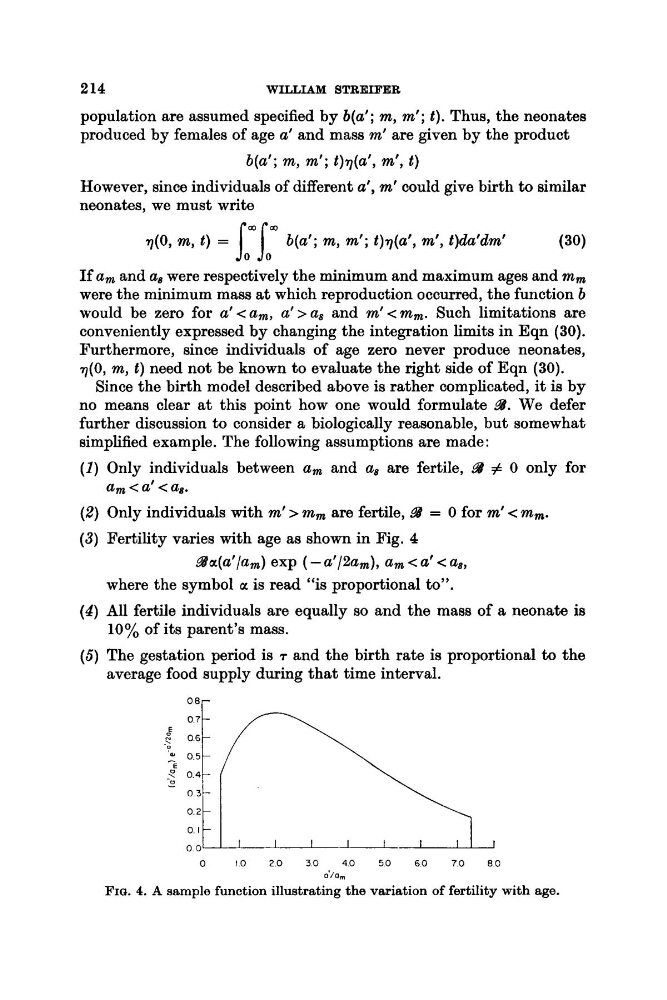
(3) Fertility varies with age as shown in Fig. 4
am < a’ < a,.
Wa(a’/am) exp ( - a‘/2am), a m < a’ < a,,
where the symbol u is read “is proportional to”.
10% of its parent’s mass.
average food supply during that time interval.
( 4 ) All fertile individuals are equally so and the mass of a neonate is
( 5 ) The gestation period is T and the birth rate is proportional to the
O a r
0
10
2 0
3 0
4 0
5 0
6 0
7 0
8 0
d/Om
FIU. 4. A sample function illustrating the variation of fertility with age.
WILLIAM STREIFER
population are assumed specified by b(a’; m, m‘; t ) . Thus, the neonates
produced by females of age a‘ and mass m’ are given by the product
b(a’; m, m’; t)q(a’, m’, t )
However, since individuals of different a’, m’ could give birth to similar
neonates, we must write
~ ( 0 ,
m, t ) = l : l : b(a’; m, m’; t)v(a’, m‘, t)cZu’dm’ (30)
If am and a, were respectively the minimum and maximum ages and mm
were the minimum mass at which reproduction occurred, the function b
would be zero for a’
conveniently expressed by changing the integration limits in Eqn (30).
Furthermore, since individuals of age zero never produce neonates,
q(0, m, t ) need not be known to evaluate the right side of Eqn (30).
Since the birth model described above is rather complicated, it is by
no means clear at this point how one would formulate W. We defer
further discussion to consider a biologically reasonable, but somewhat
simplified example. The following assumptions are made :
(1) Only individuals between am and a, are fertile, W # 0 only for
(2) Only individuals with m’ > mm are fertile, W = 0 for m’ < m,.
(3) Fertility varies with age as shown in Fig. 4
am < a’ < a,.
Wa(a’/am) exp ( - a‘/2am), a m < a’ < a,,
where the symbol u is read “is proportional to”.
10% of its parent’s mass.
average food supply during that time interval.
( 4 ) All fertile individuals are equally so and the mass of a neonate is
( 5 ) The gestation period is T and the birth rate is proportional to the
O a r
0
10
2 0
3 0
4 0
5 0
6 0
7 0
8 0
d/Om
FIU. 4. A sample function illustrating the variation of fertility with age.