

REALISTIC MODELS IN POPULATION ECOLOUY
213
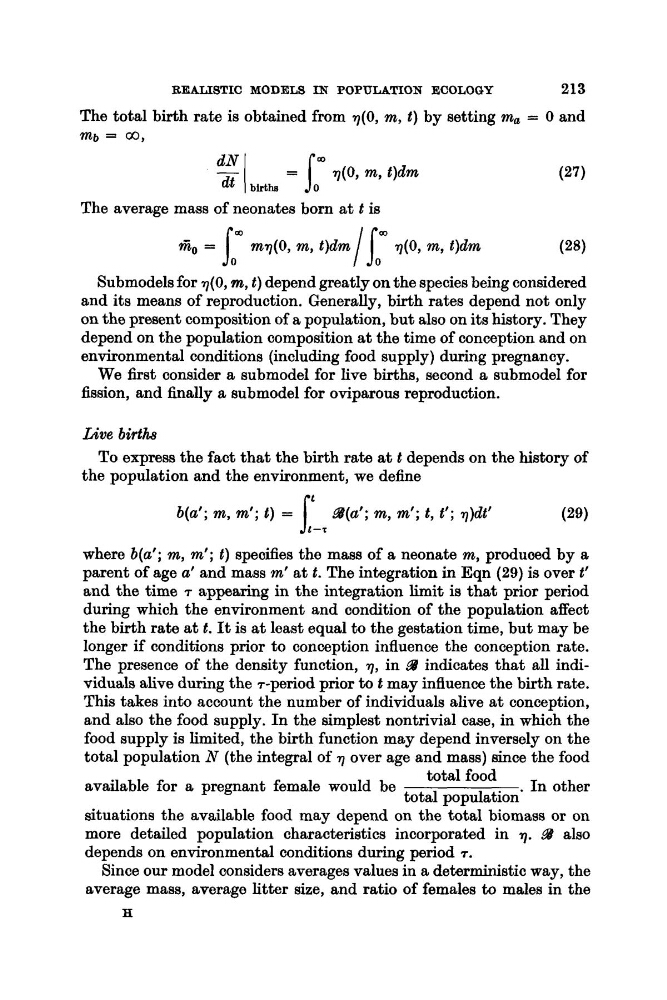
The total birth rate is obtained from q(0, m, t ) by setting ma = 0 and
mb = 00,
The average mass of neonates born at t is
Submodels for $0, m, t) depend greatly on the species being considered
and its means of reproduction. Generally, birth rates depend not only
on the present composition of a population, but also on its history. They
depend on the population composition at the time of conception and on
environmental conditions (including food supply) during pregnancy.
We first consider a submodel for live births, second a submodel for
fission, and finally a submodel for oviparous reproduction.
Live births
the population and the environment, we define
To express the fact that the birth rate at t depends on the history of
t
b(a‘; my m’; t ) =
W(a’; m, m‘; t, t’; q)dt’
(29)
where b(a’; m, m‘; t) specifies the mass of a neonate my produced by a
parent of age a’ and mass m’ at t. The integration in Eqn (29) is over t’
and the time T appearing in the integration limit is that prior period
during which the environment and condition of the population affect
the birth rate at t. It is at least equal to the gestation time, but may be
longer if conditions prior to conception influence the conception rate.
The presence of the density function, q, in W indicates that all individuals alive during the T-period prior to t may influence the birth rate.
This takes into account the number of individuals alive at conception,
and also the food supply. In the simplest nontrivial case, in which the
food supply is limited, the birth function may depend inversely on the
total population N (the integral of 7 over age and mass) since the food
available for a pregnant female would be
. In other
situations the available food may depend on the total biomass or on
more detailed population characteristics incorporated in q. W also
depends on environmental conditions during period T .
Since our model considers averages values in a deterministic way, the
average mass, average litter size, and ratio of females to males in the
LT
total food
total population
H
213
The total birth rate is obtained from q(0, m, t ) by setting ma = 0 and
mb = 00,
The average mass of neonates born at t is
Submodels for $0, m, t) depend greatly on the species being considered
and its means of reproduction. Generally, birth rates depend not only
on the present composition of a population, but also on its history. They
depend on the population composition at the time of conception and on
environmental conditions (including food supply) during pregnancy.
We first consider a submodel for live births, second a submodel for
fission, and finally a submodel for oviparous reproduction.
Live births
the population and the environment, we define
To express the fact that the birth rate at t depends on the history of
t
b(a‘; my m’; t ) =
W(a’; m, m‘; t, t’; q)dt’
(29)
where b(a’; m, m‘; t) specifies the mass of a neonate my produced by a
parent of age a’ and mass m’ at t. The integration in Eqn (29) is over t’
and the time T appearing in the integration limit is that prior period
during which the environment and condition of the population affect
the birth rate at t. It is at least equal to the gestation time, but may be
longer if conditions prior to conception influence the conception rate.
The presence of the density function, q, in W indicates that all individuals alive during the T-period prior to t may influence the birth rate.
This takes into account the number of individuals alive at conception,
and also the food supply. In the simplest nontrivial case, in which the
food supply is limited, the birth function may depend inversely on the
total population N (the integral of 7 over age and mass) since the food
available for a pregnant female would be
. In other
situations the available food may depend on the total biomass or on
more detailed population characteristics incorporated in q. W also
depends on environmental conditions during period T .
Since our model considers averages values in a deterministic way, the
average mass, average litter size, and ratio of females to males in the
LT
total food
total population
H