

212
WILLIAM STREIFER
species in which there are many large, mature individuals in the population as described by r ] ( ~ , m, t ) , the death rate of small, immature
animals would increase. The growth function should be correspondingly
modified in its dependence on r] to express the fact that the small
individuals provide food for the larger individuals. More complicated
cannibalistic phenomena, such as described by Lloyd et ul. (1968), can
also be modeled.
Both the growth and death submodels described above are functions
which depend only on the environment, food supply and density function
a t time t ; there is no provision for dependence on previous environmental conditions or the individuals' history. This appears to be a good
approximation a t least in some cases (see Frank, 1960) so long as there
are no very abrupt changes in the environment. If an individual's
history as well as its present age and mass are of importance in determining its growth and death rates, then the growth and death submodels
must take on more complicated forms similar to the birth submodel
discussed below.
Before discussing the submodel for birth rate and extensions of the
age-mass specific model, it is interesting to compare the complexity of
this model with those prevalent in physics. The belief is commonly
expressed that physical models are elegant and general. This is true to
some extent, but many of the equations of physics are substantially
more complex than Eqn (20) for the density function, Maxwell's electromagnetic field equations, for example. Furthermore, the application of
Maxwell's equations to wave propagation in various media involves
specialized complicated descriptions of the media, often with nonlinearities and time delays. Some of these types of problems have only
been solved numerically with the aid of large-scale digital computers
and many defy solution even today. I should add that it is still too early
to know the degree of complexity or the types of models which will
eventually be employed to study complicated ecological systems.
3. Birth submodel
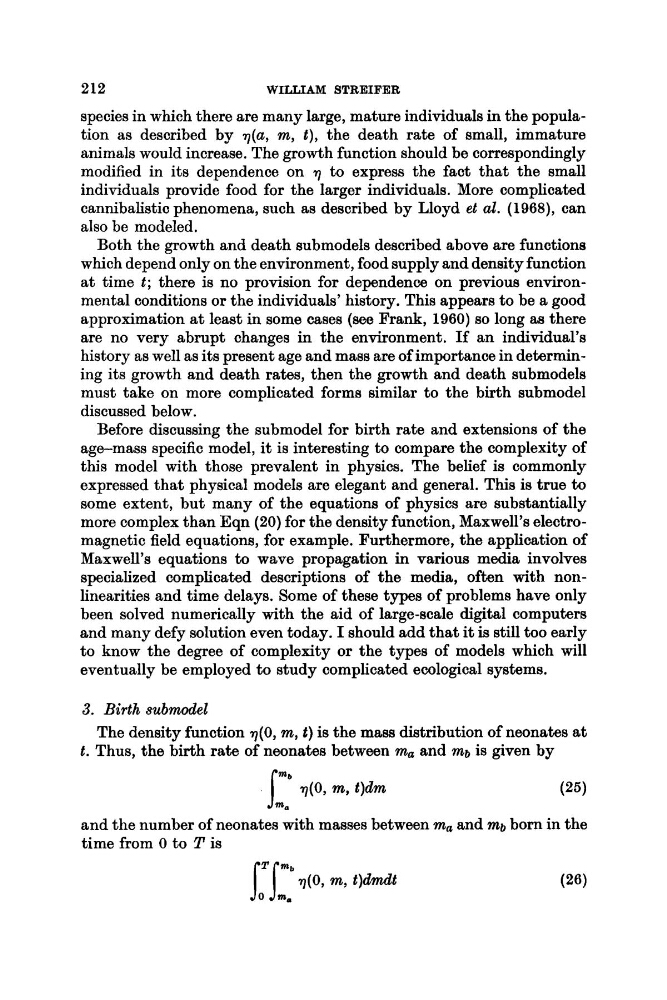
t . Thus, the birth rate of neonates between ma and mb is given by
The density function q(0, m, t ) is the mass distribution of neonates at
and the number of neonates with masses between ma and mb born in the
time from 0 to T is
J O Jm,
WILLIAM STREIFER
species in which there are many large, mature individuals in the population as described by r ] ( ~ , m, t ) , the death rate of small, immature
animals would increase. The growth function should be correspondingly
modified in its dependence on r] to express the fact that the small
individuals provide food for the larger individuals. More complicated
cannibalistic phenomena, such as described by Lloyd et ul. (1968), can
also be modeled.
Both the growth and death submodels described above are functions
which depend only on the environment, food supply and density function
a t time t ; there is no provision for dependence on previous environmental conditions or the individuals' history. This appears to be a good
approximation a t least in some cases (see Frank, 1960) so long as there
are no very abrupt changes in the environment. If an individual's
history as well as its present age and mass are of importance in determining its growth and death rates, then the growth and death submodels
must take on more complicated forms similar to the birth submodel
discussed below.
Before discussing the submodel for birth rate and extensions of the
age-mass specific model, it is interesting to compare the complexity of
this model with those prevalent in physics. The belief is commonly
expressed that physical models are elegant and general. This is true to
some extent, but many of the equations of physics are substantially
more complex than Eqn (20) for the density function, Maxwell's electromagnetic field equations, for example. Furthermore, the application of
Maxwell's equations to wave propagation in various media involves
specialized complicated descriptions of the media, often with nonlinearities and time delays. Some of these types of problems have only
been solved numerically with the aid of large-scale digital computers
and many defy solution even today. I should add that it is still too early
to know the degree of complexity or the types of models which will
eventually be employed to study complicated ecological systems.
3. Birth submodel
t . Thus, the birth rate of neonates between ma and mb is given by
The density function q(0, m, t ) is the mass distribution of neonates at
and the number of neonates with masses between ma and mb born in the
time from 0 to T is
J O Jm,