

REALISTIC MODELS IN POPULATION ECOLOGY
21 1
exogenous part, which is independent of the population, and an endogenous part, which depends on the population. Climatic conditions are
exogenous variables and food supply per individual is usually endogenous. If the population conditions the environment, that conditioning
is endogenous. A more complex situation arises in modeling a single
prey species when one wishes to include the effects of predators, but
does not wish to study the predator population dynamics in detail. In
this case the number of predators is an environmental variable. That
variable is considered exogenous if the number of predators is independent of the prey population under consideration (perhaps because an
abundance of other prey species is available). However, the number of
predators is an endogenous variable if it is in part determined by the
particular prey species being modeled. If the predator population is
strongly dependent on the presence of the prey species, it is imperative
to employ a two-species interaction model. Environmental effects can
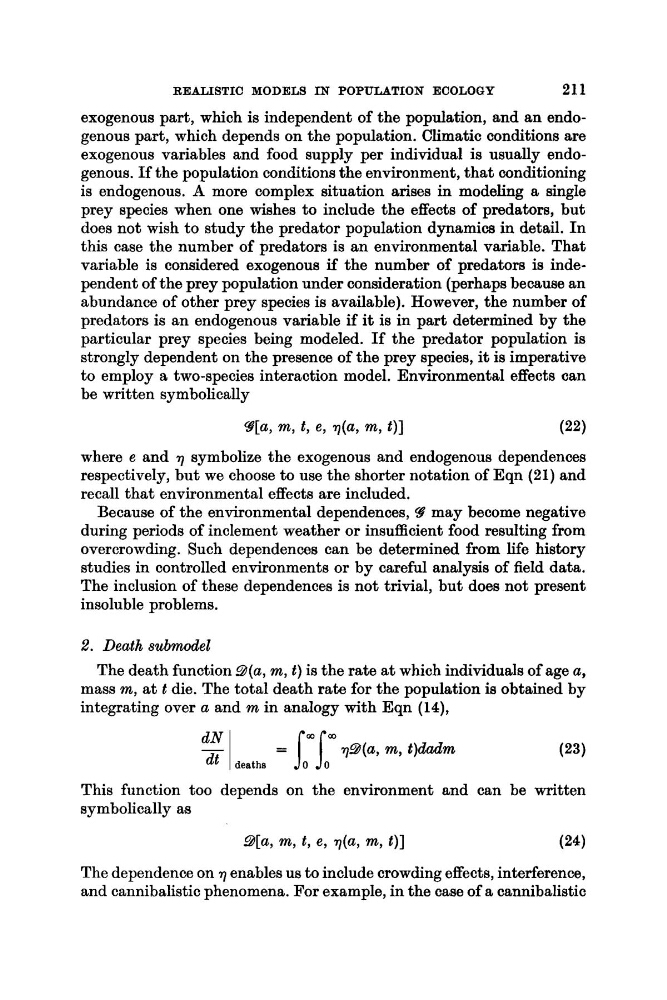
be written symbolically
(22)
3[a, m, t, e, .I(& m, t)l
where e and r ) symbolize the exogenous and endogenous dependences
respectively, but we choose to use the shorter notation of Eqn (21) and
recall that environmental effects are included.
Because of the environmental dependences, 9 may become negative
during periods of inclement weather or insufficient food resulting from
overcrowding. Such dependences can be determined from life history
studies in controlled environments or by careful analysis of field data.
The inclusion of these dependences is not trivial, but does not present
insoluble problems.
2. Death submodel
The death function 9 ( a , m, t ) is the rate at which individuals of age a,
mass m, at t die. The total death rate for the population is obtained by
integrating over a and m in analogy with Eqn (14),
This function too depends on the environment and can be written
symbolically as
9 [ a , m, t, e, r)@, m, t)l
(24)
The dependence on r ) enables us to include crowding effects, interference,
and cannibalistic phenomena. For example, in the case of a cannibalistic
21 1
exogenous part, which is independent of the population, and an endogenous part, which depends on the population. Climatic conditions are
exogenous variables and food supply per individual is usually endogenous. If the population conditions the environment, that conditioning
is endogenous. A more complex situation arises in modeling a single
prey species when one wishes to include the effects of predators, but
does not wish to study the predator population dynamics in detail. In
this case the number of predators is an environmental variable. That
variable is considered exogenous if the number of predators is independent of the prey population under consideration (perhaps because an
abundance of other prey species is available). However, the number of
predators is an endogenous variable if it is in part determined by the
particular prey species being modeled. If the predator population is
strongly dependent on the presence of the prey species, it is imperative
to employ a two-species interaction model. Environmental effects can
be written symbolically
(22)
3[a, m, t, e, .I(& m, t)l
where e and r ) symbolize the exogenous and endogenous dependences
respectively, but we choose to use the shorter notation of Eqn (21) and
recall that environmental effects are included.
Because of the environmental dependences, 9 may become negative
during periods of inclement weather or insufficient food resulting from
overcrowding. Such dependences can be determined from life history
studies in controlled environments or by careful analysis of field data.
The inclusion of these dependences is not trivial, but does not present
insoluble problems.
2. Death submodel
The death function 9 ( a , m, t ) is the rate at which individuals of age a,
mass m, at t die. The total death rate for the population is obtained by
integrating over a and m in analogy with Eqn (14),
This function too depends on the environment and can be written
symbolically as
9 [ a , m, t, e, r)@, m, t)l
(24)
The dependence on r ) enables us to include crowding effects, interference,
and cannibalistic phenomena. For example, in the case of a cannibalistic