

210
WILLIAM STREIFER
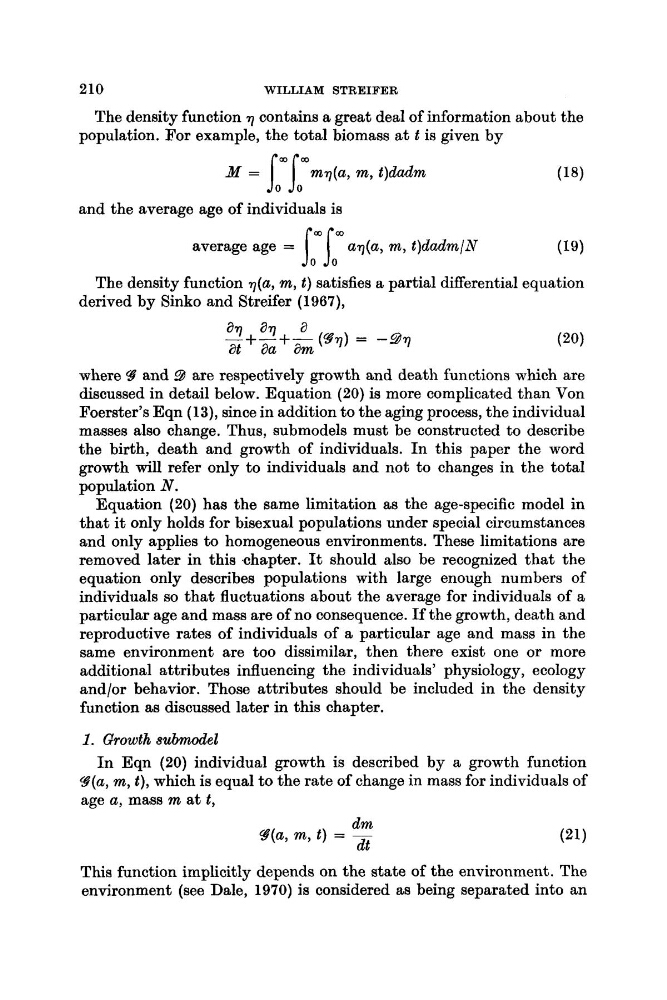
The density function rl contains a great deal of information about the
population. For example, the total biomass at t is given by
M = J
:
J
:
m + ,
m, t ) d d m
and the average age of individuals is
The density function $a, m, t ) satisfies a partial differential equation
derived by Sinko and Streifer (1967),
where B and 9 are respectively growth and death functions which are
discussed in detail below. Equation (20) is more complicated than Von
Foerster’s Eqn (13), since in addition to the aging process, the individual
masses also change. Thus, submodels must be constructed to describe
the birth, death and growth of individuals. In this paper the word
growth w i l l refer only to individuals and not to changes in the total
population N .
Equation (20) has the same limitation as the age-specific model in
that it only holds for bisexual populations under special circumstances
and only applies to homogeneous environments. These limitations are
removed later in this .chapter. It should also be recognized that the
equation only describes populations with large enough numbers of
individuals so that fluctuations about the average for individuals of a
particular age and mass are of no consequence. If the growth, death and
reproductive rates of individuals of a particular age and mass in the
same environment are too dissimilar, then there exist one or more
additional attributes influencing the individuals’ physiology, ecology
and/or behavior. Those attributes should be included in the density
function as discussed later in this chapter.
1. Growth submodel
In Eqn (20) individual growth is described by a growth function
%(a, m, t ) , which is equal to the rate of change in mass for individuals of
age a, mass m at t ,
dm
$(a, m, t ) = -
at
This function implicitly depends on the state of the environment. The
environment (see Dale, 1970) is considered as being separated into an
WILLIAM STREIFER
The density function rl contains a great deal of information about the
population. For example, the total biomass at t is given by
M = J
:
J
:
m + ,
m, t ) d d m
and the average age of individuals is
The density function $a, m, t ) satisfies a partial differential equation
derived by Sinko and Streifer (1967),
where B and 9 are respectively growth and death functions which are
discussed in detail below. Equation (20) is more complicated than Von
Foerster’s Eqn (13), since in addition to the aging process, the individual
masses also change. Thus, submodels must be constructed to describe
the birth, death and growth of individuals. In this paper the word
growth w i l l refer only to individuals and not to changes in the total
population N .
Equation (20) has the same limitation as the age-specific model in
that it only holds for bisexual populations under special circumstances
and only applies to homogeneous environments. These limitations are
removed later in this .chapter. It should also be recognized that the
equation only describes populations with large enough numbers of
individuals so that fluctuations about the average for individuals of a
particular age and mass are of no consequence. If the growth, death and
reproductive rates of individuals of a particular age and mass in the
same environment are too dissimilar, then there exist one or more
additional attributes influencing the individuals’ physiology, ecology
and/or behavior. Those attributes should be included in the density
function as discussed later in this chapter.
1. Growth submodel
In Eqn (20) individual growth is described by a growth function
%(a, m, t ) , which is equal to the rate of change in mass for individuals of
age a, mass m at t ,
dm
$(a, m, t ) = -
at
This function implicitly depends on the state of the environment. The
environment (see Dale, 1970) is considered as being separated into an