

REALISTIC MODELS IN POPULATION ECOLOGY
209
m need not represent mass; it may be any other suitable size attribute
(such as length) of individuals in the population. As in the age-specific
model, this density function is not the density of individuals in a
particular physical area; rather it has the property that the total
number of individuals between ages a, and a, and masses m, and m, at
time t is given by
I = Ja' JT v(a, m, t ) u m
(16)
For a, = 0, a, = 00, I is the total number of individuals whose masses
are between m, and m, at t, regardless of age. Similarly, setting m, = 0
and m, = 00 yields the total number between a, and a, at t . With
a, = 0, a, = co and m, = 0, m, = 00, I = N ( t ) , the total population,
Since there are no very small or very large individuals nor any very old
individuals, q = 0 near m = 0 and q approaches zero as either m or a
approaches maximum biologically attainable values for the species
under consideration. The density function, ~ ( a ,
m, t ) , is the twodimensional analog of the age-specific density function ~ ( a ,
t ) . If we
imagine a plane with axis a and m, then ~ ( a ,
m, t ) , at a particular instant
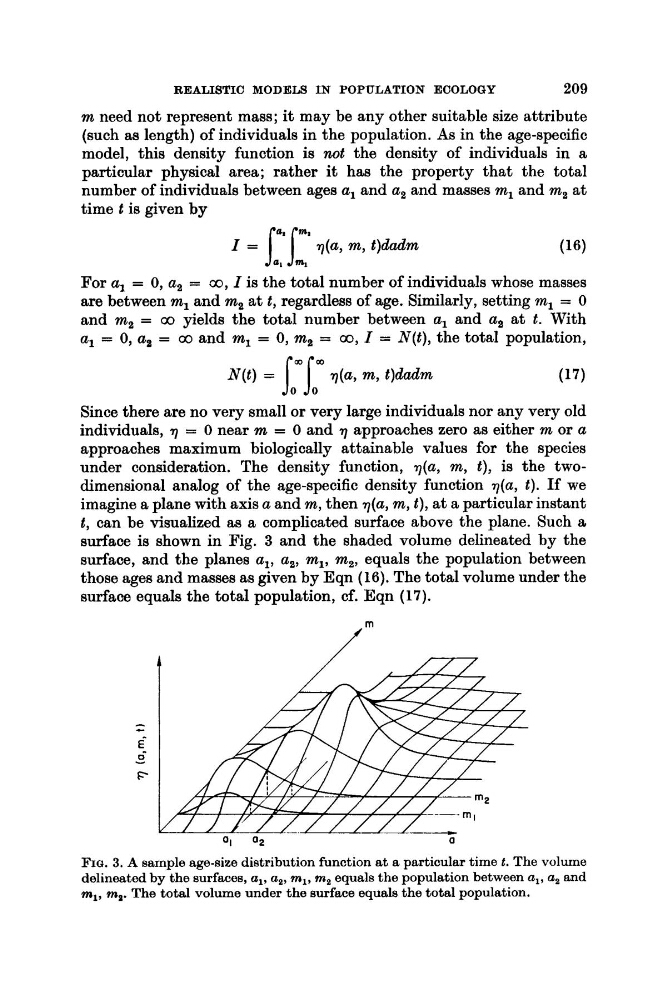
t , can be visualized as a complicated surface above the plane. Such a
surface is shown in Fig. 3 and the shaded volume delineated by the
surface, and the planes a,, a,, m,, m2, equals the population between
those ages and masses as given by Eqn (16). The total volume under the
surface equals the total population, cf. Eqn (17).
- c
E
6
0
-
01
02
0
FIG. 3. A sample age-size distribution function at a particular time t. The volume
delineated by the surfaces, a,, a2, m, , mz equals the population between a,, a2 and
m,, m,. The total volume under the surface equals the total population.
209
m need not represent mass; it may be any other suitable size attribute
(such as length) of individuals in the population. As in the age-specific
model, this density function is not the density of individuals in a
particular physical area; rather it has the property that the total
number of individuals between ages a, and a, and masses m, and m, at
time t is given by
I = Ja' JT v(a, m, t ) u m
(16)
For a, = 0, a, = 00, I is the total number of individuals whose masses
are between m, and m, at t, regardless of age. Similarly, setting m, = 0
and m, = 00 yields the total number between a, and a, at t . With
a, = 0, a, = co and m, = 0, m, = 00, I = N ( t ) , the total population,
Since there are no very small or very large individuals nor any very old
individuals, q = 0 near m = 0 and q approaches zero as either m or a
approaches maximum biologically attainable values for the species
under consideration. The density function, ~ ( a ,
m, t ) , is the twodimensional analog of the age-specific density function ~ ( a ,
t ) . If we
imagine a plane with axis a and m, then ~ ( a ,
m, t ) , at a particular instant
t , can be visualized as a complicated surface above the plane. Such a
surface is shown in Fig. 3 and the shaded volume delineated by the
surface, and the planes a,, a,, m,, m2, equals the population between
those ages and masses as given by Eqn (16). The total volume under the
surface equals the total population, cf. Eqn (17).
- c
E
6
0
-
01
02
0
FIG. 3. A sample age-size distribution function at a particular time t. The volume
delineated by the surfaces, a,, a2, m, , mz equals the population between a,, a2 and
m,, m,. The total volume under the surface equals the total population.