

REALISTIC MODELS IN POPULATION ECOLOGY
215
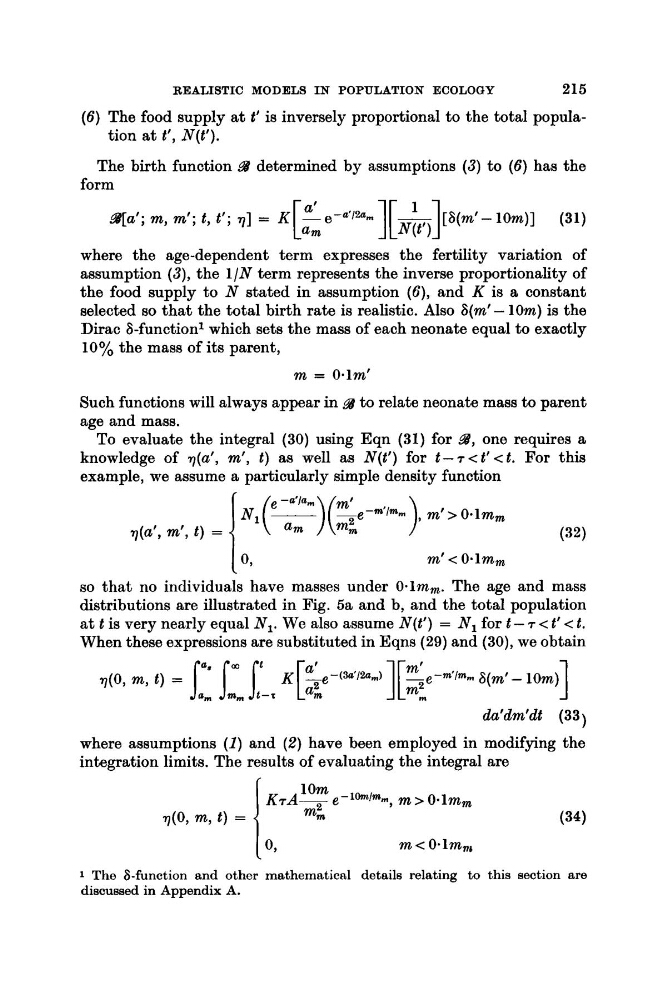
(6) The food supply at t’ is inversely proportional to the total populaThe birth function W determined by assumptions (3) to ( 6 ) has the
tion a t t’, N(t’).
form
where the age-dependent term expresses the fertility variation of
assumption (3), the 1/N term represents the inverse proportionality of
the food supply to N stated in assumption (6), and K is a constant
selected so that the total birth rate is realistic. Also S(m’- 10m) is the
Dirac 6-function1 which sets the mass of each neonate equal to exactly
10% the mass of its parent,
m = 0-lm’
Such functions will always appear in &f to relate neonate mass to parent
age and mass.
To evaluate the integral (30) using Eqn (31) for $9, one requires a
knowledge of ~ ( a ’ ,
m‘, t ) as well as N(t’) for t - ~ < t ’ < t . For this
example, we assume a particularly simple density function
m’< O.lm,
so that no individuals have masses under 0-lm,. The age and mass
distributions are illustrated in Fig. 5a and b, and the total population
at t is very nearly equal N,. We also assume N(t’) = N , for t - T < t’ < t.
When these expressions are substituted in Eqns (29) and (30), we obtain
da’dm’dt ( 3 3 )
where assumptions (1) and (2) have been employed in modifying the
integration limits. The results of evaluating the integral
rn < O.lm,
1 The 6-function and other mathematical details relating to
discussed in Appendix A.
are
(34)
this section are
215
(6) The food supply at t’ is inversely proportional to the total populaThe birth function W determined by assumptions (3) to ( 6 ) has the
tion a t t’, N(t’).
form
where the age-dependent term expresses the fertility variation of
assumption (3), the 1/N term represents the inverse proportionality of
the food supply to N stated in assumption (6), and K is a constant
selected so that the total birth rate is realistic. Also S(m’- 10m) is the
Dirac 6-function1 which sets the mass of each neonate equal to exactly
10% the mass of its parent,
m = 0-lm’
Such functions will always appear in &f to relate neonate mass to parent
age and mass.
To evaluate the integral (30) using Eqn (31) for $9, one requires a
knowledge of ~ ( a ’ ,
m‘, t ) as well as N(t’) for t - ~ < t ’ < t . For this
example, we assume a particularly simple density function
m’< O.lm,
so that no individuals have masses under 0-lm,. The age and mass
distributions are illustrated in Fig. 5a and b, and the total population
at t is very nearly equal N,. We also assume N(t’) = N , for t - T < t’ < t.
When these expressions are substituted in Eqns (29) and (30), we obtain
da’dm’dt ( 3 3 )
where assumptions (1) and (2) have been employed in modifying the
integration limits. The results of evaluating the integral
rn < O.lm,
1 The 6-function and other mathematical details relating to
discussed in Appendix A.
are
(34)
this section are