

STUDIES ON THE CEREAL ECOSYSTEM
137
ficantly larger populations of apterous aphids than those fields with a
high faunal diversity.
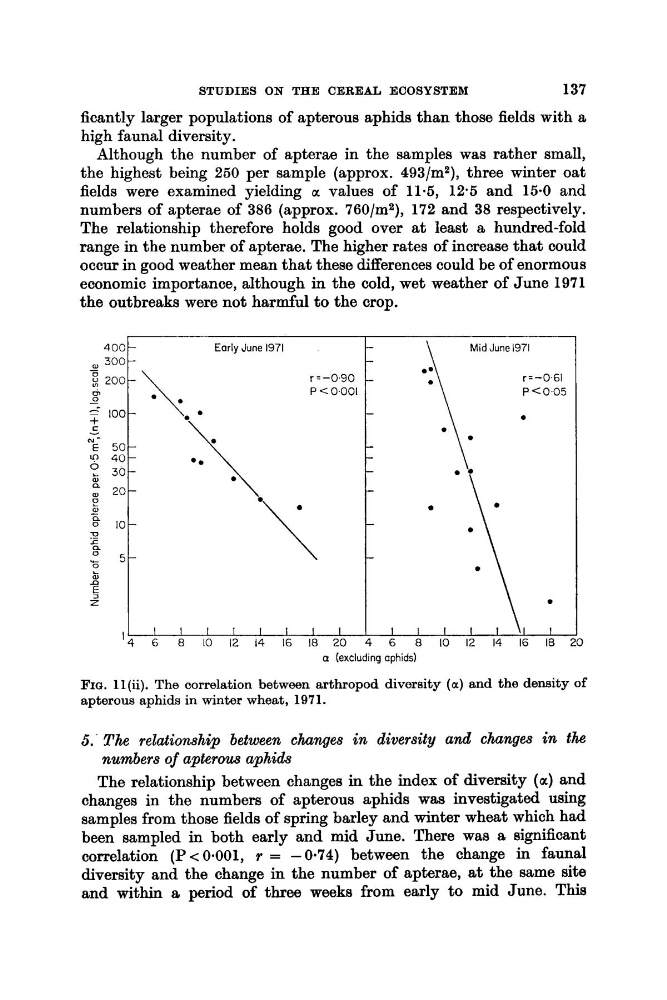
Although the number of apterae in the samples was rather small,
the highest being 250 per sample (approx. 493/m2), three winter oat
fields were examined yielding a values of 11.5, 12.5 and 15.0 and
numbers of apterae of 386 (approx. 760/m2), 172 and 38 respectively.
The relationship therefore holds good over at least a hundred-fold
range in the number of apterae. The higher rates of increase that could
occur in good weather mean that these differences could be of enormous
economic importance, although in the cold, wet weather of June 1971
the outbreaks were not harmful t o the crop.
FIG. ll(ii). The correlation between arthropod diversity (a) and the density of
apterous aphids in winter wheat, 1971.
5.' The relationship between changes in diversity and changes in the
numbers of apterous aphids
The relationship between changes in the index of diversity (a) and
changes in the numbers of apterous aphids wm investigated using
samples from those fields of spring barley and winter wheat which had
been sampled in both early and mid June. There was a significant
correlation (P
and within a period of three weeks from early to mid June. This
137
ficantly larger populations of apterous aphids than those fields with a
high faunal diversity.
Although the number of apterae in the samples was rather small,
the highest being 250 per sample (approx. 493/m2), three winter oat
fields were examined yielding a values of 11.5, 12.5 and 15.0 and
numbers of apterae of 386 (approx. 760/m2), 172 and 38 respectively.
The relationship therefore holds good over at least a hundred-fold
range in the number of apterae. The higher rates of increase that could
occur in good weather mean that these differences could be of enormous
economic importance, although in the cold, wet weather of June 1971
the outbreaks were not harmful t o the crop.
FIG. ll(ii). The correlation between arthropod diversity (a) and the density of
apterous aphids in winter wheat, 1971.
5.' The relationship between changes in diversity and changes in the
numbers of apterous aphids
The relationship between changes in the index of diversity (a) and
changes in the numbers of apterous aphids wm investigated using
samples from those fields of spring barley and winter wheat which had
been sampled in both early and mid June. There was a significant
correlation (P
and within a period of three weeks from early to mid June. This