

136
a. R. POTTS AND a. P. VICKERMAN
of a the more diverse the fauna. The index is only valid when sampling
is random and the distribution of individuals within samples conforms
to the log-normal. These criteria were fulfilled by the present data and
the use of this index enabled a comparison to be made of the diversity
of the fauna of samples taken from different fields of spring barley and
winter wheat. The values of a obtained were then compared with the
number of apterous aphids present in the samples from the respective
300 -
Early June 1971
-
Mid June 1971
-
z
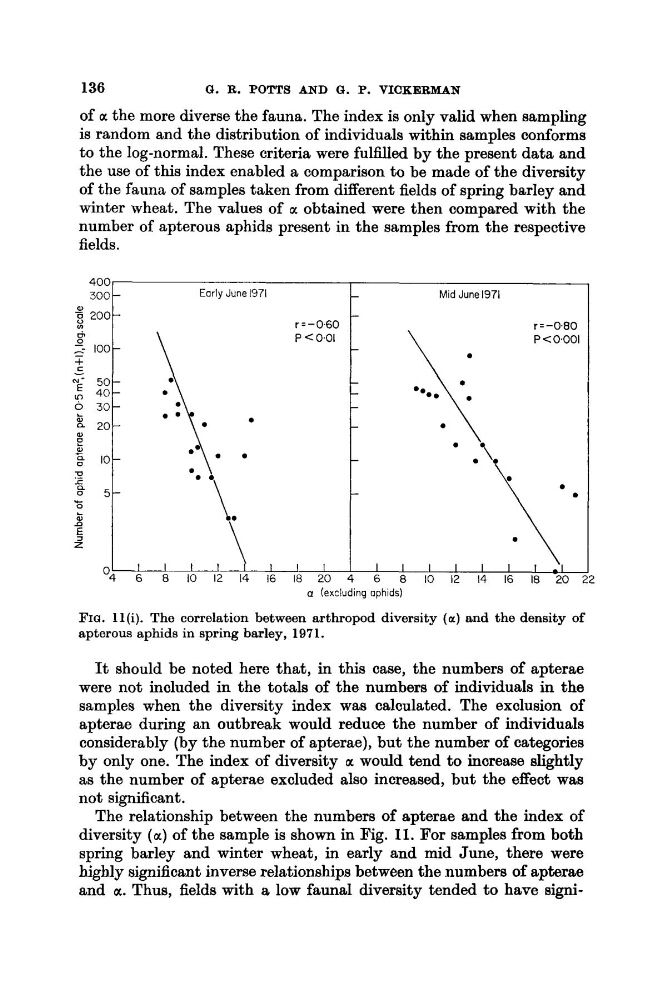
FIa. l l ( i ) . The correlation between arthropod diversity ( x ) and the density of
apterous aphids in spring barley, 1971.
It should be noted here that, in this case, the numbers of apterae
were not included in the totals of the numbers of individuals in the
samples when the diversity index was calculated. The exclusion of
apterae during an outbreak would reduce the number of individuals
considerably (by the number of apterae), but the number of categories
by only one. The index of diversity a would tend t o increase slightly
as the number of apterae excluded also increased, but the effect was
not significant.
The relationship between the numbers of apterae and the index of
diversity (a) of the sample is shown in Fig. 11. For samples from both
spring barley and winter wheat, in early and mid June, there were
highly significant inverse relationships between the numbers of apterae
and a. Thus, fields with a low faunal diversity tended to have signi-
a. R. POTTS AND a. P. VICKERMAN
of a the more diverse the fauna. The index is only valid when sampling
is random and the distribution of individuals within samples conforms
to the log-normal. These criteria were fulfilled by the present data and
the use of this index enabled a comparison to be made of the diversity
of the fauna of samples taken from different fields of spring barley and
winter wheat. The values of a obtained were then compared with the
number of apterous aphids present in the samples from the respective
300 -
Early June 1971
-
Mid June 1971
-
z
FIa. l l ( i ) . The correlation between arthropod diversity ( x ) and the density of
apterous aphids in spring barley, 1971.
It should be noted here that, in this case, the numbers of apterae
were not included in the totals of the numbers of individuals in the
samples when the diversity index was calculated. The exclusion of
apterae during an outbreak would reduce the number of individuals
considerably (by the number of apterae), but the number of categories
by only one. The index of diversity a would tend t o increase slightly
as the number of apterae excluded also increased, but the effect was
not significant.
The relationship between the numbers of apterae and the index of
diversity (a) of the sample is shown in Fig. 11. For samples from both
spring barley and winter wheat, in early and mid June, there were
highly significant inverse relationships between the numbers of apterae
and a. Thus, fields with a low faunal diversity tended to have signi-