

TOWARD UNDERSTANDING ECOSYSTEMS
13
where L(T8) is the latent heat of evaporation 88 a function of the leaf
temperature (about 680 cal gm-’ at 30°C) and ri and r e are the internal
and external diffusion resistnnces along the diffusion pathway. The
term spa(Ta) is the water vapor density of the air at saturation at the
air temperature. Lee and Gates (1964) have discussed this formulation
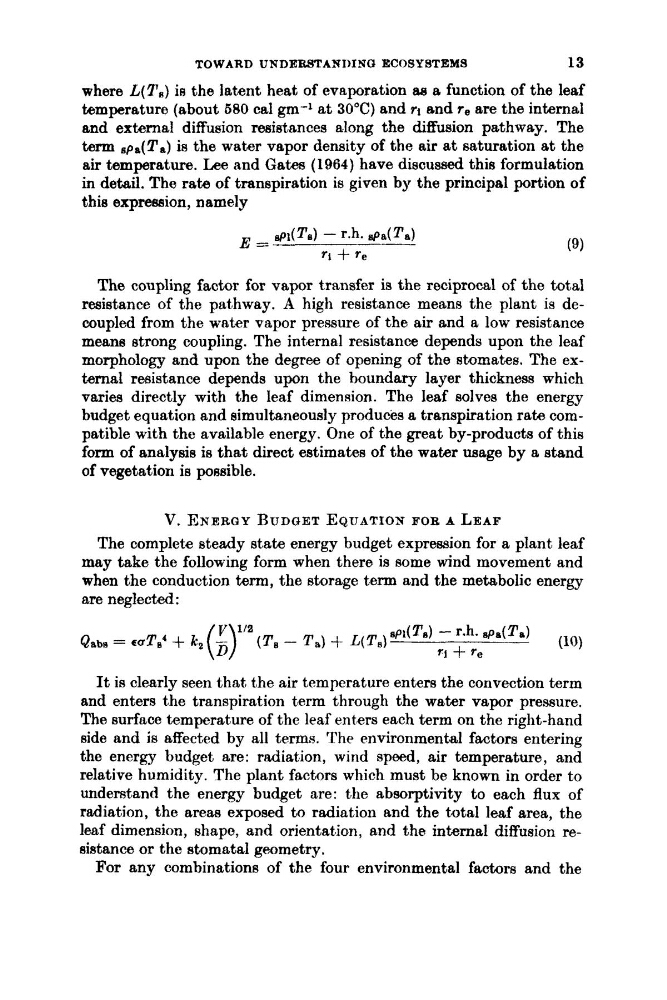
in detail. The rate of transpiration is given by the principal portion of
this expression, namely
The coupling factor for vapor transfer is the reciprocal of the total
resistance of the pathway. A high resistance means the plant is decoupled from the water vapor pressure of the air and a low resistance
means strong coupling. The internal resistance depends upon the leaf
morphology and upon the degree of opening of the stomates. The external resistance depends upon the boundary layer thickness which
varies directly with the leaf dimension. The leaf solves the energy
budget equation and simultaneously produces a transpiration rate compatible with the available energy. One of the great by-products of this
form of analysis is that direct estimates of the water usage by a stand
of vegetation is possible.
V. ENERGY BUDGET EQUATION FOR A LEAF
The complete steady state energy budget expression for a plant leaf
may take the following form when there is some wind movement and
when the conduction &mu, the storage term and the metabolic
are neglected :
energy
(10)
It is clearly seen that the air temperature enters the convection term
and enters the transpiration term through the water vapor pressure.
The surface temperature of the leaf enters each term on the right-hand
side and is affected by all terms. The environmental factors entering
the energy budget are: radiation, wind speed, air temperature, and
relative humidity. The plant fnctors which must be known in order to
underst’and the energy budget are: t.he absorptivity to each flux of
radiation, the areas exposed to radiation and the total leaf area, the
leaf dimension, shape, and orientation, and the internal diffusion resistance or the stomata1 geometry.
For any combinations of the four environmental factors and the
13
where L(T8) is the latent heat of evaporation 88 a function of the leaf
temperature (about 680 cal gm-’ at 30°C) and ri and r e are the internal
and external diffusion resistnnces along the diffusion pathway. The
term spa(Ta) is the water vapor density of the air at saturation at the
air temperature. Lee and Gates (1964) have discussed this formulation
in detail. The rate of transpiration is given by the principal portion of
this expression, namely
The coupling factor for vapor transfer is the reciprocal of the total
resistance of the pathway. A high resistance means the plant is decoupled from the water vapor pressure of the air and a low resistance
means strong coupling. The internal resistance depends upon the leaf
morphology and upon the degree of opening of the stomates. The external resistance depends upon the boundary layer thickness which
varies directly with the leaf dimension. The leaf solves the energy
budget equation and simultaneously produces a transpiration rate compatible with the available energy. One of the great by-products of this
form of analysis is that direct estimates of the water usage by a stand
of vegetation is possible.
V. ENERGY BUDGET EQUATION FOR A LEAF
The complete steady state energy budget expression for a plant leaf
may take the following form when there is some wind movement and
when the conduction &mu, the storage term and the metabolic
are neglected :
energy
(10)
It is clearly seen that the air temperature enters the convection term
and enters the transpiration term through the water vapor pressure.
The surface temperature of the leaf enters each term on the right-hand
side and is affected by all terms. The environmental factors entering
the energy budget are: radiation, wind speed, air temperature, and
relative humidity. The plant fnctors which must be known in order to
underst’and the energy budget are: t.he absorptivity to each flux of
radiation, the areas exposed to radiation and the total leaf area, the
leaf dimension, shape, and orientation, and the internal diffusion resistance or the stomata1 geometry.
For any combinations of the four environmental factors and the