

12
DAVID M. GATES
or 7 become negative, and this is equivalent to transferring it to the
left hand side of Eq. 1.
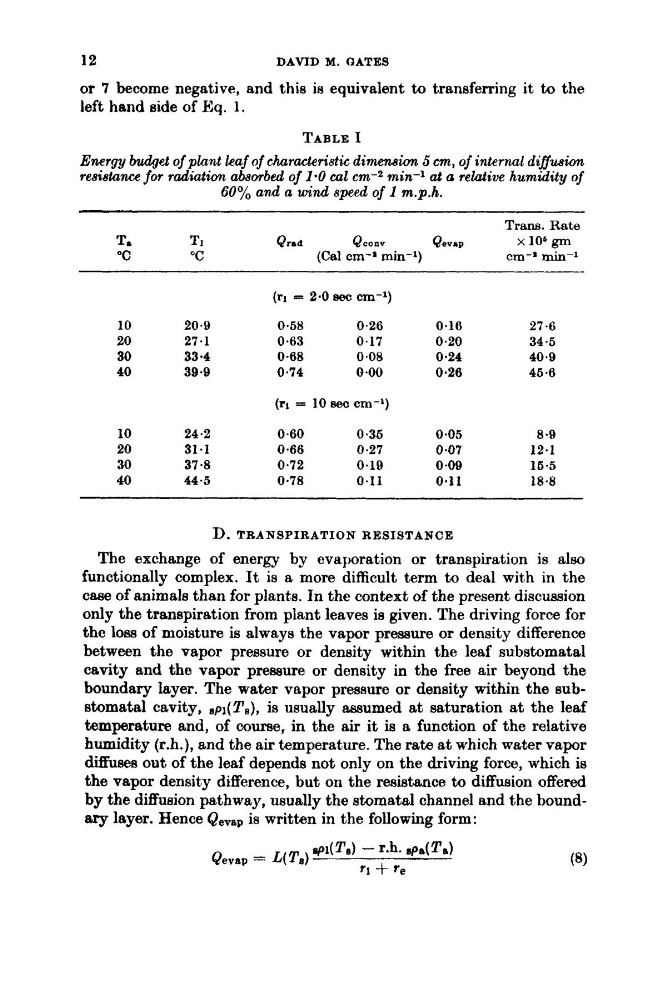
TABLE I
Energy budget of plant leaf of c h u r d r i s t i c dimension 5 cm, of internal diffwion
resietance for radiation absorbed of 1.0 cal
min-' at a relative humidity of
60% and a wind speed of 1 m.p.h.
Trans. Rate
"C
"C
(Cal cm-' min-1)
cm-' min-1
T.
TI
&r.d
Qeonv
Q e v w
x 106 gm
(rl - 2-0 sea cm-1)
0.58
0.26
0.16
27 .G
0.63
0.17
0.20
34.5
0.08
0.08
0.24
40.9
0.74
0.00
0.20
46.6
10
20.9
20
27.1
30
33 -4
40
39.9
(n = 10 aec cm-1)
10
24 -2
0.60
0 *36
0-05
8 *9
20
31.1
0.66
0-27
0.07
12.1
30
37.8
0.72
0.19
0.09
16.5
40
44.5
0.78
0.11
0.1 1
18-8
D. TRANSPIRATION RESISTANCE
The exchange of energy by evaporation or transpiration is also
functionally complex. It is a more difficult term to deal witth in the
case of animals than for plants. In the context of the present discussion
only the transpiration from plant leaves is given. The driving force for
the loss of moisture is always the vapor pressure or density difference
between the vapor pressure or density within the leaf substomatal
cavity and the vapor pressure or density in the free air beyond the
boundary layer. The water vapor pressure or density within the substornatal cavity, ,,pl(Ts), is usually assumed at saturation a t the leaf
temperature and, of course, in the air it is a function of the relative
humidity (r.h.), and the air temperature. The rate at which water vapor
diffuses out of the leaf depends not only on the driving force, which is
the vapor density difference, but on the resistance to diffusion offered
by the diffusion pathway, usually the stornatal channel and the boundarg layer. Hence Qevap is written in the following form:
DAVID M. GATES
or 7 become negative, and this is equivalent to transferring it to the
left hand side of Eq. 1.
TABLE I
Energy budget of plant leaf of c h u r d r i s t i c dimension 5 cm, of internal diffwion
resietance for radiation absorbed of 1.0 cal
min-' at a relative humidity of
60% and a wind speed of 1 m.p.h.
Trans. Rate
"C
"C
(Cal cm-' min-1)
cm-' min-1
T.
TI
&r.d
Qeonv
Q e v w
x 106 gm
(rl - 2-0 sea cm-1)
0.58
0.26
0.16
27 .G
0.63
0.17
0.20
34.5
0.08
0.08
0.24
40.9
0.74
0.00
0.20
46.6
10
20.9
20
27.1
30
33 -4
40
39.9
(n = 10 aec cm-1)
10
24 -2
0.60
0 *36
0-05
8 *9
20
31.1
0.66
0-27
0.07
12.1
30
37.8
0.72
0.19
0.09
16.5
40
44.5
0.78
0.11
0.1 1
18-8
D. TRANSPIRATION RESISTANCE
The exchange of energy by evaporation or transpiration is also
functionally complex. It is a more difficult term to deal witth in the
case of animals than for plants. In the context of the present discussion
only the transpiration from plant leaves is given. The driving force for
the loss of moisture is always the vapor pressure or density difference
between the vapor pressure or density within the leaf substomatal
cavity and the vapor pressure or density in the free air beyond the
boundary layer. The water vapor pressure or density within the substornatal cavity, ,,pl(Ts), is usually assumed at saturation a t the leaf
temperature and, of course, in the air it is a function of the relative
humidity (r.h.), and the air temperature. The rate at which water vapor
diffuses out of the leaf depends not only on the driving force, which is
the vapor density difference, but on the resistance to diffusion offered
by the diffusion pathway, usually the stornatal channel and the boundarg layer. Hence Qevap is written in the following form: