

TOWARD UNDERSTANDING ECOSYSTEMS
i l
a temperature difference between the organism surface temperature,
T,, and the fluid temperature, Ta. For natural convection the amount
of energy transferred is given by a relationship similar to the following:
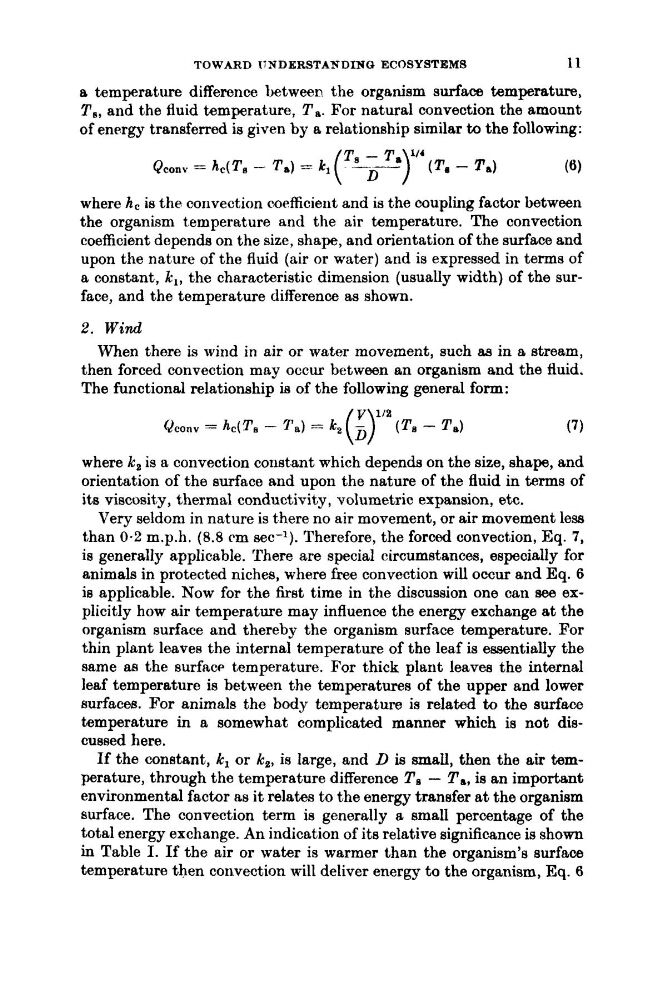
where h, is the convection coefficient and is the coupling factor between
the organism temperature and the air temperature. The convection
coefficient depends on the size, shape, and orientation of the surface and
upon the nature of the fluid (air or water) and is expressed in terms of
a constant, k,, the characteristic dimension (usually width) of the surface, and the temperature difference as shown.
2. wind
When there is wind in air or water movement, such m in tb stream,
then forced convection may occur between an organism and the fluid.
The functional relationship is of the following general form:
where k, is a convection constant which depends on the size, shape, and
orientation of the surface and upon the nature of the fluid in terms of
it8 viscosity, thermal conductivity, volumetric expansion, etc.
Very seldom in nature is there no air movement, or air movement less
than 0.2 m.p.h. (8.8 rm sec-l). Therefore, the forced convection, Eq. 7,
is generally applicable. There are special circumstances, especially for
animals in protected niches, where free convection will occur and Eq. 6
is applicable. Now for the first time in the discussion one can 888 explicitly how air temperature may influence the energy exchange at the
organism surface and thereby the organism surface temperature. For
thin plant leave8 the internal temperature of the leaf is essentially the
same a8 the surface temperature. For thick plant leaves the internal
leaf temperature is between the temperatures of the upper and lower
surfaces. For animals the body temperature is related to the surface
temperature in a somewhat complicated manner which is not discussed here.
If the constant, k, or k,, is large, and D is small, then the air ternperature, through the temperature differonce T, - T . , is an important
environmental factor as it relates to the energy transfer a t the organism
surface, The convection term is generally a small percentage of the
total energy exchange. An indication of its relative significance is shown
in Table I. If the air or water is warmer than the organism’s surface
temperature then convection will deliver energy to the organism, Eq. 6
i l
a temperature difference between the organism surface temperature,
T,, and the fluid temperature, Ta. For natural convection the amount
of energy transferred is given by a relationship similar to the following:
where h, is the convection coefficient and is the coupling factor between
the organism temperature and the air temperature. The convection
coefficient depends on the size, shape, and orientation of the surface and
upon the nature of the fluid (air or water) and is expressed in terms of
a constant, k,, the characteristic dimension (usually width) of the surface, and the temperature difference as shown.
2. wind
When there is wind in air or water movement, such m in tb stream,
then forced convection may occur between an organism and the fluid.
The functional relationship is of the following general form:
where k, is a convection constant which depends on the size, shape, and
orientation of the surface and upon the nature of the fluid in terms of
it8 viscosity, thermal conductivity, volumetric expansion, etc.
Very seldom in nature is there no air movement, or air movement less
than 0.2 m.p.h. (8.8 rm sec-l). Therefore, the forced convection, Eq. 7,
is generally applicable. There are special circumstances, especially for
animals in protected niches, where free convection will occur and Eq. 6
is applicable. Now for the first time in the discussion one can 888 explicitly how air temperature may influence the energy exchange at the
organism surface and thereby the organism surface temperature. For
thin plant leave8 the internal temperature of the leaf is essentially the
same a8 the surface temperature. For thick plant leaves the internal
leaf temperature is between the temperatures of the upper and lower
surfaces. For animals the body temperature is related to the surface
temperature in a somewhat complicated manner which is not discussed here.
If the constant, k, or k,, is large, and D is small, then the air ternperature, through the temperature differonce T, - T . , is an important
environmental factor as it relates to the energy transfer a t the organism
surface, The convection term is generally a small percentage of the
total energy exchange. An indication of its relative significance is shown
in Table I. If the air or water is warmer than the organism’s surface
temperature then convection will deliver energy to the organism, Eq. 6