

164
N. WALOFF
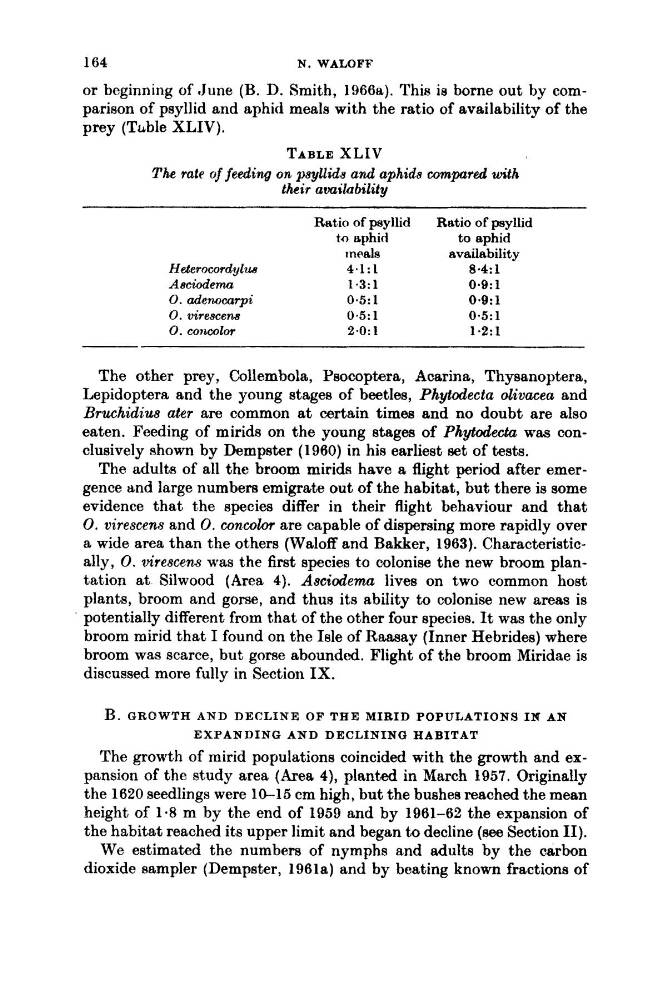
or beginning of June (B. D. Smith, 1966tl). This is borne out by comparison of psyllid and aphid meals with the ratio of availability of the
prey (Table XLIV).
TABLE XLIV
The rate of feeding on psyllids and aphids compared with
their availability
Ratio of psyllid
Ratio of psyllid
to aphid
to aphid
rneals
availability
Heterowrd&u
4.1 : 1
8.4: 1
Aeciodema
1.3:1
0.9: 1
0. adenmarpi
0.5: 1
0.9:l
0. uirescena
0.5: 1
0.5: 1
0 . concolor
2.0: 1
1-2:l
The other prey, Collembola, Psocoptera, Acarina, Thysanoptera,
Lepidoptera and the young stages of beetles, Phytodecta divacea and
Bruchidius ater are common at certain times and no doubt are also
eaten. Feeding of mirids on the young stages of Phytadectu was conclusively shown by Dempster (1960) in his earliest set of tests.
The adults of all the broom mirids have a flight period after emergence and large numbers emigrate out of the habitat, but there is some
evidence that the species differ in their flight behaviour and that
0. virescens and 0 . w n w h are capable of dispersing more rapidly over
a wide area than the others (Waloff and Bakker, 1963). Characteristically, 0. virescens was the first species to colonise the new broom plantation at Silwood (Area 4). Asciademu lives on two common host
plants, broom and gorse, and thus its ability to colonise new areas is
potentially different from that of the other four species. It was the only
broom mirid that I found on the Isle of Raasay (Inner Hebrides) where
broom was scarce, but gorse aboundd. Flight of the broom Miridae is
discussed more fully in Section IX.
B . GROWTH A N D DECLINE O F T H E MIRID POPULATIONS IN A N
EXPANDING A N D DECLINING HABITAT
The growth of mirid populations coincided with the growth and expansion of the study area (Area 4), planted in March 1957. Originally
the 1620 seedlings were 10-15 cm high, but the bushes reached the mean
height of 1.8 m by the end of 1959 and by 1961-62 the expansion of
the habitat reached its upper limit and began to decline (eee Section 11).
We estimated the numbers of nymphs and adults by the carbon
dioxide sampler (Dempster, 1961a) and by beating known fractions of
N. WALOFF
or beginning of June (B. D. Smith, 1966tl). This is borne out by comparison of psyllid and aphid meals with the ratio of availability of the
prey (Table XLIV).
TABLE XLIV
The rate of feeding on psyllids and aphids compared with
their availability
Ratio of psyllid
Ratio of psyllid
to aphid
to aphid
rneals
availability
Heterowrd&u
4.1 : 1
8.4: 1
Aeciodema
1.3:1
0.9: 1
0. adenmarpi
0.5: 1
0.9:l
0. uirescena
0.5: 1
0.5: 1
0 . concolor
2.0: 1
1-2:l
The other prey, Collembola, Psocoptera, Acarina, Thysanoptera,
Lepidoptera and the young stages of beetles, Phytodecta divacea and
Bruchidius ater are common at certain times and no doubt are also
eaten. Feeding of mirids on the young stages of Phytadectu was conclusively shown by Dempster (1960) in his earliest set of tests.
The adults of all the broom mirids have a flight period after emergence and large numbers emigrate out of the habitat, but there is some
evidence that the species differ in their flight behaviour and that
0. virescens and 0 . w n w h are capable of dispersing more rapidly over
a wide area than the others (Waloff and Bakker, 1963). Characteristically, 0. virescens was the first species to colonise the new broom plantation at Silwood (Area 4). Asciademu lives on two common host
plants, broom and gorse, and thus its ability to colonise new areas is
potentially different from that of the other four species. It was the only
broom mirid that I found on the Isle of Raasay (Inner Hebrides) where
broom was scarce, but gorse aboundd. Flight of the broom Miridae is
discussed more fully in Section IX.
B . GROWTH A N D DECLINE O F T H E MIRID POPULATIONS IN A N
EXPANDING A N D DECLINING HABITAT
The growth of mirid populations coincided with the growth and expansion of the study area (Area 4), planted in March 1957. Originally
the 1620 seedlings were 10-15 cm high, but the bushes reached the mean
height of 1.8 m by the end of 1959 and by 1961-62 the expansion of
the habitat reached its upper limit and began to decline (eee Section 11).
We estimated the numbers of nymphs and adults by the carbon
dioxide sampler (Dempster, 1961a) and by beating known fractions of