

STUDIES ON THE INSECT FAUNA ON WOMH BBOOM
163
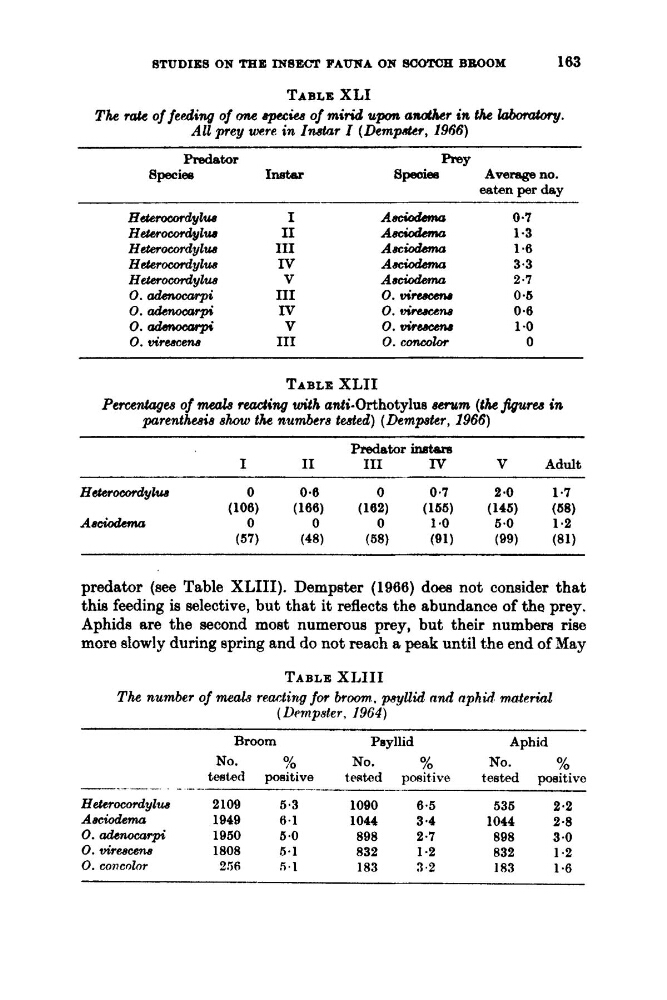
TABLE XLI
The r d t of feeding of ane speciee of mirid upon a d r ia the loborakny.
All prey were in Iniztar I (Demp&er, 1966)
predetor
h Y
Speciee
III8t.W
Speoiee
Average no.
eaten per day
I
I1
111
IV
V
I11
Iv
V
111
0-7
1.3
1.6
3.3
2.7
0 -6
0.6
1 *o
0
TABLE XLII
Pereentogee of meals reading with anti-Orthotylue 8 m m (the &urea in
parenthe.& s?ww the numbers tested) (Dempter, 1966)
Predator inetars
I
I1
111
Iv
V
Adult
Hsterocordylw
0
0.6
0
0.7
2 -0
1 *7
(106)
(166)
(162)
(166)
(146)
(68)
ABciodcmo
0
0
0
1 -0
5.0
1 a 2
(57)
(48)
(58)
(91)
(99)
(81)
predator (see Table XLIII). Dempster (1966) does not consider that
this feeding is selective, but that it reflects the abundance of the prey.
Aphids are the second most numerous prey, but their numbers rise
more slowly during spring and do not reach a peak until the end of May
TABLE XLIII
The number of mala reacting for broom. pqllid and nphid material
(Dpmpster, 1964)
Broom
Psyllid
Aphid
No.
%
No.
%
No.
%
Heterocordylua
2109
5.3
1090
6.5
535
2.2
Aeciodema
1949
6.1
1044
3 *4
1044
2.8
0. admwcarpi
1950
5 *O
898
2.7
898
3 *O
0. viremem
1808
5.1
832
1 -2
832
1 * 2
0. concolor
256
5.1
183
3 . 2
183
1.8
tested positive
teRtCd positive
tested positive
--I __ . - - __
163
TABLE XLI
The r d t of feeding of ane speciee of mirid upon a d r ia the loborakny.
All prey were in Iniztar I (Demp&er, 1966)
predetor
h Y
Speciee
III8t.W
Speoiee
Average no.
eaten per day
I
I1
111
IV
V
I11
Iv
V
111
0-7
1.3
1.6
3.3
2.7
0 -6
0.6
1 *o
0
TABLE XLII
Pereentogee of meals reading with anti-Orthotylue 8 m m (the &urea in
parenthe.& s?ww the numbers tested) (Dempter, 1966)
Predator inetars
I
I1
111
Iv
V
Adult
Hsterocordylw
0
0.6
0
0.7
2 -0
1 *7
(106)
(166)
(162)
(166)
(146)
(68)
ABciodcmo
0
0
0
1 -0
5.0
1 a 2
(57)
(48)
(58)
(91)
(99)
(81)
predator (see Table XLIII). Dempster (1966) does not consider that
this feeding is selective, but that it reflects the abundance of the prey.
Aphids are the second most numerous prey, but their numbers rise
more slowly during spring and do not reach a peak until the end of May
TABLE XLIII
The number of mala reacting for broom. pqllid and nphid material
(Dpmpster, 1964)
Broom
Psyllid
Aphid
No.
%
No.
%
No.
%
Heterocordylua
2109
5.3
1090
6.5
535
2.2
Aeciodema
1949
6.1
1044
3 *4
1044
2.8
0. admwcarpi
1950
5 *O
898
2.7
898
3 *O
0. viremem
1808
5.1
832
1 -2
832
1 * 2
0. concolor
256
5.1
183
3 . 2
183
1.8
tested positive
teRtCd positive
tested positive
--I __ . - - __