

8TUI)IER ON THE INRECT FAUNA ON SCOTCH BROOM
136
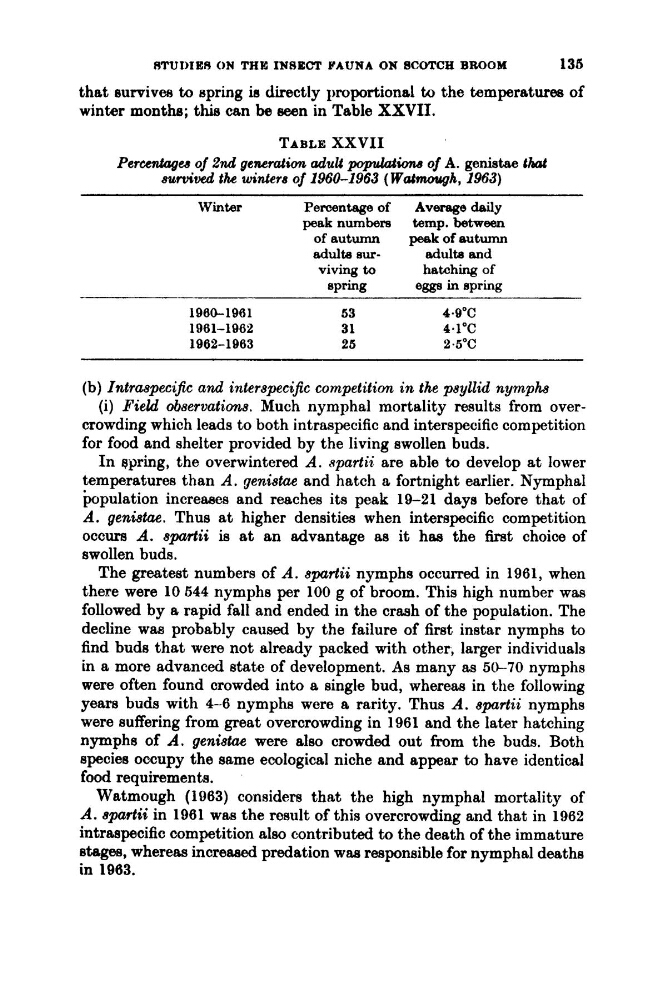
that survives to spring is directly proportional to the temperatures of
winter months; this can be seen in Table XXVII.
TABLE XXVII
Percentuges of 2nd generation adult popddions of A. geniatae that
szlrvived the winters of 1960-1963 ( W a h m g h , 1963)
~~
~
~~
Winter
Percentage of
Average daily
peek numbers temp. between
of autumn
peak of autumn
adults Buradults and
viving to
hatching of
spring
eggcl in spring
1980- 196 1
53
49°C
1981-1862
31
4.1"C
1962-1983
25
2.5"C
(b) Intraspecific and interspecijic competition in the psyllid nymphs
(i) Fiela' observations. Much nymphal mortality results from overcrowding which leads to both intraspecific and interspecific competition
for food and shelter provided by the living swollen buds.
In qxing, the overwintered A. spartii are able to develop at lower
temperatures than A. genistae and hatch a fortnight earlier. Nymphal
population increases and reaches its peak 19-21 days before that of
A. genietae, Thus at higher densities when interspecific competition
occurs A. epadii is at an advantage as it haa the first choice of
swollen buds.
The greatest numbers of A. spartid nymphs occurred in 1961, when
these were 10 544 nymphs per 100 g of broom. This high number was
followed by a rapid fall and ended in the crash of the population. The
decline wa8 probably caused by the failure of first instar nymphs to
find buds that were not already packed with other, larger individuals
in a more advanced state of development. As many as 50-70 nymphs
were often found crowded into a single bud, whereas in the following
years buds with 4-6 nymphs were a rarity. Thus A. epartii nymphs
were suffering from great overcrowding in 1961 and the later hatching
nymphs of A. genistae were also crowded out from the buds. Both
species occupy the same ecological niche and appear to have identical
food requirements.
Watmough (1963) considers that the high nymphal mortality of
A. ~purtii in 1961 was the result of this overcrowding and that in 1962
intraspecific competition also contributed to the death of the immature
stages, whereas increased predation waa responsible for nymphal deaths
in 1963.
136
that survives to spring is directly proportional to the temperatures of
winter months; this can be seen in Table XXVII.
TABLE XXVII
Percentuges of 2nd generation adult popddions of A. geniatae that
szlrvived the winters of 1960-1963 ( W a h m g h , 1963)
~~
~
~~
Winter
Percentage of
Average daily
peek numbers temp. between
of autumn
peak of autumn
adults Buradults and
viving to
hatching of
spring
eggcl in spring
1980- 196 1
53
49°C
1981-1862
31
4.1"C
1962-1983
25
2.5"C
(b) Intraspecific and interspecijic competition in the psyllid nymphs
(i) Fiela' observations. Much nymphal mortality results from overcrowding which leads to both intraspecific and interspecific competition
for food and shelter provided by the living swollen buds.
In qxing, the overwintered A. spartii are able to develop at lower
temperatures than A. genistae and hatch a fortnight earlier. Nymphal
population increases and reaches its peak 19-21 days before that of
A. genietae, Thus at higher densities when interspecific competition
occurs A. epadii is at an advantage as it haa the first choice of
swollen buds.
The greatest numbers of A. spartid nymphs occurred in 1961, when
these were 10 544 nymphs per 100 g of broom. This high number was
followed by a rapid fall and ended in the crash of the population. The
decline wa8 probably caused by the failure of first instar nymphs to
find buds that were not already packed with other, larger individuals
in a more advanced state of development. As many as 50-70 nymphs
were often found crowded into a single bud, whereas in the following
years buds with 4-6 nymphs were a rarity. Thus A. epartii nymphs
were suffering from great overcrowding in 1961 and the later hatching
nymphs of A. genistae were also crowded out from the buds. Both
species occupy the same ecological niche and appear to have identical
food requirements.
Watmough (1963) considers that the high nymphal mortality of
A. ~purtii in 1961 was the result of this overcrowding and that in 1962
intraspecific competition also contributed to the death of the immature
stages, whereas increased predation waa responsible for nymphal deaths
in 1963.