

136
N. WALOFF
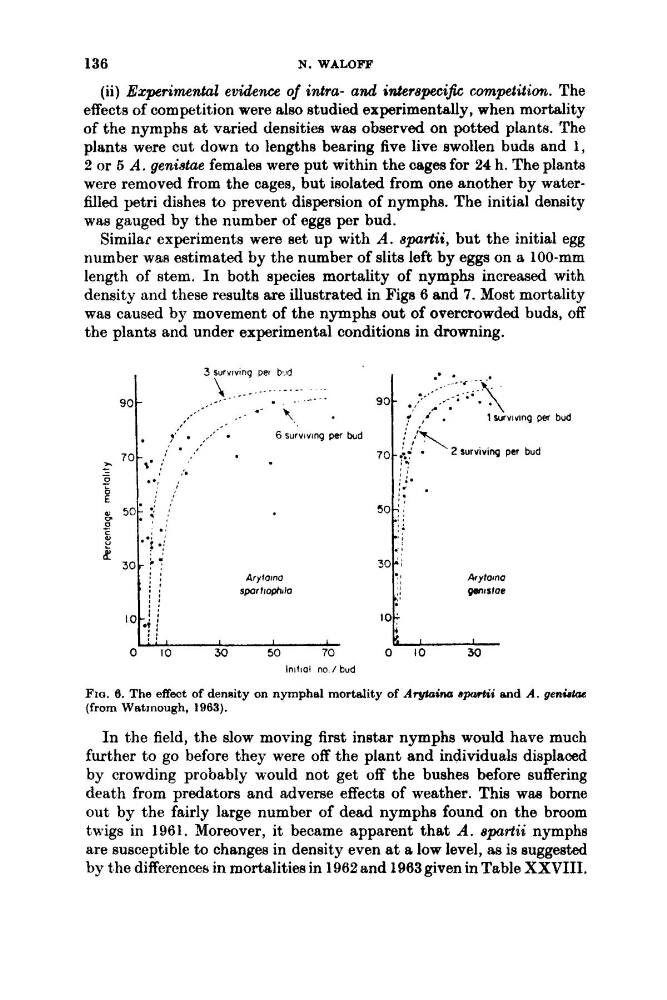
(ii) Experimental evidence of intra- and interspeciif;C competition. The
effects of competition were also studied experimentally, when mortality
of the nymphs a t varied densities w a ~ observed on potted plants. The
plants were cut down to lengths bearing five live swollen buds and 1,
2 or 5 A. genietae females were put within the cages for 24 h. The plants
were removed from the cages, but isolated from one another by waterfilled petri dishes to prevent dispersion of nymphs. The initial density
was gauged by the number of eggs per bud.
Similar experiments were set up with A. sprtii, but the initial egg
number wa.8 estimated by the number of slits left by eggs on a 100-mm
length of stem. In both species mortality of nymphs increased with
density and these results are illustrated in Figs 6 and 7. Most mortality
was caused by movement of the nymphs out of overcrowded buds, off
the plants and under experimental conditions in drowning.
bud
bud
Arylorno
pcntsfoe
1 0 i ;
0
10
30
lnltial no /bud
FIG. 6. The effeot of dennity on nymphal mortality of Arytaina qpw6ii and A . genwloc
(from Wstmough, 1963).
In the field, the slow moving first instar nymphs would have much
further to go before they were off the plant and individuals displaced
by crowding probably would not get off the bushes before suffering
death from predators and adverse effects of weather. This waa borne
out by the fairly large number of dead nymphs found on the broom
twigs in 1961. Moreover, it became apparent that A. spartii nymphs
are susceptible to changes in density even at a low level, as is suggested
by the differences in mortalities in 1962 and 1963given in Table XXVIII.
N. WALOFF
(ii) Experimental evidence of intra- and interspeciif;C competition. The
effects of competition were also studied experimentally, when mortality
of the nymphs a t varied densities w a ~ observed on potted plants. The
plants were cut down to lengths bearing five live swollen buds and 1,
2 or 5 A. genietae females were put within the cages for 24 h. The plants
were removed from the cages, but isolated from one another by waterfilled petri dishes to prevent dispersion of nymphs. The initial density
was gauged by the number of eggs per bud.
Similar experiments were set up with A. sprtii, but the initial egg
number wa.8 estimated by the number of slits left by eggs on a 100-mm
length of stem. In both species mortality of nymphs increased with
density and these results are illustrated in Figs 6 and 7. Most mortality
was caused by movement of the nymphs out of overcrowded buds, off
the plants and under experimental conditions in drowning.
bud
bud
Arylorno
pcntsfoe
1 0 i ;
0
10
30
lnltial no /bud
FIG. 6. The effeot of dennity on nymphal mortality of Arytaina qpw6ii and A . genwloc
(from Wstmough, 1963).
In the field, the slow moving first instar nymphs would have much
further to go before they were off the plant and individuals displaced
by crowding probably would not get off the bushes before suffering
death from predators and adverse effects of weather. This waa borne
out by the fairly large number of dead nymphs found on the broom
twigs in 1961. Moreover, it became apparent that A. spartii nymphs
are susceptible to changes in density even at a low level, as is suggested
by the differences in mortalities in 1962 and 1963given in Table XXVIII.