

134
N. wAIA3m
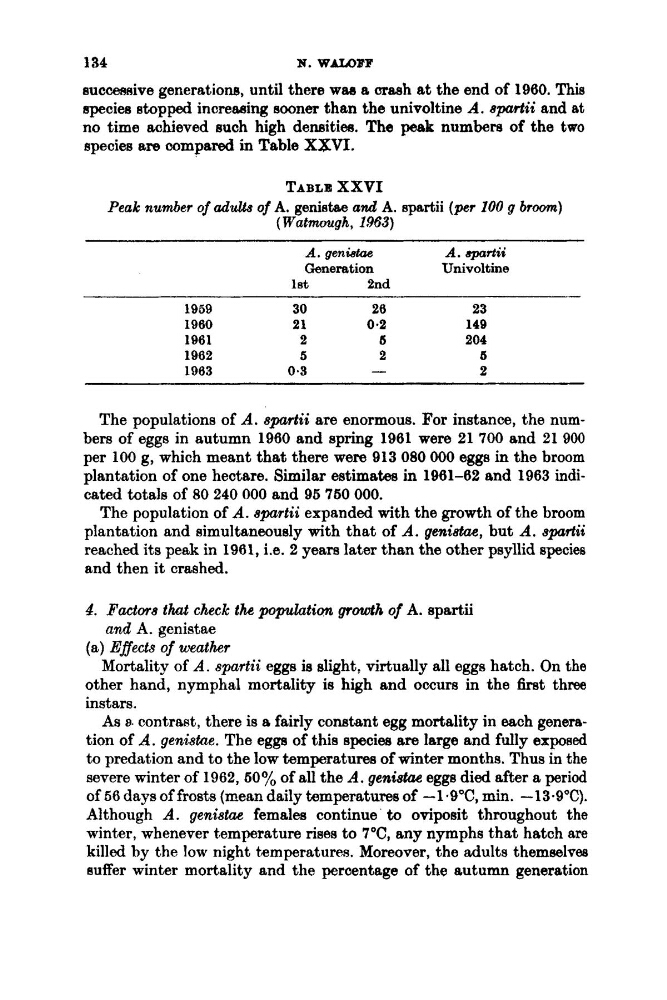
succeasive generatiom, until there wm a mash at the end of 1960. This
species stopped increaeing sooner than the univoltine A. spartii and at
no time achieved such high densitiee. The peak numbers of the two
species are compared in Table XXVI.
TABLE XXVI
Peak number of duUS of A. genisb and A. spartii (per ZOO g broom)
( Wutmaugh, 1963)
A . genietae
A . spartii
Generation
Univoltine
1st
2nd
1959
30
26
23
1960
21
0 -2
149
1981
2
5
204
1962
5
2
5
2
1963
0.3
I
The populations of A. sprtii are enormous. For instance, the numbers of eggs in autumn 1960 and spring 1961 were 21 700 and 21 900
per 100 g, which meant that there were 913 080 000 eggs in the broom
plantation of one hectare. Similar estimates in 1961-62 and 1963 indicated totals of 80 240 000 and 96 760 000.
The population of A. spartii expanded with the growth of the broom
plantation and simultaneously with that of A. genistue, but A . spa&
reached its peak in 1961 , i.e. 2 years later than the other psyllid species
and then it crashed.
4. Factore thut check the population growth of A. spartii
and A. genistae
(a) Efsects of weatiber
Mortality of A. spurtii eggs is slight, virtually all eggs hatch. On the
other hand, nymphal mortality is high and occurs in the Grst three
instars.
As 8. contrast, there is a fairly conatant egg mortality in each generation of A. genistcce. The egga of this species are large and fully exposed
to predation and to the low temperatures of winter months. Thus in the
severe winter of 1962, 60% of all the A. genistae eggs died after a period
of 56 days of frosts (mean daily temperatures of -1-9"C, min. -13.9"C).
Although A. genistue females continue to oviposit throughout the
winter, whenever temperature rises to 7 O C , any nymphs that hatch are
killed hy the low night temperatures. Moreover, the adults themselvea
suffer winter mortality and the percentage of the autumn generation
N. wAIA3m
succeasive generatiom, until there wm a mash at the end of 1960. This
species stopped increaeing sooner than the univoltine A. spartii and at
no time achieved such high densitiee. The peak numbers of the two
species are compared in Table XXVI.
TABLE XXVI
Peak number of duUS of A. genisb and A. spartii (per ZOO g broom)
( Wutmaugh, 1963)
A . genietae
A . spartii
Generation
Univoltine
1st
2nd
1959
30
26
23
1960
21
0 -2
149
1981
2
5
204
1962
5
2
5
2
1963
0.3
I
The populations of A. sprtii are enormous. For instance, the numbers of eggs in autumn 1960 and spring 1961 were 21 700 and 21 900
per 100 g, which meant that there were 913 080 000 eggs in the broom
plantation of one hectare. Similar estimates in 1961-62 and 1963 indicated totals of 80 240 000 and 96 760 000.
The population of A. spartii expanded with the growth of the broom
plantation and simultaneously with that of A. genistue, but A . spa&
reached its peak in 1961 , i.e. 2 years later than the other psyllid species
and then it crashed.
4. Factore thut check the population growth of A. spartii
and A. genistae
(a) Efsects of weatiber
Mortality of A. spurtii eggs is slight, virtually all eggs hatch. On the
other hand, nymphal mortality is high and occurs in the Grst three
instars.
As 8. contrast, there is a fairly conatant egg mortality in each generation of A. genistcce. The egga of this species are large and fully exposed
to predation and to the low temperatures of winter months. Thus in the
severe winter of 1962, 60% of all the A. genistae eggs died after a period
of 56 days of frosts (mean daily temperatures of -1-9"C, min. -13.9"C).
Although A. genistue females continue to oviposit throughout the
winter, whenever temperature rises to 7 O C , any nymphs that hatch are
killed hy the low night temperatures. Moreover, the adults themselvea
suffer winter mortality and the percentage of the autumn generation