

ECOLOGICAL STUDIES AT LOUGH I N E
267
0
0
0 0
0
0
eo
- ' i
O
0 .
m
- I
-
W
U
P
e
40
t
0
0 0
0 0 0
0
0
8
O
O
0
0
0
0
0
0 0
e o
0
O
L
,
I
'
I
12 I
'
"
16 1 1 " 1 " " 1 1 ' 1
20
24
28
HEIGHT OF SHELL (rnrn)
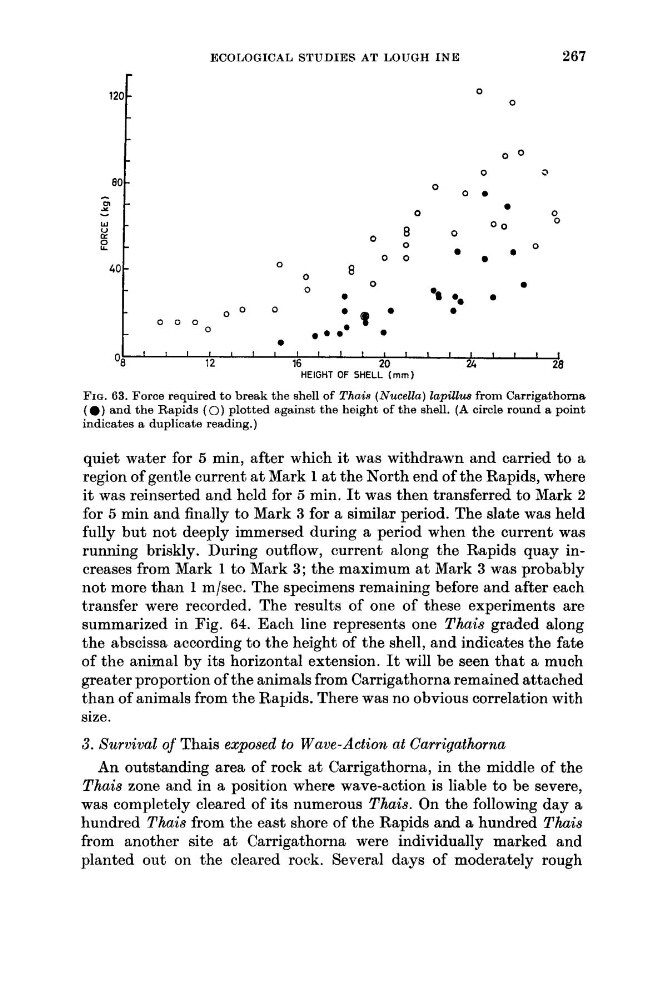
FIG. 63. Force required to break the shell of Thais (Nucella) lapillw, from Carrigathorna
( 0 ) and the Rapids (0) plotted against the height of the shell. (A circle round a point
indicates a duplicate reading.)
quiet water for 5 min, after which it was withdrawn and carried to a
region of gentle current a t Mark 1 at the North end of the Rapids, where
it was reinserted and held for 5 min. It was then transferred to Mark 2
for 5 min and finally to Mark 3 for a similar period. The slate was held
fully but not deeply immersed during a period when the current was
running briskly. During outflow, current along the Rapids quay increases from Mark 1 to Mark 3; the maximum at Mark 3 was probably
not more than 1 m/sec. The specimens remaining before and after each
transfer were recorded. The results of one of these experiments are
summarized in Fig. 64. Each line represents one Thais graded along
the abscissa according to the height of the shell, and indicates the fate
of the animal by its horizontal extension. It will be seen that a much
greater proportion of the animals from Carrigathorna remained attached
than of animals from the Rapids. There was no obvious correlation with
size.
3. Survival of Thais exposed to Wave-Action at Carrigathorna
An outstanding area of rock a t Carrigathorna, in the middle of the
Thais zone and in a position where wave-action is liable to be severe,
was completely cleared of its numerous Thais. On the following day a
hundred Thais from the east shore of the Rapids and a hundred Thais
from another site a t Carrigathorna were individually marked and
planted out on the cleared rock. Several days of moderately rough
267
0
0
0 0
0
0
eo
- ' i
O
0 .
m
- I
-
W
U
P
e
40
t
0
0 0
0 0 0
0
0
8
O
O
0
0
0
0
0
0 0
e o
0
O
L
,
I
'
I
12 I
'
"
16 1 1 " 1 " " 1 1 ' 1
20
24
28
HEIGHT OF SHELL (rnrn)
FIG. 63. Force required to break the shell of Thais (Nucella) lapillw, from Carrigathorna
( 0 ) and the Rapids (0) plotted against the height of the shell. (A circle round a point
indicates a duplicate reading.)
quiet water for 5 min, after which it was withdrawn and carried to a
region of gentle current a t Mark 1 at the North end of the Rapids, where
it was reinserted and held for 5 min. It was then transferred to Mark 2
for 5 min and finally to Mark 3 for a similar period. The slate was held
fully but not deeply immersed during a period when the current was
running briskly. During outflow, current along the Rapids quay increases from Mark 1 to Mark 3; the maximum at Mark 3 was probably
not more than 1 m/sec. The specimens remaining before and after each
transfer were recorded. The results of one of these experiments are
summarized in Fig. 64. Each line represents one Thais graded along
the abscissa according to the height of the shell, and indicates the fate
of the animal by its horizontal extension. It will be seen that a much
greater proportion of the animals from Carrigathorna remained attached
than of animals from the Rapids. There was no obvious correlation with
size.
3. Survival of Thais exposed to Wave-Action at Carrigathorna
An outstanding area of rock a t Carrigathorna, in the middle of the
Thais zone and in a position where wave-action is liable to be severe,
was completely cleared of its numerous Thais. On the following day a
hundred Thais from the east shore of the Rapids and a hundred Thais
from another site a t Carrigathorna were individually marked and
planted out on the cleared rock. Several days of moderately rough