

ECOLOGICAL STUDIES AT LOUGH INE
223
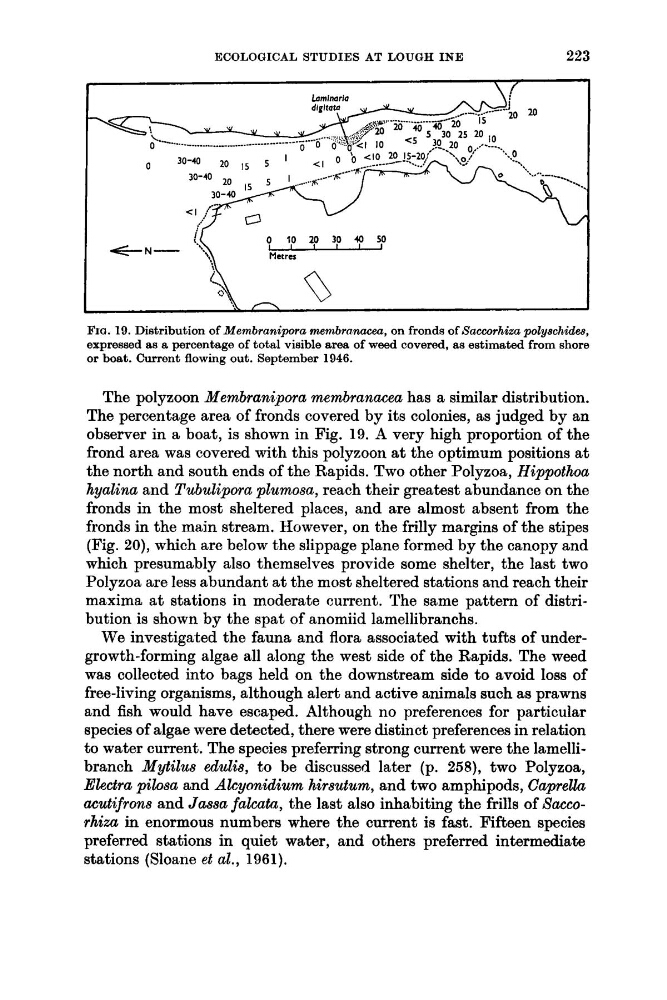
FIa. 19. Distribution of Membranipora membranacea, on fronds of Saccorhim polyschides,
expressed as a percentage of total visible area of weed covered, as estimated from shore
or boat. Current flowing out. September 1946.
The polyzoon Membranipora membranacea has a similar distribution.
The percentage area of fronds covered by its colonies, as judged by an
observer in a boat, is shown in Fig. 19. A very high proportion of the
frond area was covered with this polyzoon at the optimum positions at
the north and south ends of the Rapids. Two other Polyzoa, Hippothoa
hyalina and Tubulipora plumosa, reach their greatest abundance on the
fronds in the most sheltered places, and are almost absent from the
fronds in the main stream. However, on the frilly margins of the stipes
(Fig. 20), which are below the slippage plane formed by the canopy and
which presumably also themselves provide some shelter, the last two
Polyzoa are less abundant a t the most sheltered stations and reach their
maxima a t stations in moderate current. The same pattern of distribution is shown by the spat of anomiid lamellibranchs.
We investigated the fauna and flora associated with tufts of undergrowth-forming algae all along the west side of the Rapids. The weed
was collected into bags held on the downstream side t o avoid loss of
free-living organisms, although alert and active animals such as prawns
and fish would have escaped. Although no preferences for particular
species of algae were detected, there were distinct preferences in relation
to water current. The species preferring strong current were the lamellibranch Mytilus edulis, to be discussed later (p. 258), two Polyzoa,
Ebctra pilosa and Alcyonidium hirsutum, and two amphipods, Caprella
acutifrons and Jmsa falcata, the last also inhabiting the frills of Saccorhiza in enormous numbers where the current is fast. Fifteen species
preferred stations in quiet water, and others preferred intermediate
stations (Sloane et al., 1961).
223
FIa. 19. Distribution of Membranipora membranacea, on fronds of Saccorhim polyschides,
expressed as a percentage of total visible area of weed covered, as estimated from shore
or boat. Current flowing out. September 1946.
The polyzoon Membranipora membranacea has a similar distribution.
The percentage area of fronds covered by its colonies, as judged by an
observer in a boat, is shown in Fig. 19. A very high proportion of the
frond area was covered with this polyzoon at the optimum positions at
the north and south ends of the Rapids. Two other Polyzoa, Hippothoa
hyalina and Tubulipora plumosa, reach their greatest abundance on the
fronds in the most sheltered places, and are almost absent from the
fronds in the main stream. However, on the frilly margins of the stipes
(Fig. 20), which are below the slippage plane formed by the canopy and
which presumably also themselves provide some shelter, the last two
Polyzoa are less abundant a t the most sheltered stations and reach their
maxima a t stations in moderate current. The same pattern of distribution is shown by the spat of anomiid lamellibranchs.
We investigated the fauna and flora associated with tufts of undergrowth-forming algae all along the west side of the Rapids. The weed
was collected into bags held on the downstream side t o avoid loss of
free-living organisms, although alert and active animals such as prawns
and fish would have escaped. Although no preferences for particular
species of algae were detected, there were distinct preferences in relation
to water current. The species preferring strong current were the lamellibranch Mytilus edulis, to be discussed later (p. 258), two Polyzoa,
Ebctra pilosa and Alcyonidium hirsutum, and two amphipods, Caprella
acutifrons and Jmsa falcata, the last also inhabiting the frills of Saccorhiza in enormous numbers where the current is fast. Fifteen species
preferred stations in quiet water, and others preferred intermediate
stations (Sloane et al., 1961).