

222
J. A. KITCHING AND F. J. EBLING
IV. INFLUENCE OF CURRENT
A. DISTRIBUTION I N RELATION TO CURRENT
Laminarian algae form a forest covering the whole Rapids area, and
the plants and animals which inhabit the oanopy of fronds are more
fully exposed to the current than are those living on the bottom. Moreover, most of the bottom is occupied by one species of laminarian alga,
Succorhim polyschides, so that an extensive uniform substrate is provided for the population of plants and animals which live upon its
fronds and stipes. Laminaria digitata is confined to the Sill and to the
side of the quay. We have detailed information about the distribution
within the Rapids area of several animals associated with Saccorhiza
(Ebling et al., 1948).
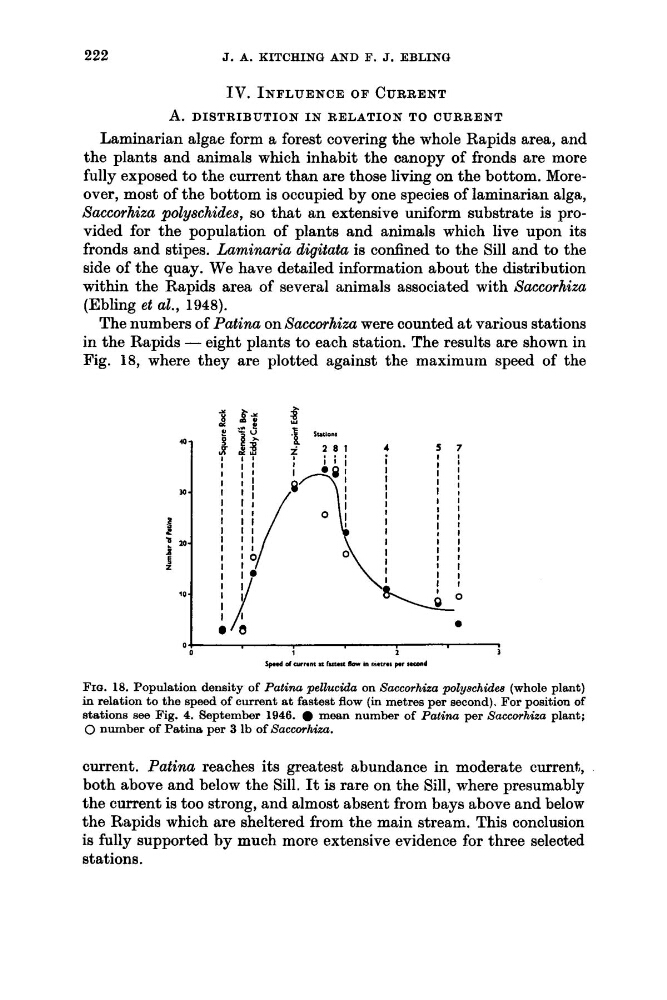
The numbers of Patina on Succorhim were counted at various stations
in the Rapids - eight plants to each station. The results are shown in
Fig. 18, where they are plotted against the maximum speed of the
0
i
i
- .
3
sprrd d W ~ W . 1 r-n
I I -
in rn.tr.~ p~ -d
FIQ. 18. Population density of Patina pellucida on Saccovhiza polyschides (whole plant)
in relation to the speed of current at fastest flow (in metres per second). For position of
stations see Fig. 4. September 1946.
mean number of Patina per Saccorhiza plant;
0 number of Patina per 3 lb of Saccorhim.
current. Patina reaches its greatest abundance in moderate current,
both above and below the Sill. It is rare on the Sill, where presumably
the current is too strong, and almost absent from bays above and below
the Rapids which are sheltered from the main stream. This conclusion
is fully supported by much more extensive evidence for three selected
stations.
J. A. KITCHING AND F. J. EBLING
IV. INFLUENCE OF CURRENT
A. DISTRIBUTION I N RELATION TO CURRENT
Laminarian algae form a forest covering the whole Rapids area, and
the plants and animals which inhabit the oanopy of fronds are more
fully exposed to the current than are those living on the bottom. Moreover, most of the bottom is occupied by one species of laminarian alga,
Succorhim polyschides, so that an extensive uniform substrate is provided for the population of plants and animals which live upon its
fronds and stipes. Laminaria digitata is confined to the Sill and to the
side of the quay. We have detailed information about the distribution
within the Rapids area of several animals associated with Saccorhiza
(Ebling et al., 1948).
The numbers of Patina on Succorhim were counted at various stations
in the Rapids - eight plants to each station. The results are shown in
Fig. 18, where they are plotted against the maximum speed of the
0
i
i
- .
3
sprrd d W ~ W . 1 r-n
I I -
in rn.tr.~ p~ -d
FIQ. 18. Population density of Patina pellucida on Saccovhiza polyschides (whole plant)
in relation to the speed of current at fastest flow (in metres per second). For position of
stations see Fig. 4. September 1946.
mean number of Patina per Saccorhiza plant;
0 number of Patina per 3 lb of Saccorhim.
current. Patina reaches its greatest abundance in moderate current,
both above and below the Sill. It is rare on the Sill, where presumably
the current is too strong, and almost absent from bays above and below
the Rapids which are sheltered from the main stream. This conclusion
is fully supported by much more extensive evidence for three selected
stations.