

276
H . KLOMP
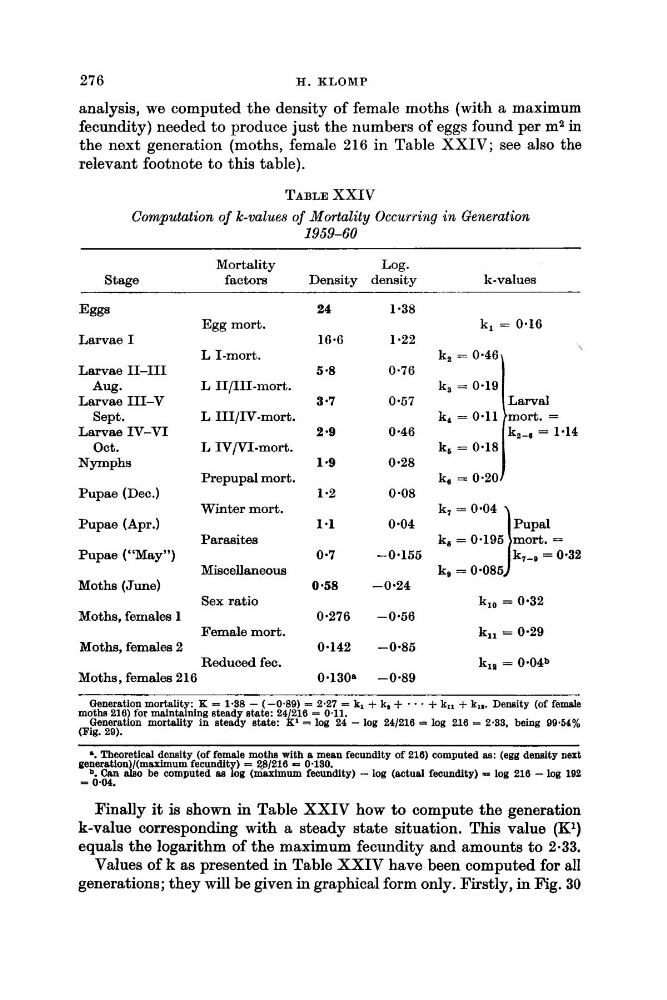
analysis, we computed the density of female moths (with a maximum
fecundity) needed to produce just the numbers of eggs found per m2 in
the next generation (moths, female 216 in Table XXIV; see also the
relevant footnote to this table).
TABLE XXIV
Computation of k-values of Mortality Occurring in Generation
1959-60
k, = 0.19
k, = 0.11
k, = 0.18
~~~~~~~
~~
Mortality
Log.
stage
factors
Density density
k-values
Larval
)mort. =
k2-@ = 1.14
Eggs
Larvae I
Larvae 11-111
Larvae 111-V
Larvae IV-VI
Aug.
Sept.
Nymphs
Oct.
Pupae (Dec.)
Pupae (Apr.)
Pupae (“May”)
Moths (June)
Moths, females 1
Moths, females 2
Moths, females 2 16
Egg mort.
L I-mort.
L II/III-mort.
L III/IV-mort.
L IV/VI-mort.
Prepupal mort.
Winter mort.
Parasites
Miscellaneous
Sex ratio
Female mort.
Reduced fec.
24
16.6
5 *8
3 -7
2 -9
1 -9
1.2
1.1
0.7
0 ~ 5 8
0-276
0.142
0.1308
1.38
1 *22
0.76
0.57
0-46
0.28
0.08
0.04
-0.155
-0.24
-0.56
-0.85
-0.89
k,, = 0.32
k,, = 0.29
k,, = 0.04b
Qeneration mortality: E = 1.38 - (-0.89) = 2.27 = kl + k, + . * * + kll + kl,. Density (of female
Generation mortality in steady state: K 1 = log 24 - log 24/216 = log 216 = 2.33, being 99.64%
moths 216) for maintaining steady state: 24/216 = 0.11.
(Fig. 20).
*. Theoretical density (of female moths with a mean fecundity of 216) computed as: (egg deneity next
b . Can also be computed BS log (maximum fecundity) - log (actual fecundity) = log 216 - log 192
generation)/(maximum fecundity) = 281216 = 0.130.
= 0.04.
Finally it is shown in Table XXIV how to compute the generation
k-value corresponding with a steady state situation. This value (Kl)
equals the logarithm of the maximum fecundity and amounts to 2-33.
Values of k as presented in Table XXIV have been computed for all
generations; they will be given in graphical form only. Firstly, in Fig. 30
H . KLOMP
analysis, we computed the density of female moths (with a maximum
fecundity) needed to produce just the numbers of eggs found per m2 in
the next generation (moths, female 216 in Table XXIV; see also the
relevant footnote to this table).
TABLE XXIV
Computation of k-values of Mortality Occurring in Generation
1959-60
k, = 0.19
k, = 0.11
k, = 0.18
~~~~~~~
~~
Mortality
Log.
stage
factors
Density density
k-values
Larval
)mort. =
k2-@ = 1.14
Eggs
Larvae I
Larvae 11-111
Larvae 111-V
Larvae IV-VI
Aug.
Sept.
Nymphs
Oct.
Pupae (Dec.)
Pupae (Apr.)
Pupae (“May”)
Moths (June)
Moths, females 1
Moths, females 2
Moths, females 2 16
Egg mort.
L I-mort.
L II/III-mort.
L III/IV-mort.
L IV/VI-mort.
Prepupal mort.
Winter mort.
Parasites
Miscellaneous
Sex ratio
Female mort.
Reduced fec.
24
16.6
5 *8
3 -7
2 -9
1 -9
1.2
1.1
0.7
0 ~ 5 8
0-276
0.142
0.1308
1.38
1 *22
0.76
0.57
0-46
0.28
0.08
0.04
-0.155
-0.24
-0.56
-0.85
-0.89
k,, = 0.32
k,, = 0.29
k,, = 0.04b
Qeneration mortality: E = 1.38 - (-0.89) = 2.27 = kl + k, + . * * + kll + kl,. Density (of female
Generation mortality in steady state: K 1 = log 24 - log 24/216 = log 216 = 2.33, being 99.64%
moths 216) for maintaining steady state: 24/216 = 0.11.
(Fig. 20).
*. Theoretical density (of female moths with a mean fecundity of 216) computed as: (egg deneity next
b . Can also be computed BS log (maximum fecundity) - log (actual fecundity) = log 216 - log 192
generation)/(maximum fecundity) = 281216 = 0.130.
= 0.04.
Finally it is shown in Table XXIV how to compute the generation
k-value corresponding with a steady state situation. This value (Kl)
equals the logarithm of the maximum fecundity and amounts to 2-33.
Values of k as presented in Table XXIV have been computed for all
generations; they will be given in graphical form only. Firstly, in Fig. 30