

DYNAMICS OF F I E L D POPULATION O F PtNE LOOPER
263
A possible cause of variability in size and in the proportion of sixinstar larvae in the field would be the ever-changing weather. We did
not study this factor. The influence of weather 011 growth may be expected to be rather complicated. The slow growing larvae are exposed to
the weather for a period of about three months, and as shown by
Schwenke (1953), the various instars have different temperature optima.
Moreover, temperature and light may be supposed to have an effect on
the number of instars, but we are not informed a,bout the mechanism
determining this number. To appreciate the influence of the weather, it
is necessary to know more about the precise effect of separate physical
factors on the growth of this species, and at present our knowledge is
entirely insufficient in this respect.
It appeared, however, that the above variation is correlated with
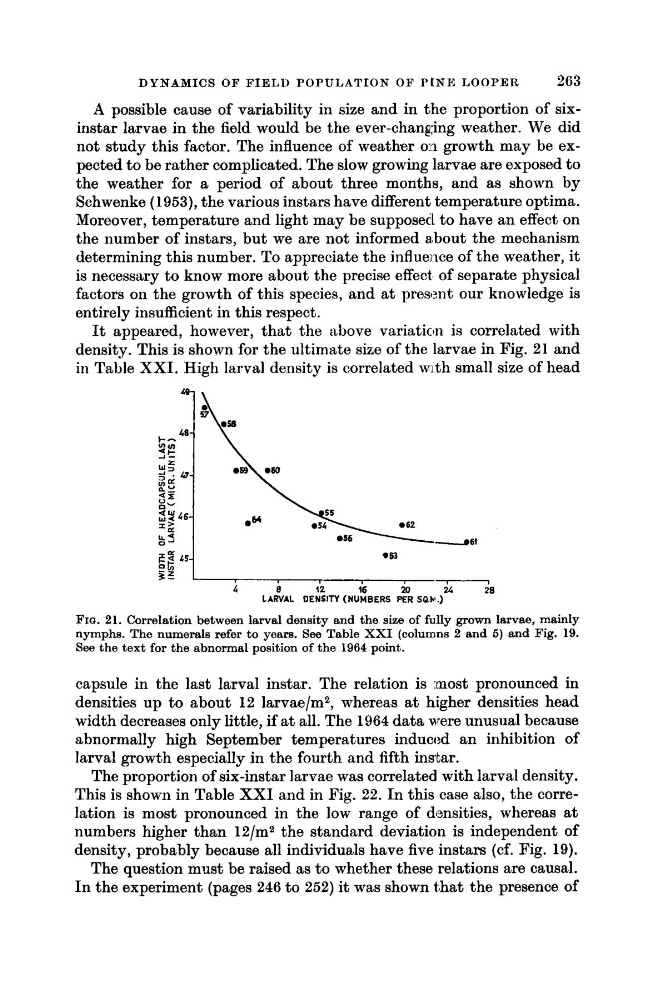
density. This is shown for the ultimate size of the larvae in Fig. 21 and
in Table XXI. High larval density is correlated with small size of head
-
1
8
12
I6
a0
24
28
LARVAL DENSITY (NUMBERS PER sa.cN.)
FIG. 21. Correlation between larval density and the size of fully grown larvae, mainly
nymphs. The numerals refer to years. See Table XXI (columns 2 end 6) and Fig. 19.
See the text for the abnormal position of the 1984 point.
capsule in the last larval instar. The relation is :most pronounced in
densities up to about 12 larvae/m2, whereas at higher densities head
width decreases only little, if at all. The 1964 data were unusual because
abnormally high September temperatures induced an inhibition of
larval growth especially in the fourth and fifth instar.
The proportion of six-instar larvae was correlated with larval density.
This is shown in Table XXI and in Fig. 22. In this case also, the correlation is most pronounced in the low range of densities, whereas at
numbers higher than 12/m2 the standard deviation is independent of
density, probably because all individuals have five instars (cf. Fig. 19).
The question must be raised as to whether these relations are causal.
In the experiment (pages 246 to 252) it was shown that the presence of
263
A possible cause of variability in size and in the proportion of sixinstar larvae in the field would be the ever-changing weather. We did
not study this factor. The influence of weather 011 growth may be expected to be rather complicated. The slow growing larvae are exposed to
the weather for a period of about three months, and as shown by
Schwenke (1953), the various instars have different temperature optima.
Moreover, temperature and light may be supposed to have an effect on
the number of instars, but we are not informed a,bout the mechanism
determining this number. To appreciate the influence of the weather, it
is necessary to know more about the precise effect of separate physical
factors on the growth of this species, and at present our knowledge is
entirely insufficient in this respect.
It appeared, however, that the above variation is correlated with
density. This is shown for the ultimate size of the larvae in Fig. 21 and
in Table XXI. High larval density is correlated with small size of head
-
1
8
12
I6
a0
24
28
LARVAL DENSITY (NUMBERS PER sa.cN.)
FIG. 21. Correlation between larval density and the size of fully grown larvae, mainly
nymphs. The numerals refer to years. See Table XXI (columns 2 end 6) and Fig. 19.
See the text for the abnormal position of the 1984 point.
capsule in the last larval instar. The relation is :most pronounced in
densities up to about 12 larvae/m2, whereas at higher densities head
width decreases only little, if at all. The 1964 data were unusual because
abnormally high September temperatures induced an inhibition of
larval growth especially in the fourth and fifth instar.
The proportion of six-instar larvae was correlated with larval density.
This is shown in Table XXI and in Fig. 22. In this case also, the correlation is most pronounced in the low range of densities, whereas at
numbers higher than 12/m2 the standard deviation is independent of
density, probably because all individuals have five instars (cf. Fig. 19).
The question must be raised as to whether these relations are causal.
In the experiment (pages 246 to 252) it was shown that the presence of