

262
H . KLOMP
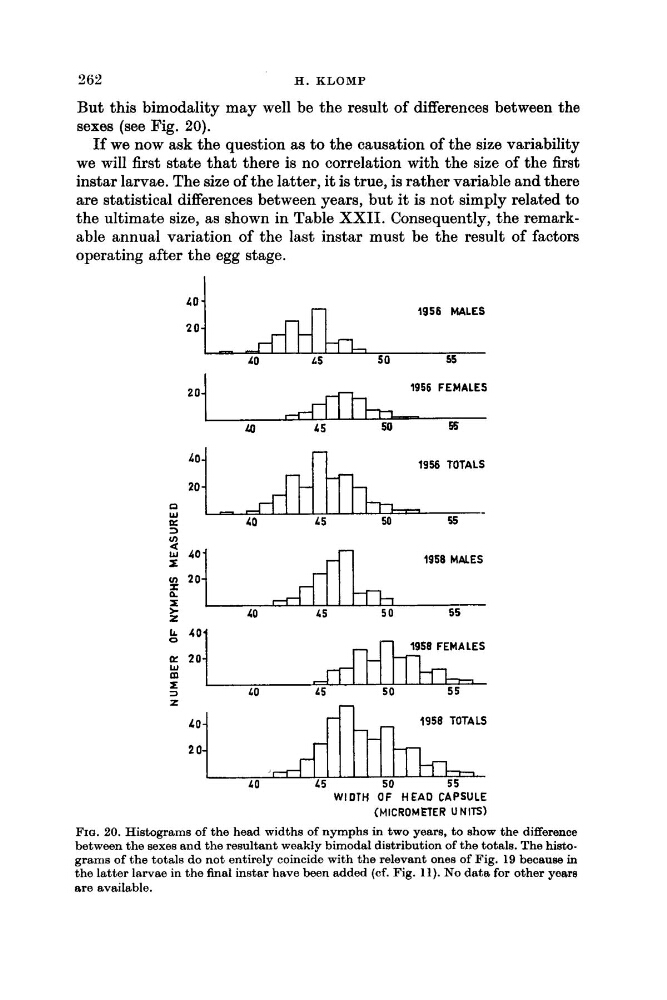
But this bimodality may well be the result of differences between the
sexes (see Fig. 20).
If we now ask the question as to the causation of the size variability
we will first state that there is no correlation with the size of the first
instar larvae. The size of the latter, it is true, is rather variable and there
are statistical differences between years, but it is not simply related to
the ultimate size, as shown in Table XXII. Consequently, the remarkable annual variation of the last instar must be the result of factors
operating after the egg stage.
-
LO2 01956 MALES
2 0
40 LO L5 50 55
1958 TOTALS
- -
-
1956 FEMALES
1956 TOTALS
:
:
I - A
n
40
45
50
55
w
K
3
In
1958 MALES
! r : : I A
E
2
>
40
L5
5 0
55
1958 FEMALES
w
m
LO
L5
5 0
55
I
2
WIDTH O F HEAD CAPSULE
(MICROMEfER UNITS)
FIG. 20. Histograms of the head widths of nymphs in two years, to show the difference
between the sexes and the resultant weakly bimodal distribution of the totals. The histograms of the totals do not entirely coincide with the relevant ones of Fig. 19 because in
the latter larvae in the final instar have been added (cf. Fig. 11). No data for other years
are available.
H . KLOMP
But this bimodality may well be the result of differences between the
sexes (see Fig. 20).
If we now ask the question as to the causation of the size variability
we will first state that there is no correlation with the size of the first
instar larvae. The size of the latter, it is true, is rather variable and there
are statistical differences between years, but it is not simply related to
the ultimate size, as shown in Table XXII. Consequently, the remarkable annual variation of the last instar must be the result of factors
operating after the egg stage.
-
LO2 01956 MALES
2 0
40 LO L5 50 55
1958 TOTALS
- -
-
1956 FEMALES
1956 TOTALS
:
:
I - A
n
40
45
50
55
w
K
3
In
1958 MALES
! r : : I A
E
2
>
40
L5
5 0
55
1958 FEMALES
w
m
LO
L5
5 0
55
I
2
WIDTH O F HEAD CAPSULE
(MICROMEfER UNITS)
FIG. 20. Histograms of the head widths of nymphs in two years, to show the difference
between the sexes and the resultant weakly bimodal distribution of the totals. The histograms of the totals do not entirely coincide with the relevant ones of Fig. 19 because in
the latter larvae in the final instar have been added (cf. Fig. 11). No data for other years
are available.