

264
5 ,
I
d 4 -
e I? = 38
2
d 2<
u)
H. KLOMP
a57
a59
as8 *64
em
e m
e55
a 61
e6L e56
m a
1
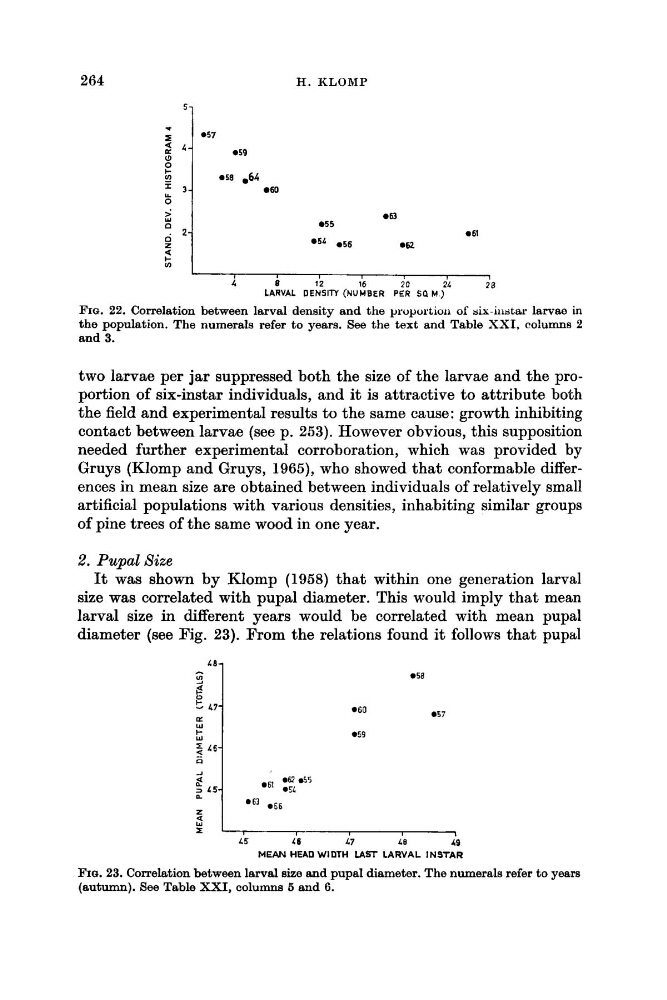
FIG. 22. Correlation between larval density and the proportioil of six-iwtw larvae in
the population. The numerals refer to years. See the text and Table XXI, columns 2
and 3.
two larvae per jar suppressed both the size of the larvae and the proportion of six-instar individuals, and it is attractive to attribute both
the field and experimental results to the same cause: growth inhibiting
contact between larvae (see p. 253). However obvious, this supposition
needed further experimental corroboration, which was provided by
Gruys (Klomp and Gruys, 1965), who showed that conformable differences in mean size are obtained between individuals of relatively small
artificial populations with various densities, inhabiting similar groups
of pine trees of the same wood in one year.
2. Pupal Size
It was shown by Klomp (1958) that within one generation larval
size was correlated with pupal diameter. This would imply that mean
larval size in different years would be correlated with mean pupal
diameter (see Fig. 23). From the relations found it follows that pupal
a5, a@ a55
a56
i4L 45 MEAN HEAD 46 WIDTH L7 I LAST LARVAL LB I INSTAR 49 1
FIQ. 23. Correlation between larval size and pupal diameter. The numerals refer to years
(autumn). See Table XXI, columns 6 and 6.
5 ,
I
d 4 -
e I? = 38
2
d 2<
u)
H. KLOMP
a57
a59
as8 *64
em
e m
e55
a 61
e6L e56
m a
1
FIG. 22. Correlation between larval density and the proportioil of six-iwtw larvae in
the population. The numerals refer to years. See the text and Table XXI, columns 2
and 3.
two larvae per jar suppressed both the size of the larvae and the proportion of six-instar individuals, and it is attractive to attribute both
the field and experimental results to the same cause: growth inhibiting
contact between larvae (see p. 253). However obvious, this supposition
needed further experimental corroboration, which was provided by
Gruys (Klomp and Gruys, 1965), who showed that conformable differences in mean size are obtained between individuals of relatively small
artificial populations with various densities, inhabiting similar groups
of pine trees of the same wood in one year.
2. Pupal Size
It was shown by Klomp (1958) that within one generation larval
size was correlated with pupal diameter. This would imply that mean
larval size in different years would be correlated with mean pupal
diameter (see Fig. 23). From the relations found it follows that pupal
a5, a@ a55
a56
i4L 45 MEAN HEAD 46 WIDTH L7 I LAST LARVAL LB I INSTAR 49 1
FIQ. 23. Correlation between larval size and pupal diameter. The numerals refer to years
(autumn). See Table XXI, columns 6 and 6.