

DYNA4MICS O F FIELD POPULATION O F PINE LOOPER
257
I
23E
Y
I - -
Y
I 2 2 -
4
P
-
-
w 21u
w
2
w
I
< 20I
T
-
PUPAL 0 IAM ETE R -+
. .
.
.
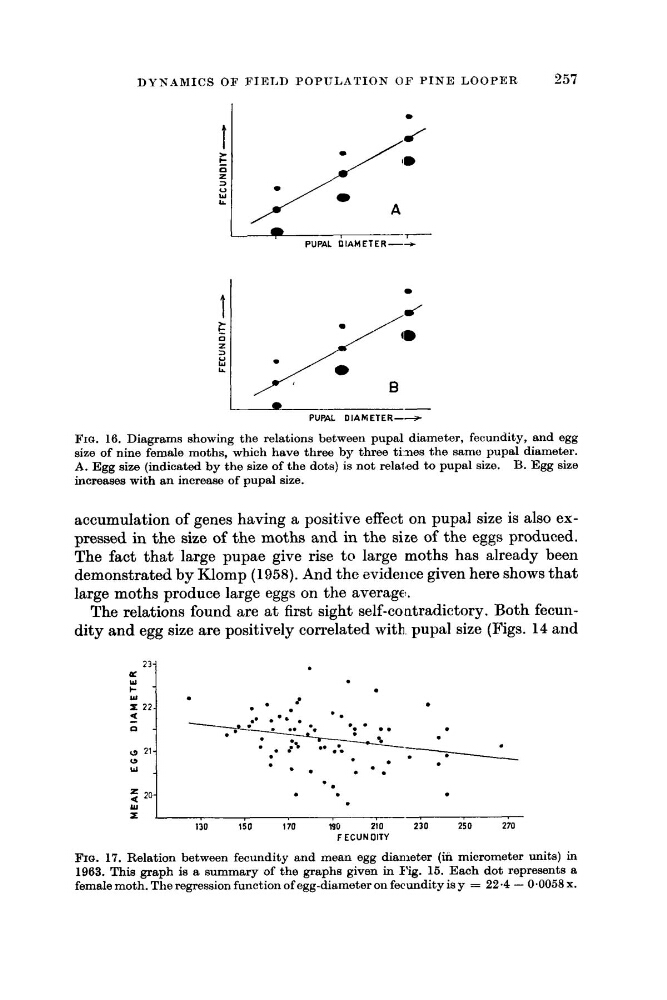
PUPAL DIAMETER-FIQ. 16. Diagrams showing the relations between pupal diameter, fecundity, and egg
size of nine female moths, which have three by three tines the same pupal diameter.
A. Egg size (indicated by the size of the dots) is not relai,ed to pupal size. 13. Egg size
increases with an increase of pupal size.
accumulation of genes having a posit,ive effect on pupal size is also expressed in the size of the moths and in the size of the eggs produced.
The fact that large pupae give rise to large moths has already been
demonstrated by Klomp (1958). And the evidence given here shows that
large moths produce large eggs on the average.
The relations found are at first sight self-contradictory. Both fecundity and egg size are positively correlated with. pupal size (Figs. 14 and
FIG. 17. Relation between fecundity and mean egg diameter (ih micrometer units) in
1963. This graph is a summary of the graphs given in Fig. 15. Each dot represents a
female moth. The regression function of egg-diameter on fecundity is y = 22.4 - 0.0058 X.
257
I
23E
Y
I - -
Y
I 2 2 -
4
P
-
-
w 21u
w
2
w
I
< 20I
T
-
PUPAL 0 IAM ETE R -+
. .
.
.
PUPAL DIAMETER-FIQ. 16. Diagrams showing the relations between pupal diameter, fecundity, and egg
size of nine female moths, which have three by three tines the same pupal diameter.
A. Egg size (indicated by the size of the dots) is not relai,ed to pupal size. 13. Egg size
increases with an increase of pupal size.
accumulation of genes having a posit,ive effect on pupal size is also expressed in the size of the moths and in the size of the eggs produced.
The fact that large pupae give rise to large moths has already been
demonstrated by Klomp (1958). And the evidence given here shows that
large moths produce large eggs on the average.
The relations found are at first sight self-contradictory. Both fecundity and egg size are positively correlated with. pupal size (Figs. 14 and
FIG. 17. Relation between fecundity and mean egg diameter (ih micrometer units) in
1963. This graph is a summary of the graphs given in Fig. 15. Each dot represents a
female moth. The regression function of egg-diameter on fecundity is y = 22.4 - 0.0058 X.