

246
H . KLOMP
of its recurrent incidence in successive years (with two exceptions only) it
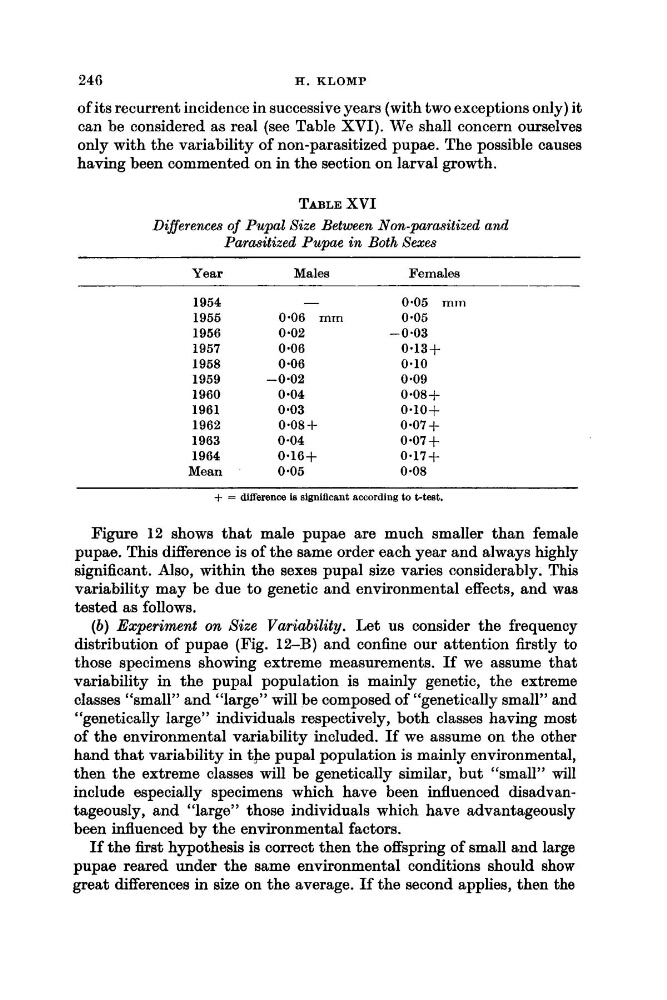
can be considered as real (see Table XVI). We shall concern ourselves
only with the variability of non-parasitized pupae. The possible causes
having been commented on in the section on larval growth.
TABLE XVI
Differences of Pupal Size Between Non-parasitized and
Parasitized Pupae in Both Sexes
Year
Males
Females
1954
1955
1956
1957
1958
1959
1960
1961
1962
1963
1964
Mean
-
0.06 mm
0.02
0.06
0-06
-0.02
0.04
0.03
0.08 +
0-04
0.16+
0.05
0.05 min
0.05
-0.03
0*13+
0.10
0.09
0.08+
O s l o +
0.07 +
0.07 +
0.17+
0.08
+ = difference is aigniflcant according to t-test.
Figure 12 shows that male pupae are much smaller than female
pupae. This difference is of the same order each year and always highly
significant. Also, within the sexes pupal size varies considerably. This
variability may be due to genetic and environmental effects, and was
tested as follows.
(b) Experiment on Size Variability. Let us consider the frequency
distribution of pupae (Fig. 12-B) and confine our attention firstly to
those specimens showing extreme measurements. If we assume that
variability in the pupal population is mainly genetic, the extreme
classes “small” and “large” will be composed of “genetically small” and
“genetically large” individuals respectively, both classes having most
of the environmental variability included. If we assume on the other
hand that variability in the pupal population is mainly environmental,
then the extreme classes will be genetically similar, but “small” will
include especially specimens which have been influenced disadvantageously, and “large” those individuals which have advantageously
been influenced by the environmental factors.
If the first hypothesis is correct then the offspring of small and large
pupae reared under the same environmental conditions should show
great differences in size on the average. If the second applies, then the
H . KLOMP
of its recurrent incidence in successive years (with two exceptions only) it
can be considered as real (see Table XVI). We shall concern ourselves
only with the variability of non-parasitized pupae. The possible causes
having been commented on in the section on larval growth.
TABLE XVI
Differences of Pupal Size Between Non-parasitized and
Parasitized Pupae in Both Sexes
Year
Males
Females
1954
1955
1956
1957
1958
1959
1960
1961
1962
1963
1964
Mean
-
0.06 mm
0.02
0.06
0-06
-0.02
0.04
0.03
0.08 +
0-04
0.16+
0.05
0.05 min
0.05
-0.03
0*13+
0.10
0.09
0.08+
O s l o +
0.07 +
0.07 +
0.17+
0.08
+ = difference is aigniflcant according to t-test.
Figure 12 shows that male pupae are much smaller than female
pupae. This difference is of the same order each year and always highly
significant. Also, within the sexes pupal size varies considerably. This
variability may be due to genetic and environmental effects, and was
tested as follows.
(b) Experiment on Size Variability. Let us consider the frequency
distribution of pupae (Fig. 12-B) and confine our attention firstly to
those specimens showing extreme measurements. If we assume that
variability in the pupal population is mainly genetic, the extreme
classes “small” and “large” will be composed of “genetically small” and
“genetically large” individuals respectively, both classes having most
of the environmental variability included. If we assume on the other
hand that variability in the pupal population is mainly environmental,
then the extreme classes will be genetically similar, but “small” will
include especially specimens which have been influenced disadvantageously, and “large” those individuals which have advantageously
been influenced by the environmental factors.
If the first hypothesis is correct then the offspring of small and large
pupae reared under the same environmental conditions should show
great differences in size on the average. If the second applies, then the