

DYNAMICS OF FIELD POPULATION 'OF PINE LOOPER
245
2. Pupal Size
(a) The Variability of Pupal Size in the Field. The great variability of
larval size in the last instar is reflected in the size of the pupae (see
Klomp, 1958, Fig. 4). This variation has been studied annually from
random collections in the study area in April (see p. 240). Their sex was
established according to the method described by Escherich (1931), and
both males and females were measured (for method, see Klomp, 1968)
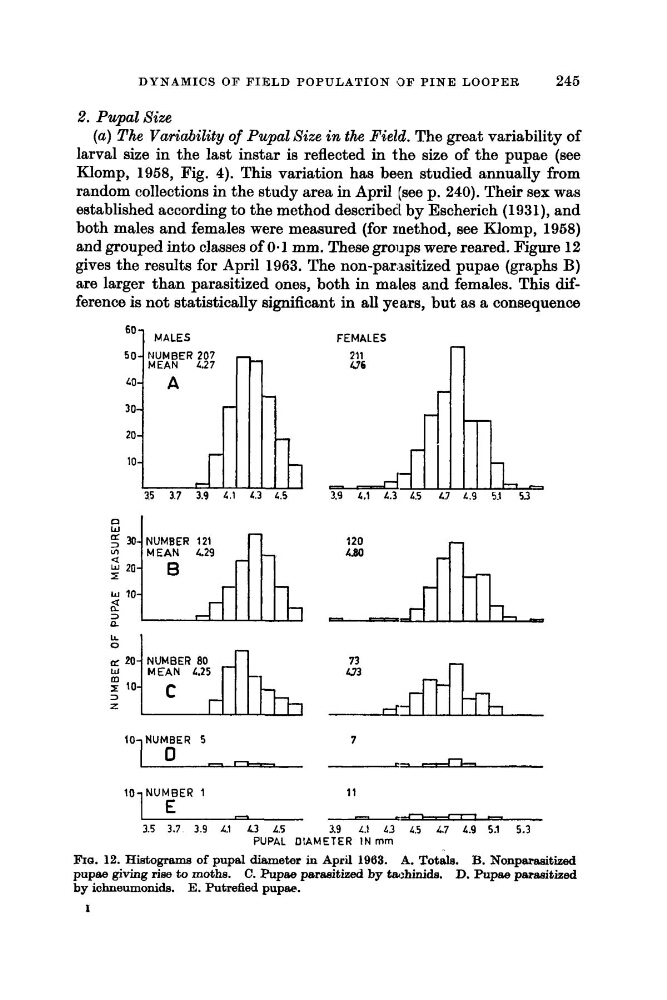
and grouped into classes of 0.1 mm. These groups were reared. Figure 12
gives the results for April 1963. The non-par.witized pupae (graphs B)
are larger than parasitized ones, both in males and females. This difference is not statistically significant in all years, but as a consequence
601 MALES
FEMALES
211
0 6
n
- -
10 NUMBER I
E
-
7
- -
11
- , .
h
_ _ _ ~
3.5 3.7 3.9 L.1 L.3 L.5
3.9 L.1 L3 L.5 L.7 L.9 5.1 5.3
PUPAL DIAMETER I N m m
FIQ. 12. Histograms of pupal diameter i n April 1963.
pupae giving rise to moths.
by ichneumonids. E. Putrefied pupae.
A. Totals. B. Nonparaaitized
D. Pupae parasitized
C. Pupae parasitized by hchinids.
I
245
2. Pupal Size
(a) The Variability of Pupal Size in the Field. The great variability of
larval size in the last instar is reflected in the size of the pupae (see
Klomp, 1958, Fig. 4). This variation has been studied annually from
random collections in the study area in April (see p. 240). Their sex was
established according to the method described by Escherich (1931), and
both males and females were measured (for method, see Klomp, 1968)
and grouped into classes of 0.1 mm. These groups were reared. Figure 12
gives the results for April 1963. The non-par.witized pupae (graphs B)
are larger than parasitized ones, both in males and females. This difference is not statistically significant in all years, but as a consequence
601 MALES
FEMALES
211
0 6
n
- -
10 NUMBER I
E
-
7
- -
11
- , .
h
_ _ _ ~
3.5 3.7 3.9 L.1 L.3 L.5
3.9 L.1 L3 L.5 L.7 L.9 5.1 5.3
PUPAL DIAMETER I N m m
FIQ. 12. Histograms of pupal diameter i n April 1963.
pupae giving rise to moths.
by ichneumonids. E. Putrefied pupae.
A. Totals. B. Nonparaaitized
D. Pupae parasitized
C. Pupae parasitized by hchinids.
I